iBankCoin
Home / 2017 (page 217)

Yearly Archives: 2017

Update on Fancy My GARP Index

I know some of you rolled your eyes when I UNVEILED plans to update my GARP index — specifically because you believe you can do better. News flash for you: YOU CANNOT. Genetically, you and I aren’t even the same species. One of us enjoys the arts, is an alpha, and embarks on live long journeys towards financial hegemony. The other saunters around the house, talking shit on the internets — doing absolutely nothing with his life.

Year to date, the 15 stocks that make up the GARP index is higher by nearly 5% now.
gainz

What the hell have you dumb shits done this year? When was the last time you banked 20% in a fucking nuclear bomb play?

I know, I’m filled with a lot of questions, especially since you hold all the moronic answers.

As we speak, the NASDAQ is pressing higher. I need to head out and buy an FDA failure biotech now. See you in a bit.

Comments »

Trump Menaces Toyota to Ditch Mexican Plant in Favor for an American One

And libtards go apeshit, because taking jobs away from indigenous Mexicans is so fucking horrible.

Meanwhile, Trump continues to make Mexico pay for their many sins — shaming the very sensitive Japanese into making the honorable decision to move their Toyota factory into the US, else pay the price.

Related: Mexican pesos hits new lows.
img_6032

Next up, the wall.

Comments »

GRAVE DANGERS LURK AROUND THE BEND: I Bought a Piece of Shit China-Scam

First let me alert you to the fact the US yield curve is shrinking as rates drop. Do any of you still pay attention to such things? Anyone? I didn’t think so.

I’ve read in some old dusty books that the yield curve is important for banks. It effects their margins, probably a whole bunch of gobblygook.

Also, the dollar is finally receding today, off by a cock solid 1% — breathing renewed vigor into gold shares. Bonds are rallying and so is crude. This is just like early 2016, sans the equity crash.
img_6029

img_6030

img_6031

Copper trading lower could only mean one thing: there are China fears lingering. In order to best prepare myself for the coming storm, I went out and searched for the biggest piece of shit China scam stock, one that trades volume and has the look and feel of being a real company. You know, the sort of stock you discuss over dinner with the inlaws, as you dig into a dog steak with some bok choy.

I found it!

I bought $YY.

I’ve added this complete loser to my stockpile of perfectly fine movie theatre plays and nuclear bomb stock. Thus far, here are my 2016 holdings.

$RGC, $IMAX, $UEC, $SEDG, $TDW and $YY.

I’ve got a few more sectors to hit upon and intend on adding to this ‘man portfolio’ over the coming days.

Ciao.

Comments »

Bitcoins Have Been Destroyed…NEXT

Just when the scam currency hit new highs and all of the plebs crawled out from their holes to buy some, the fucking thing disintergrated right before your eyes.

img_6028

Let this be a warning for all, not just scam currency buyers. Nothing goes up forever. Eventually, boolishness will hit an apex, crest, and then bitcoin your asses into a state of abject misery.

But that’s just Fly talking silly trash. We all know stocks can’t trade down. It’s Trumpenomics.

So, I’m looking to buy another piece of shit stock today. Stay tuned.

Comments »

Dollar

The headlines are full of scary reports about the dollar’s rise to a 14-year high against a basket of six major currencies. Its strength will hurt U.S. manufacturing while triggering capital flight from emerging markets, economists say. The appreciation “is a real serious noose around the neck of the global economy,” David Beckworth, a senior research fellow at the Mercatus Center at George Mason University in Arlington, Va., said in November.

What’s really alarming, though, is that even though the dollar has jumped 6 percent against the euro and 12 percent against the yen since the U.S. presidential election, it remains well below its historic highs. If its rise to date is causing trouble, imagine how much worse things could get if it went on a serious upward run.

econ_dollarchart03_360
The included chart shows how much headroom remains for the greenback. It’s the Federal Reserve’s index of the value of the dollar against a basket of currencies of 26 trading partners, with each one’s value adjusted for that nation’s inflation rate. This is a better indicator of the dollar’s strength than the frequently cited U.S. Dollar Index, which covers just six currencies and isn’t adjusted for inflation. The Fed’s index remains 10 percent below its 2002 high and fully 19 percent below the lofty high of 1985, which led to an emergency international accord to lower the greenback’s value through official, coordinated sales of dollar reserves.

Fundamental factors are driving the dollar upward. Because U.S. growth is strong and unemployment low, Fed policymakers are projecting three more quarter-point increases in short-term rates in 2017. That will tend to push up the dollar by making U.S. Treasuries and other fixed-income investments more lucrative. Investors are also betting President-elect Donald Trump will touch off a growth spurt through tax cuts and infrastructure investment.

Meanwhile, “The euro zone debt crisis and the travails of the Chinese renminbi have weakened the dollar’s main rivals and cemented its dominance as a key benchmark for other currencies,” Cornell University economist Eswar Prasad wrote in an e-mail. ABN Amro, a Dutch bank with a more extreme forecast than most, projects that the euro, worth $1.15 as recently as May, will be only 95¢ for most of 2017. Trump Gives the Dollar Wings, it headlined a November research report.

A strong dollar is bad for U.S. growth, making American goods and services less competitive in world markets. A rule of thumb says that a 10 percent rise in the dollar increases the trade deficit by 1 percent of gross domestic product, and that translates into the loss of hundreds of thousands of jobs, says Brad Setser, a senior fellow at the Council on Foreign Relations in New York. Warnings about the damage from dollar strength have come recently from U.S. companies including Boeing, Emerson Electric, 3M, and United Technologies.

The greenback’s strength could cause problems in emerging markets such as Mexico and Turkey, because it increases how much of the local currency borrowers need to spend to make payments on bonds they issued in dollars. And bond issuers in those countries must pay higher interest to attract buyers when the Fed raises rates. Petróleos Mexicanos pointed to the peso’s depreciation as a factor in a 23 percent increase in the peso value of its debt in the first three quarters of 2016. In China, debt-laden builders are suddenly having trouble selling dollar-denominated bonds.

At the end of 2015 there was $9.7 trillion in nonfinancial debt outside the U.S. issued in dollars, and one-third of it was owed by issuers in emerging markets, according to the Bank for International Settlements (BIS), which is run jointly by the central banks of several countries. “If the current trend of dollar strength persists, it is very likely that we will see emerging market currency crises,” Variant Perception, a London-based research firm, wrote to clients in December.

Whatever gains in trade competitiveness that emerging-market economies get when the dollar rises against their currencies can be outweighed by the rise in their borrowing costs, says a December research report by BIS economists Nikola Tarashev, Stefan Avdjiev, and Ben Cohen. That’s true mostly for countries whose finances are already fragile.

Plenty of analysts see little reason for concern about the dollar’s rise. “We think the dollar has pretty much run its course,” says Gorky Urquieta, co-head of emerging-markets debt for Neuberger Berman, an asset management firm. Most emerging-market issuers of dollar debt are protected against a big dollar rise, either because they have offsetting financial hedges or because they receive a steady income of dollars from trade, says Joe Kogan, co-head of Latin America strategy at Scotia Capital Markets in New York. Emerging-market economies are in better shape than they were in 1997, when rising rates caused a financial crisis in Asia, says Mark Follett, managing director for emerging Asia debt capital markets at JPMorgan Chase in Hong Kong.

Then again, Follett doesn’t know where the dollar is headed from here. “No one,” he says, “has any idea at the end of the day.”

The bottom line: Several factors, from higher interest rates to a hoped-for Trump tax cut, are making the dollar stronger

Comments »

America’s Retail Landscape is Shaping Up to be a Dystopian One

What kind of world are we heading into when just Amazon and Apple survives? Don’t give me the LULU bullet points and how they’re proof that all of retail isn’t dead. Yoga pants is a trend. When it dies, so will LULU — just like every other smart idea Canada ever had.

Two of America’s premier department stores are getting hammered today after news that Christmas sucked and their business is horrible.

Expect shares of other retailers to fall in sympathy, and do so with vigor.

JCP is already off by 6%. No need to look at the news there. You know they’re wretchedly terrible.
img_6024

Bear in mind, both Macy’s and Kohl’s were two winners over the past year, in an industry that is heading for disaster.
img_6025

img_6026

In other news, stocks are wonderful. Prepare for Dow 20,000, fuck faces.

Comments »

Rand Paul Introduces Bill to Audit the Fed, Says it Has Trump Support

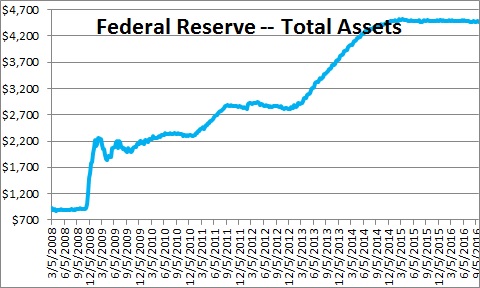
Literally nothing is going to happen here. Let’s not pretend Congress will actually pass a Rand Paul bill that simply requests for the Federal Reserve to be audited. After all, they’re the central bank for the world now, rigging markets and fixing rates almost on demand. There are a lot of people with a lot of questions for the Fed — an entity who presides over an unlimited balance sheet and the power to both print fiat currency at will and to increase the amount of interest it charges the U.S. government.

Any person or entity under the auspices of the SEC or FINRA is forced to undergo routine audits, just to make sure everything is kosher. Why isn’t the same standard used for the Fed?

Rand Paul wants to change that and he says it has the support of President elect Trump.

On Tuesday, U.S. Senator Rand Paul reintroduced his Federal Reserve Transparency Act, widely known as the “Audit the Fed” bill, to prevent the Federal Reserve from concealing vital information on its operations from Congress. Eight cosponsors joined Senator Paul on the legislation.

Representative Thomas Massie (KY-4) has introduced companion legislation, H.R. 24, in the U.S. House.

“No institution holds more power over the future of the American economy and the value of our savings than the Federal Reserve,” said Sen. Paul, “yet Fed Chair Yellen refuses to be fully accountable to the people’s representatives.”

“The U.S. House has responded to the American people by passing Audit the Fed multiple times, and President-elect Trump has stated his support for an audit. Let’s send him the bill this Congress.”

“The American public deserves more insight into the practices of the Federal Reserve,” said Rep. Massie. “Behind closed doors, the Fed crafts monetary policy that will continue to devalue our currency, slow economic growth, and make life harder for the poor and middle class. It is time to force the Federal Reserve to operate by the same standards of transparency and accountability to the taxpayers that we should demand of all government agencies.”

On January 12, 2016, a bipartisan Senate majority voted 53-44 in support of Audit the Fed.

S. 16 would require the nonpartisan, independent Government Accountability Office (GAO) to conduct a thorough audit of the Federal Reserve’s Board of Governors and reserve banks within one year of the bill’s passage and to report back to Congress within 90 days of completing the audit.

Audit the Fed would amend section 714b of Title 31 of the U.S. Code to allow the GAO to fully audit:

transactions for or with a foreign central bank, government of a foreign country, or nonprivate international financing organization;

deliberations, decisions, or actions on monetary policy matters, including discount window operations, reserves of member banks, securities credit, interest on deposits, and open market operations;

transactions made under the direction of the Federal Open Market Committee; or

a part of a discussion or communication among or between members of the Board and officers and employees of the Federal Reserve System related to clauses (1)–(3) of this subsection.

Isn’t anyone interested in learning how this happened and how they intend to unwind it?

feds-balance-sheet

Comments »

Kohl’s and Macy’s Confirm Christmas Was a Bust; Shares Crash in After Hours

Who needs physical stores when we have Amazon and voice automated Echo devices to assist us with our shopping needs? In the after hours, both $KSS and $M warned and lowered guidance — sending shares CRASHING lower — because no one visits shopping malls anymore.

img_6020

Kohl’s lowers FY17 EPS guidance below consensus; co cites lower than expected gross margins due to the mix and timing of the sales and the competitive promotional environment; Nov-Dec comps -2.1%

Co issues lowered guidance for FY17 (Jan), sees EPS of $3.60-3.65 from $3.80-4.00 vs. $3.93 Capital IQ Consensus Estimate.
Co reported that its comparable sales decreased 2.1 percent in the fiscal months of November and December 2016 combined, compared with the prior year period. Total sales for the combined fiscal November and December period decreased 2.7 percent.

“Sales were volatile throughout the holiday season. Strong sales on Black Friday and during the week before Christmas were offset by softness in early November and December.” From a line of business perspective, Men’s, Home and Footwear were the strongest categories while Accessories was the most challenging.

The change in guidance is primarily a result of lower than planned sales for the quarter. Gross margin is projected to be lower than plan due to the mix and timing of the sales and the competitive promotional environment. SG&A expenses are projected to be as planned. Inventories per store at the end of the fourth quarter are projected to decrease from prior year levels in the mid-to-high single digit range.

img_6021

Comparable sales on an owned plus licensed basis declined by 2.1% in the months of November and December 2016 combined, compared to the same period last year. On an owned basis, comparable sales declined by 2.7 percent in the combined November/December period.

“While our sales trend is consistent with the lower end of our guidance, we had anticipated sales would be stronger. We believe that our performance during the holiday season reflects the broader challenges facing much of the retail industry. We are pleased with the performance of our digital business, with double-digit gains at both macys.com and bloomingdales.com; however, store sales continued to be impacted by changing customer behavior. Our apparel business, which includes women’s, men’s and children’s, performed well, with particular strength in active and cold-weather merchandise. Sales were also strong in fine jewelry, as well as furniture and bedding, reflecting the success of our initiatives in those categories. However, ongoing weakness in handbags and watches negatively impacted our results.”

Macy’s maintains its previously provided full-year sales guidance of a 2.5-3.0% decrease in comparable sales on an owned plus licensed basis, and expects to come in at the lower end of that guidance, with comparable sales on an owned basis to be ~50 basis points lower.

Lowers FY17 adj. EPS to $2.95 to $3.10 (compared with previous guidance of $3.15 to $3.40) vs. $3.28 consensus.

Look for the entire retail sector to get lit up tomorrow. But it won’t matter all that much for the overall health and integrity of markets. We have gains to achieve and milestones to reach.

Comments »

STOCKS CONTINUE TO ACHIEVE GREATNESS: ARE YOU ALONG FOR THE RIDE?

Everything went up today. Bitcoins rose by 8%. Biotech and LED lighting stocks broke jaws to the upside. Literally nothing lost anyone money today — as stocks wistfully pressed higher in a quest to achieve 20,000 on the Dow Jones Industrial Average.

img_6018
Wondrous wonders.

What could go wrong, after all, when everyone from the best professional money managers down to the lowest of the low day trader is making bank every day — at a time when sovereign bond yields blow out and fiscal budgets explode due to entitlements, and governments scramble to make it all work and for growth to achieve assigned goals — efficiently coordinated with central bank rigging?

img_6010
Going higher.

Please do not mistake my dark sarcasm as a veiled threat of apprehension or pessimism for markets. Quite the contrary is true. Ignorance is bliss and the less one has to think about solving the puzzle, the less one has to solve the fucking puzzle.

I remain obstinately long $UEC, $RGC, $IMAX, $SEDG and $TDW — with more to come. I welcome the coming sell offs and only hope that things become disjointed to the point that blood flows through the streets. I’ve always fashioned myself on equal terms with a vampire, when it came to opportunistically trading markets. Until then, I’ll be packed tightly inside the box car with all of the others, in a menacingly fast train, speeding for destinations unknown.

Comments »

And Here’s Vice President Elect Mike Pence Discussing Eradicating the Legacy of President Obama

And to think how hard Obama worked to pass the ACA. I guess it’s simply the byproduct of a failed venture on a very large scale, by a man who has never successfully run a lemonade stand, let alone a real job.

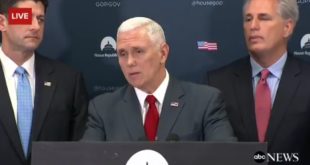
Here’s the genetically modified Mike Pence promising to repeal the shit storm that is Obamacare.

This follows an earlier tweet storm by the President Elect, describing how wretched and rotten Obamacare is and how premiums and skyrocketing.

img_6017

Comments »