Now that the world is laundering their money via Bitcoin, the ‘evil currency’ of choice, I felt it was time to open up a new world to iBankCoiner’s: the fanciful world of Pepe Cash and how it facilitates the wonders of RARE PEPE ART that will someday take the place of the US dollar.
Any questions?
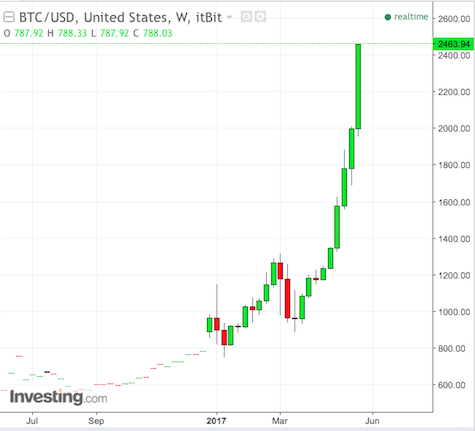
You can see by the chart below that the price action in bitcoin is very normal. This is what bull markets look like, assholes.
Normal chart
Moving past bitcoins and into PEPE CASH, I entreat you to examine this piece of art.
DO NOT SAVE, VERY RARE
On RarePepeWallet, the exchange rate is $1=37 Pepe cash. There, you can buy any number of rare pieces of Pepe art.
For example, this Lord Kek, ruler of all Pepes, fetches for $34,000 So Rare
There are other Pepe’s worth investing in, aside from Kek, such as ‘Ten Pin Putin’s.’ This is a collectors item for any Trump fan.
Forget about your silly stock’d market, based on earnings and revenues. This is where the kids are investing their money today — the future of finance — based on ‘literally nothing’ but the caprices and superfluities of a generation of morons.
It’s over for you advisorfags, making all sorts of unseemly money in variable annuities, IPOs, bonds — deploying ravenous sales tactics to finance your lurid lifestyles. The new fiduciary rules are about to be eddied in, starting June 9th, which means you’re completely, and irrevocably, fucked.
Here is a refresher, in case you dregs forgot.
The Department of Labor’s definition of a fiduciary demands that advisors act in the best interests of their clients, and to put their clients’ interests above their own. It leaves no room for advisors to conceal any potential conflict of interest, and states that all fees and commissions must be clearly disclosed in dollar form to clients. The definition has been expanded to include any professional making a recommendation or solicitation — and not simply giving ongoing advice. Previously, only advisors who were charging a fee for service (either hourly or as a percentage of account holdings) on retirement plans were considered fiduciaries.
Fiduciary is a much higher level of accountability than the suitability standard previously required of financial salespersons, such as brokers, planners and insurance agents, who work with retirement plans and accounts. “Suitability” meant that as long as an investment recommendation met a client’s defined need and objective, it was deemed appropriate. Now, financial professionals are legally obligated to put their client’s best interests first rather than simply finding “suitable” investments. The new rule could therefore eliminate many commission structures that govern the industry.
Advisors who wish to continue working on commission will need to provide clients with a disclosure agreement, called a Best Interest Contract Exemption (BICE), in circumstances where a conflict of interest could exist (such as, the advisor receiving a higher commission or special bonus for selling a certain product). This is to guarantee that the advisor is working unconditionally in the best interest of the client. All compensation that is paid to the fiduciary must be clearly spelled out as well.
Do you have any idea how far FINRA will be up your ass in about 1 year from now?
As a result of these changes, Morgan Stanley, Merrill Lynch and UBS are no longer interested in hiring new brokers, especially paying them 300% of their trailing 12 as a sign up bonus.
The Department of Labor instructed banks that the exorbitant sign up bonuses would conflict with the new fiduciary laws (lolz, so fucked) and they needed to coalesce, mind you, around client needs. Plainly, firms shouldn’t encourage advisors/brokers to hit sales targets anymore — since they run counter to the client. The days of the large sign up bonuses are over. A new era of austerity, and low 7 figure incomes, is upon you, Mr. Wall Street.
“Going forward, we intend to increase the investments and resources supporting our existing talent and platforms even further and significantly reduce experienced adviser recruiting,” said Morgan Stanley
Without question, the bluebeard’s who run these firms will now switch towards spending resources on retentions and cultivating talent, rather than deal with recruiters to fish out greedy strumpets in search of garish sign up bonuses.
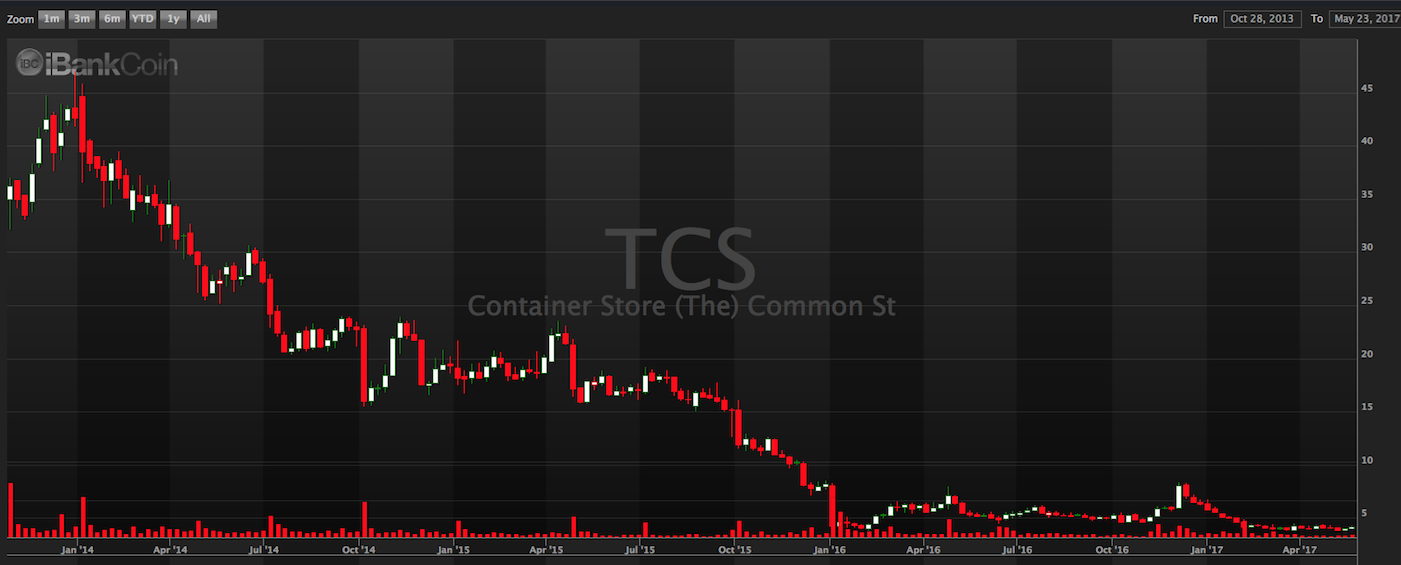
When TCS came public in 2011, it was all the rage on Wall Street. The stock was priced at $18 and soared to $47 within a week of IPOing. Their price to sales ratio in 2011 was 2.9x; today, following a 90% decline in its shares, the p/s is 0.35x.
Shareholders are getting a reprieve today, following a better than expected quarterly report — sending shares screaming higher by 40%.
Sales increased by 5.3%, while net income surged 143%. Gross margins slipped 20bps to 57.6% — thanks to an increase in lower margin produces and services. Part of the beat was attributed to better cost controls, with SG&A declining to 45.2% from 47.8%.
The company offered favorable guidance of $0.25-0.35 with sales ranging from $830 to $850m — above analyst expectations.
With 20% of shares sold short, this stock is going to rip the heads of late comer bears right off their flaccid torsos today.
What else is new with our ‘intelligence community?’ These people can’t help themselves, constantly leaking to their catamite friends in the media. They’re like mafia snitches, depraved and desperate for glamour. Perhaps they like to see their stories in the newspapers and on teevee. It might make their pathetic lives feel a little less moribund, all things considered.
In a rare rebuke, Britain aired their displeasure over leaks in the US, revealing details of the Manchester attacker and his alleged network.
Source: Reuters
U.S broadcasters, drawing on U.S. sources, named the suspected killer as Salman Abedi hours before Manchester police revealed his identity. Non-U.S. media followed, again citing U.S. sources.
“The British police have been very clear that they want to control the flow of information in order to protect operational integrity, the element of surprise, so it is irritating if it gets released from other sources,” British interior minister Amber Rudd said when asked about the U.S. leaks by the BBC.
“I have been very clear with our friends that should not happen again,” Rudd said.
Asked whether the U.S. leaks had compromised the investigation, Rudd said: “I wouldn’t go that far but I can say that they are perfectly clear about the situation and that it shouldn’t happen again.”
Christopher Meyer, UK ambassador to Washington from 1997 to 2003, said on Twitter that Rudd had been “quite right to give the U.S. a kicking.”
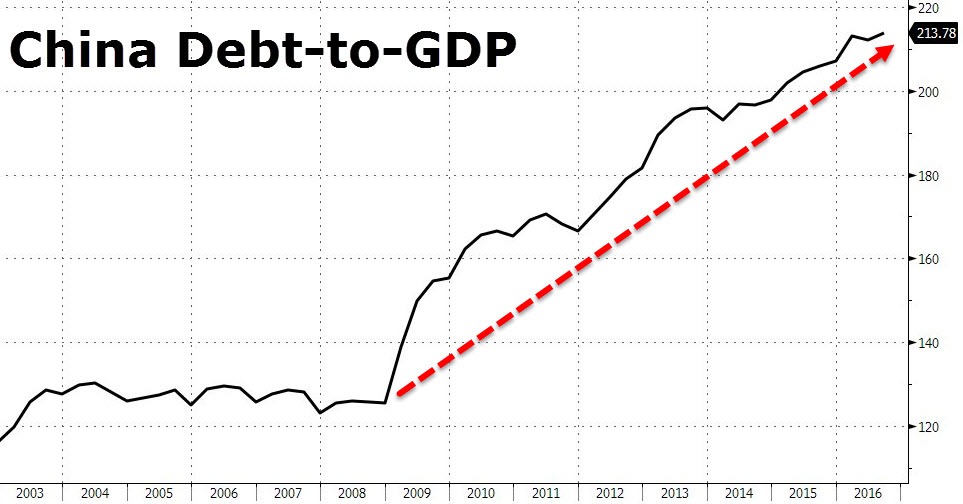
Moody’s is concerned that China will not be able to ‘rein in’ leverage, whilst growing at a fixed 7.1% rate, indefinitely. I suppose Moody’s is concerned over China’s 250% debt to GDP and how it might create tangential concerns away from the narrative of ‘global growth’ and a one world economy, coexisting in an effervescent haze of happiness.
Moody’s reduced their rating from A1 to Aa3 — citing a ‘material rise’ in economy wide debt, changing their outlook to stable from negative.
Who gives a shit, really? New highs abound. Markets work.
Total outstanding credit climbed to about 260 percent of GDP by the end of 2016, up from 160 percent in 2008, according to Bloomberg Intelligence. At the same time, China’s external debt is low by international standards, at around 12 percent of gross domestic product, according to the International Monetary Fund, meaning that a downgrade isn’t likely to be as disruptive as it would be for nations more reliant on international funding.
Overseas institutions’ holdings of onshore bonds dropped to 830 billion yuan ($121 billion) as of the end of March, from 853 billion yuan three months earlier, People’s Bank of China data show. That’s less than 1.5 percent of 63.7 trillion yuan of outstanding notes, according to Bloomberg calculations based on the central bank data.
Moody’s last cut China’s sovereign rating in 1989, when it downgraded the sovereign to Baa2 from Baa1, according to spokesperson, Manvela Yeung.
Moody’s states.
“The stable outlook reflects our assessment that, at the A1 rating level, risks are balanced. The erosion in China’s credit profile will be gradual and, we expect, eventually contained as reforms deepen. The strengths of its credit profile will allow the sovereign to remain resilient to negative shocks, with GDP growth likely to stay strong compared to other sovereigns, still considerable scope for policy to adapt to support the economy, and a largely closed capital account.”
China rejected the credit downgrade — calling it ‘inappropriate.’
Granted, he didn’t deliver this theory in the most cogent way possible, ending up looking like your crazy uncle spewing out UFO theories at the Thanksgiving table. As traders, it’s very easy to simply chalk up the market action to some unseen hand, the proverbial plunge protection team working tirelessly to keep America’s only credible export viable.
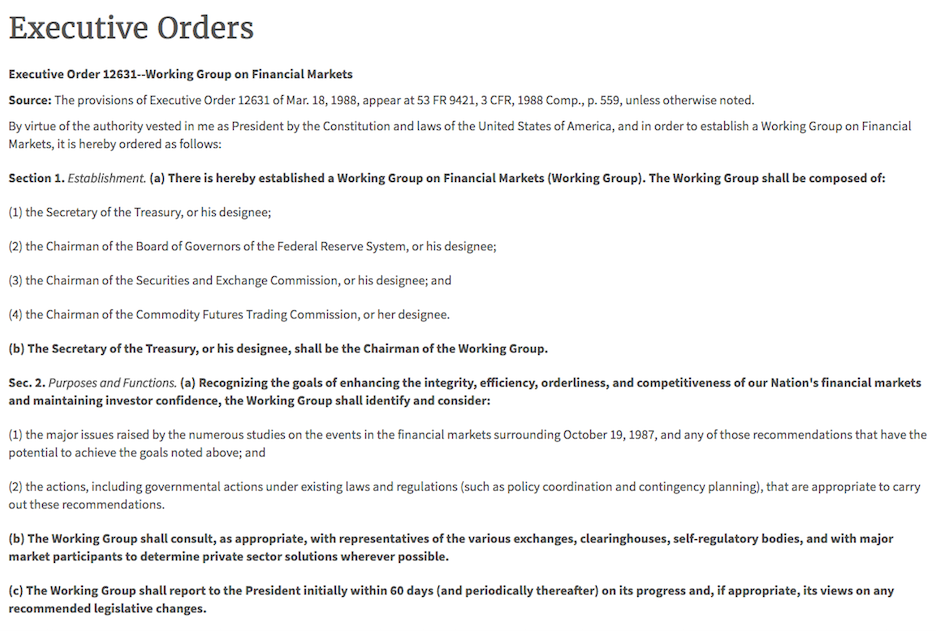
All of this stems from executive order 12631, under President Reagan — where a ‘working group’ would be designated to stabilize markets.
It seems pretty explicit to me, does it not. We’re not talking about hiding the fact that the earth is flat, or ancient civilizations are living in Antarctica in underground cities. You’d think the government would have a vested interest in rigging markets, or at least stabilizing them, in order to support the tax base, create an environment where corporations hire more workers and/or merge with others — creating more tax events. Stable markets, inherently, promote prosperity and our place in the world as currency reserve status. The equity built up by corporations can be used to issue dividends, encouraging employees and shareholders to spend more and donate to charity. When hedge funds rake in the profits, there is a tangible ripple effect that is enjoyed by the nation, via philanthropic causes and/or art, real estate, travel and the collectibles market.
Shit, I can think of a thousand reasons why the government should stabilize markets — actively buy them, in secret of course, in order to keep this racket going. Frankly, it’s less logical not to consider the existence of the working group, than merely dismissing it as idle conspiratorial subterfuge.
Smoking gun evidence aside, there is record low volatility, record highs, in a shitty global economy beset by both political and monetary instability. Nothing stops it, not negative interest rates, massive Chinese capital outflows, flash crashes, terrorist attacks, fraud, scam IPOs, outrageous valuations in the tech sector, war etc. The end result, as always, is a very orderly melt up to new highs. Markets are not tethered to any economic backdrop worth exploring, but instead the path of least resistance.
Some on social media disagree.
This is the dumbest, most data- and logic-free theory I’ve ever heard. Lucky I wasn’t on set. https://t.co/LuKQJFkQPV
— Downtown Josh Brown (@ReformedBroker) May 24, 2017
The obvious rebuttal to people who believe markets are rigged is ‘what happened in 2008-2009 and any of the other market scares?’ Playing devil’s advocate here, and as someone who happens to think there is definitely chicanery in our markets taking place on a regular basis, I’d argue that during times of grave market dislocations, the animal spirits of the many overwhelm the resources of the few who are tasked with stabilizing markets. The same could be said about Fed rate cuts during the financial crisis. Typically when the Fed cuts, especially emergency cuts, markets respond by rallying. Back then, nothing was helping stocks rally — it was down, down and then down some more. It was, in a sense, the end of western finance. It had the feeling of destined doom, a sense that nothing would be able to provide markets with a bid. It was at that moment, 666 on the S&P, that markets placed in an apathetic bottom and never looked back.
I doubt the plunge protection team had anything to do with the market bottoming in 2009. But do they exist? Maybe (cue creepy alien music).
Katie Hopkins, a columnist for the Daily Mail, published a tweet calling for western men to stand up to protect their wives, daughters and sons, in light of the recent events in Machester. This was flagged by a do-gooder liberal, who then CCd the British Metro Police, who then relayed this message to Ms. Hopkins.
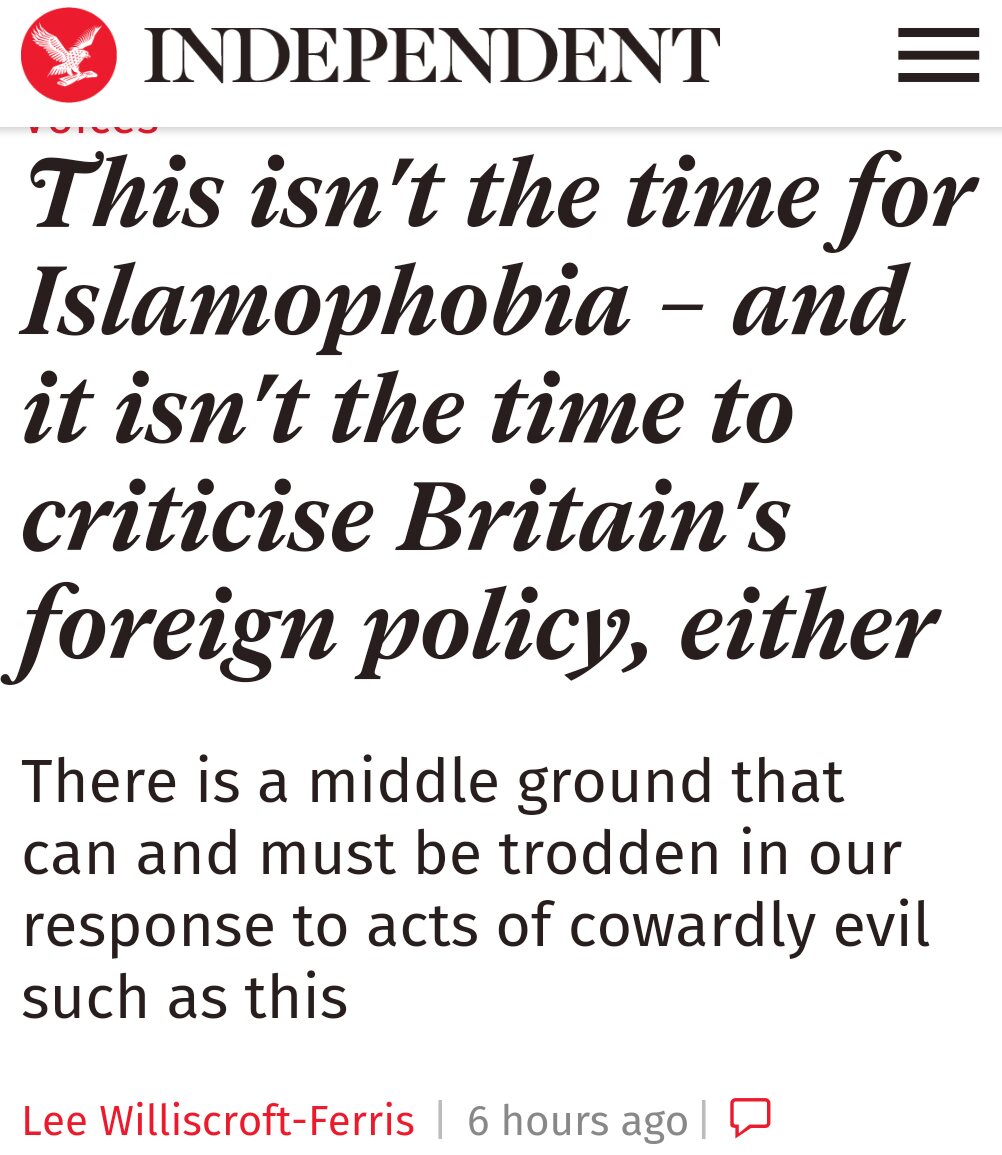
Perhaps it’s an auto-response and not as ‘Orwellian’ as it seems. Nonetheless, we’ve seen an overwhelming response by the media to pander to muslims, worry about their feelings, ignoring the fears and feelings of those who’ve become terrorized by radical elements inside their communities.
Case in point, the media was praising ‘muslim taxi drivers’ offering free rides to people last night. How very christian of them. The only problem with the narrative they attempted to paint was the poster man for these kind acts was a sikh.
Or the very rich and very privileged Russophobe, former British MP, Louise Mensch, who went bat-shit crazy after Wikileaks revealed that the former editor of HeatSt was, in fact, working for Hillary Clinton in secret — all the while duping her readers into believing she was a conservative. How about this for virtue signaling?
To all my dear Muslim brothers and sisters in Manchester and across the U.K., we got your back. Neither terrorists nor Nazis will divide us.
And here’s a BBC reporter submitting to radical Islam, saying Europe will have to get used to these sort of attacks. If Churchill was alive, he’d flick his cigar at her face.
This market is all about large cap hedge fund hotels pressing new highs, ironically fueled higher by large hedge fund managers. The numbers do not lie.
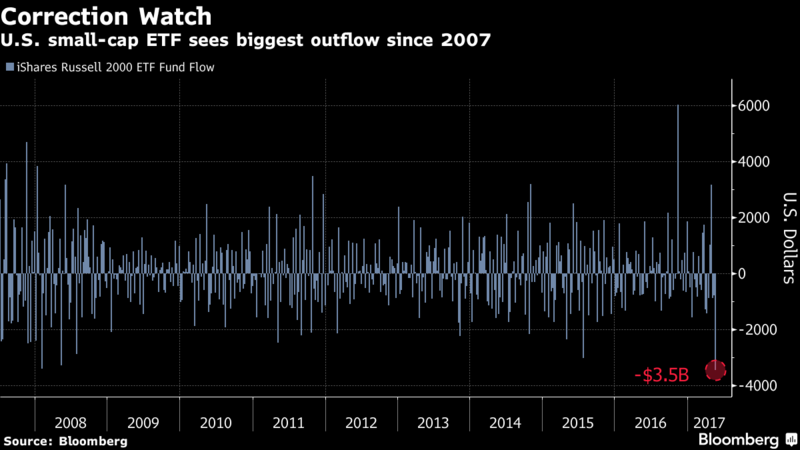
Look at the Russell 2000 outflows, the largest since 2007.
Here are some interesting numbers that illuminate the lack of diversity in this record move higher.
Stocks with market caps under $5b are down 0.89% for the past week, -0.86% for the past month, -2.74% for the past 3 months, and +0.19% for the past 6 months. Hardly impressive, more like depressive.
Stocks with market caps over $5b are up 0.12% for the past week, +1.53% for the past month, +1.65% for the past 3 months, and +10.15% for the past 6 months. Wow.
The spread between large and small caps stocks is 1,000bps over the past 6 months. The fact that no one is talking about this is equally crazy. It seems that all of Wall Street are holed up in a few stocks, such as AMZN, AAPL, MSFT and NFLX, while everything else wallows in a holding pattern.
In my experience, this sort of dichotomy tends to lead to gigantic blow outs, once the market softens. Everyone is chasing alpha now and the place to be is in larger cap stocks, which investors view as ‘safe’ and liquid. However, the safety and liquidity of these stocks have been negated by overcrowding — so buyer beware.
I used to be one of those people who upgraded to the latest iPhone on the very day it was released. My motive was fairly straight forward. I was enamored with the new technology, speeds of the phone, and new features. However, the phones have gotten so good, commingled with my increasingly curmudgeon attitude, that I haven’t upgraded my iPhone in years. I think I have the iPhone 5 or 5s, while everyone else in my family has brand new ones.
Seriously, I couldn’t care less. As long as I am able to place a call, retrieve my emails, and do cursory searches, I am happy.
Credit Suisse thinks I’m an outlier. In a research note out, they’re suggesting chasing Apple up here — at record highs — ahead of the 2018 release of the iPhone 8.
“We remain convinced that the iPhone product cycle will be significant in terms of driving multi-year unit growth, and maintain our conviction on Apple’s ability to introduce new higher pricing tiers with improved mix,” analyst Kulbinder Garcha wrote in a note to clients Tuesday entitled “8 Super-cycle – rising demand, rising price.”
“Given this, as well as a high retention rate, we see the 8 Super-cycle will unleash pent-up demand,” he wrote.
“Apple has historically raised iPhone prices along with key updates,” he wrote. “Given its affluent user base, a significant feature upgrade, limited price elasticity shown so far, as well as Samsung’s higher pricing points of the Galaxy S8 devices, we believe our pricing assumptions could prove conservative at $670/$770/$900 for three tiers of the new phones.”
Credit Suisse raised their estimates to $11.62 from $10.77. But does it really matter, all things considered? The company has $250b in the bank. They already won.
Their 12mo price target is $170.
I’m just curious what the 8 will have that the 7s didn’t? Remember years ago when there was speculation that the iPhone might include MVIS tech for their projector technology. That never panned out. Aside from processing speed and better resolution, I remain unconvinced as to why I should upgrade to a new phone.
We all are familiar with the $64b in lost capital by Madoff, which was the worst ponzi scheme loss in history. But did you know that only $17.5b in principal was lost? Of that principal, most of it has been recovered — $9 through Picard and another $4b through Breeden. I am not here to suggest that losing $4.5b isn’t dreadful — because it is. But most people still believe that people were totally wiped out by Madoff, who is currently serving a 150 year sentence in prison.
The big winners in all of this, naturally, are the lawyers who are administrating the victim funds via billable hours.
Through a Bloomberg FOIA request, we’ve learned that the DOJ hired Breeden to distribute $4b in recovered funds to Madoff victims, of which ZERO has been paid to date. Breeden, on the other hand, has racked up $38.8m in fees.
“It’s very frustrating that people are making money off us like this, using money that was recovered for victims,” said Daphne Brogdon, a Food Network personality, whose family lost about $5 million in the Madoff scam. “They’re eating away at whatever percentage we could possibly get.”
The other big recovery fund, managed by Irving Picard, has paid out more than $9b since 2009. The recovery effort was rigorous, via his firm’s aggressive litigation actions, netting as much as $1b in billable hours.
One-fucking-billion for Baker and Hostetler LLP.
Picard called it a “very good return on an investment.”
Unlike Breeden, his fees are paid for by Securities Investor Protection Corp., not the victims.