iBankCoin

MIAMI BEACH MAYOR: GET OUT; ‘THIS IS A NUCLEAR HURRICANE’

UPDATE:

Imagine yourself hosting a party and a hurricane filed with nuclear bombs showed up and blew away your little condo, like the big bad wolf did to that little piggy straw house. According to the Miami Beach Mayor, that’s exactly what Hurricane Irma is going to do when it lands in Florida this weekend. He’s warning residents to ‘get out’ because Hurricane Irma is a ‘nuclear hurricane.’

As an incentive, hotels and condos are shutting down power to force people to leave.

The Governor of Florida, Rick Scott, warned residents that ‘the storm surge can kill you‘, pleading with people to leave.

It’s important to note, Hurricane Irma is sustaining 180mph winds for the longest time in history and is now the size of Texas.

Dr. Masters from Wunderground opines.

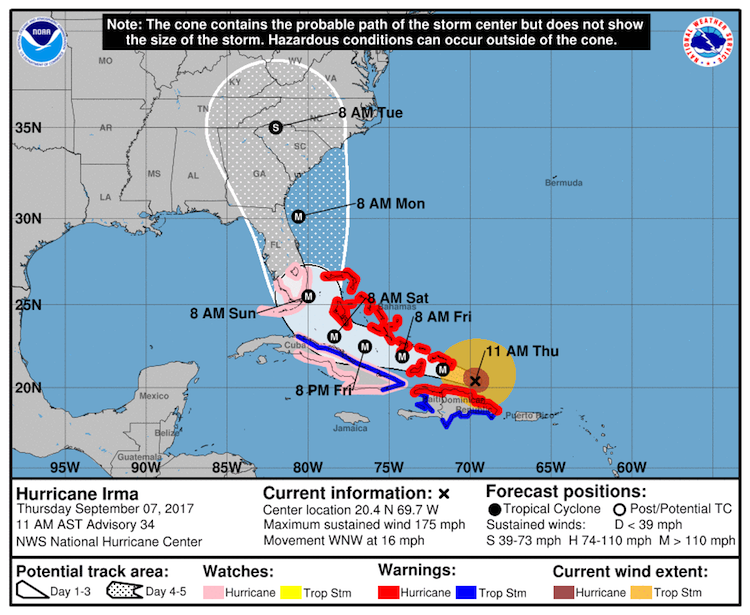
Florida: Where and when Irma makes its right-hand turn will largely determine its track with respect to the Florida peninsula. Based on recent ensemble models (in which a large number of parallel runs are carried out to simulate uncertainty in the atmosphere), it is still possible that Irma could take a south-to-north inland track across the Florida peninsula, or a track that stays just east of Florida’s East Coast. However, it appears most likely that Irma will hug the state’s East Coast from south to north, potentially moving inland over some sections. This type of track is far different from those of Hurricane Andrew (1992) and Katrina (2005), which moved from east to west across the Miami metro area. A south-to-north track would affect a much larger part of this elongated metroplex. In an interview published in Capital Weather Gang in August, Bryan Norcross touches on the many issues that a hurricane like Irma could bring to South Florida, which has not experienced a storm this strong in 25 years.

Depending on Irma’s track, hurricane conditions could extend well inland, as well as northward along the length of the peninsula. The entire Florida peninsula is within the five-day cone of uncertainty in the official NHC forecast, and all residents of these areas should pay close attention to the progress of Irma, especially along Florida’s East Coast. NHC may issue Hurricane Watches for parts of South Florida and the Keys on Thursday.

Irma’s intensity will likely undergo fluctuations over the next couple of days, but intensity models show only gradual weakening, and NHC maintains Irma as a Cat 5 storm through Friday. Wind shear is predicted to remain low to moderate along Irma’s path until Saturday, and Irma will be passing over waters that are as warm or slightly warmer than its current environment (see discussion in our Tuesday PM post). Land interaction with Cuba could weaken Irma somewhat, but we must assume that Irma will be at least a Category 4 as it nears South Florida on Sunday, as predicted by NHC.
More from Dr. Hanson

—Irma is likely to be at least a Category 4 when it nears Southeast Florida on Sunday. There is nothing in the atmosphere on the large scale that would be expected to produce significant weakening before at least Saturday. As Irma moves just north of Hispaniola on Thursday, and offshore or just over the north coast of Cuba on Friday into Saturday, the interaction with land may disrupt Irma somewhat, as noted above. On the other hand, water temperatures will remain steady or slightly increase along Irma’s path, which is favorable for maintaining Irma’s strength. Irma may experience moderate wind shear by Sunday (around 15 knots), but it is safest to assume that Irma will maintain at least Category 4 intensity on its final approach to Florida, as reflected in NHC’s 11 am Thursday forecast. More significant weakening is expected from Sunday into Monday, because of increasing wind shear and land interaction. Irma is still predicted to approach the Southeast coast of GA/SC as a Category 3 hurricane.

—Regardless of its strength at final landfall, Irma has the potential to generate a catastrophic storm surge across the Southeast coast from northern Florida to South Carolina. Under almost all track scenarios for Irma, the vast amount of water being pushed northwest by the storm is expected to slam into the Southeast coast and produce a devastating storm surge. Even if Irma’s winds decrease as expected by Monday, this water will already be in motion, packed with tremendous momentum. From our Wednesday PM post on the storm surge potential: “Even areas up to a hundred miles to the north of where the center makes landfall could potentially see record storm surges. The area of most concern is the northern coast of Florida, the coast of Georgia, and the southern coast of South Carolina, due to the concave shape of the coast, which will act to funnel and concentrate the storm surge to ridiculous heights.” See our Wednesday post for more details.

Within the storm surge warning area along the Southeast Florida coast, water levels above ground (inundation) could reach 5 to 10 feet, according to official NHC storm surge guidance as of 11 am EDT Thursday. Storm surge expert Dr. Hal Needham has launched a storm surge website for Miami with details on the city’s surge history and surge potential.?

—Large parts of the Florida peninsula would experience damaging winds on any of the most likely tracks for Irma. Irma’s hurricane-force winds now extend up to 50 miles from its center, and that radius will increase over time. Even after Irma’s top winds weaken, the wind field will gradually expand over time. Tropical-storm-force winds extend up to 160 miles from Irma’s center, which would be enough to straddle the entire Florida peninsula. In 2005, Hurricane Wilma crossed the state at Category 2/3 strength from Cape Romano to Jupiter. Even though Wilma’s center was 60 miles north of Fort Lauderdale, the city’s downtown experienced significant damage, with many glass facades sheared off by high wind. Floridians should be prepared for massive loss of windows and glass facades with Irma, especially if it tracks near or over Florida’s East Coast. It’s worth noting that Broward County—population 1.9 million—has not experienced a direct hit from a major hurricane since 1947. At that point, the county’s population was about 85,000.

Additionally, both Jose and Katia are rapidly developing. Should all three storms make landfall this weekend, it would be the first time 3 storms hit simultaneously dating back to 1851.

Comments »

$RH Executes Shorts After CEO Diabolically Plotted Their Demise

The CEO of RH is insane. I have proof.

So, the stock is up by ~40% today after crushing earnings and guiding higher. That’s the cover story. The real story is Gary Friedman (CEO) has been planning for this moment, like Dracula in a fucking Transylvanian castle (cue thunder), for quite some time.

In fact, he presided over an unbelievable share repurchase, the likes I have never seen before. The company bought back 49.5% of its outstanding shares!

We have reinvested the $282 million of free cash flow generated in the first half, and the $263 million of cash and investments on our balance sheet at the beginning of the year towards the repurchase of our stock, which we believe is an excellent allocation of capital for the long-term benefit of our shareholders. We have repurchased 20.2 million shares to date in 2017, or 49.5% of the shares outstanding at the beginning of the year. Outside of the convertible notes that are due in June 2019 and June 2020, we had aggregate debt of approximately $504 million at the end of the second quarter, including a $100 million second lien bridge loan that we expect to repay in full by year end.

How did this crazy fucker do it? The company borrowed $460 million and used practically every penny to execute a vendetta to decapitate short sellers.

Courtesy: Zerohedge

With 57% of the shares sold short and the stock up 150% for the year, I think it’s fair to say Friedman is winning.

Comments »

Let’s Peruse Today’s Awesome Hurricane Plays

Capitalists are out in force today. When walking around my neighborhood, I saw men in top hats and canes directing their runners to buy shares in companies who will profit from all of the death and destruction to come.

After I heard this, I ran back home and opened up my time machine to see what was going on. Alas, I was surprised to see furniture stocks ripping tits to the upside. I can’t say I wasn’t warned. Just the other day, an Emmy award winning storm chaser said Irma would cause for rooftops to be ripped off and put ‘furniture in the streets.’

RH is higher by 45%, but that’s financial engineering. I’ll get to that in another post.

Here are some winners:

CAB +14% – they sold a fucking bank. They had a bank and the Fed approved the sale. Not kidding.
FIT +14% — the real news is they teamed up with a company to do glucose monitoring. However, I like to believe people in Miami are buying them en masse in anticipation of vacating the city. Gonna get their steps on.
GPRO +13% — people are buying cameras and placing it on their heads to film themselves drowning. And they upped guidance.
CONN +12% — people will need new teevees after Irma wipes them out. Guidance upped too.
SNAP +6% — The stock is benefitting from an increase in FUCKERY.
GNC +6% — along with the FIT play, people have become quite healthy whilst evacuating from their homes. Perhaps they’re picking up some extra whey before heading out?
CROX +6% — water resistant shoes, FTW.

On the downside are all of these insurance fuckers: UVE, HCI, HRTG, AHL, BCRH, UIHC, FNHC, VR, RE.

Comments »

HURRICANE IRMA HAS DESTROYED PART OF ME ALREADY

Well, not literally — but emotionally I am scarred. Just yesterday I ventured out into the market to buy a Floridian property insurance stock, thinking Irma might veer left and “barrel up the Gulf sideways” to lay waste to some other part of the world, only to be quickly dispatched in a manner that is mean spirited and completely devoid of honor.

There I am, right at the top of the pack — UVE.

A normal person would see this and be frightened, report back to his wife the loss and move on to the next FUCKING DICK GUILLOTINE. But I am not an ordinary man, am I?

I intend to see this through, all the way down to zero. I’ve never seen an insurance stock get hammered like this in anticipation of a little thunder storm. Hurricane Irma is going to be the very worst natural disaster to ever strike Florida. It will make people rue the day they migrated down to that marsh, like birds, in the hopes for a better life.

I will not buy more today, but maybe mañana.

Moving on, fuck the banks, truly. My FAZ is kicking ass and I am really hoping something dreadful happens to them. My hurricane resistant windows play, PGTI, is chugging along higher too, in addition to TLT, GLD and all of the other shit that I own. But let’s face it, this all PALES IN COMPARISON to the crematoria treatment I am receiving in UVE. This shit is a rollercoaster into a fucking oven and I am in the front row enjoying the view.

Comments »

MORNING POPPERS

Today’s back to school day, which means that my duties have been exponentially increased from mere provider and idler in chief to breakfast chef and chauffeur. My clients expect the best, so paninis were served alongside a gigantic sized serving of apple pie this morning.

Because it was the first day, their spirits were high and brave enough to walk 3 blocks to the school bus stop — which left me and my drivers cap sitting in the living room, idling again, posting analyst moves on Twitter.

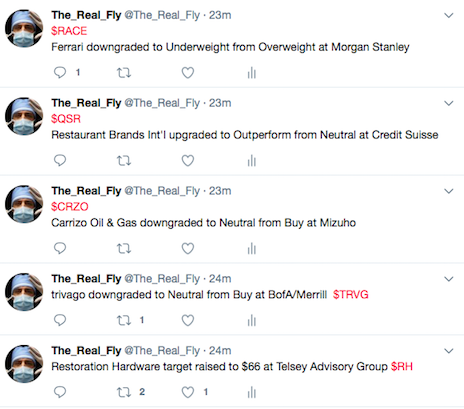
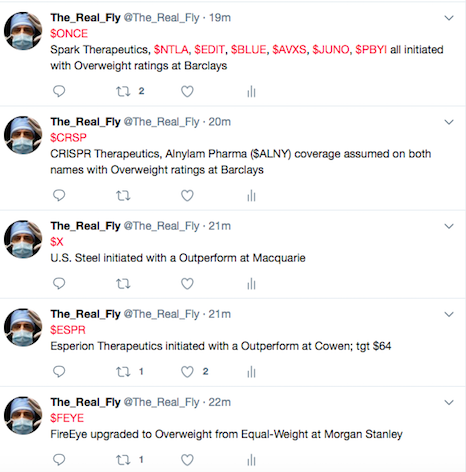
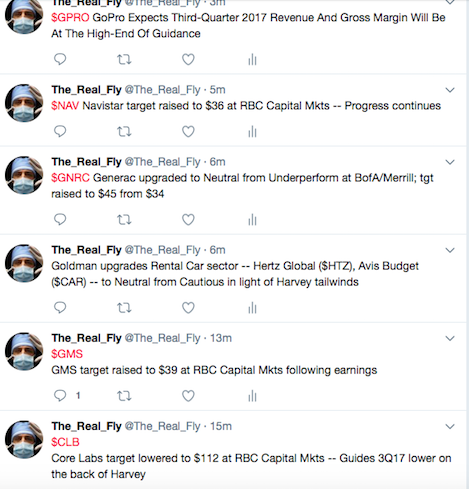
Here’s what I accomplished so far.

One of my best friends used to be an executive at Enterprise Rental cars. I can tell you with confidence, they are gouging people like motherfuckers down in Florida now. I like the Goldman call, upgrading HTZ and CAR.

Comments »

Prime Minister of Barbuda/Antigua After Irma: ‘Unprecedented’ Destruction, Island ‘Barely Habitable’

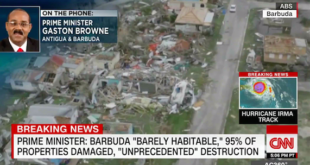
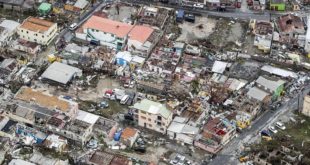
In what is being described as a ‘storm for the ages’, or Donald Trump’s grande distraction, Hurricane Irma burnt through the island of Barbuda today, leveling most of the country. According to its Prime Minister, 95% of the buildings in the country have been damaged or destroyed. The damage was so extensive and ‘unprecedented’, he said the island is now ‘barely habitable.’

“Barbuda is literally rubble,” Prime Minister Gaston Browne of Antigua and Barbuda told an interviewer with ABS TV/Radio Antigua.

“The entire housing stock was damaged,” Browne said after visiting the island. “It is just a total devastation.”

Irma is still sustaining winds at 185mph for 33 hours straight, a new record.

Comments »

Reminder: Experts Have Been Warning Us About Global Warming Since the 1930s

I will not pretend to be a scientist in this blog, or even claim to know the very first thing about global warming or lack thereof. I am more interested in human narratives, how they are woven, and the basis from which they were formed. Just like in stocks, when listening to an analyst, I like to know the historical performance of his/her previous picks.

Now that we have a very active hurricane season again, all of the self-made climatologists are out shilling for their global agendas. It’s all very convenient, reminiscent of sudden calls for gun control following a mass murder.

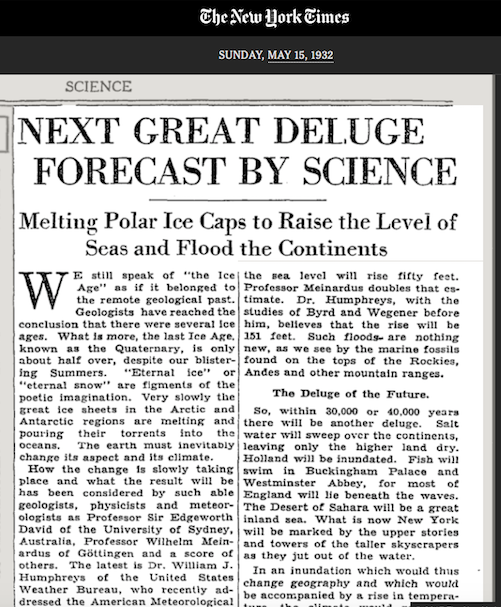
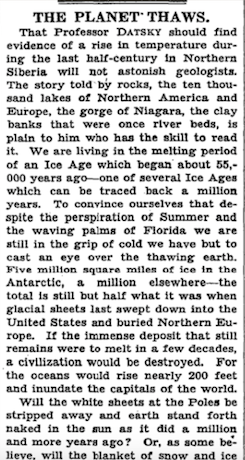
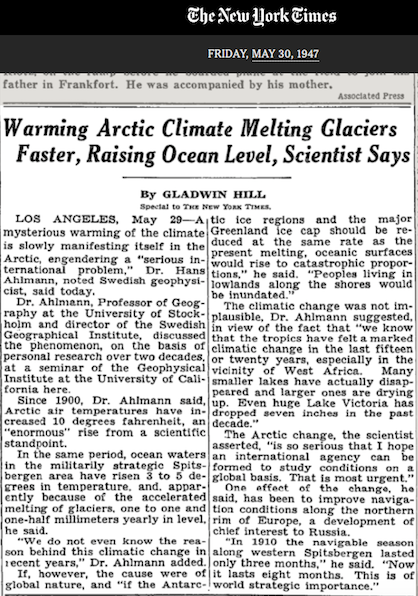
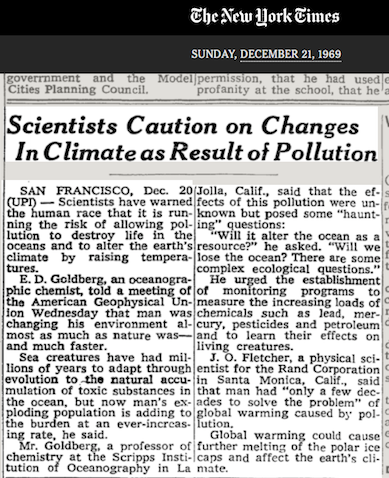
Doing a cursory search of the NY Times archives, I found several articles warning Americans of the perils of global warming, several dating back to the early 1930s.

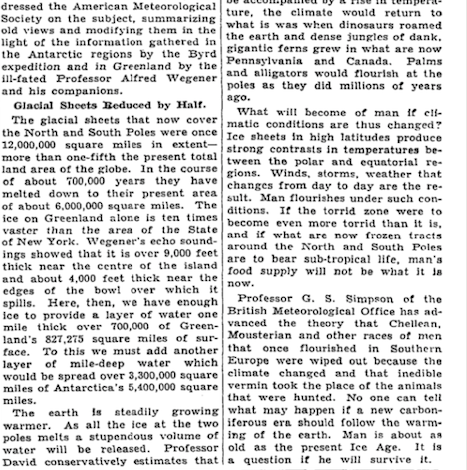
In the article below, dated May 15th, 1932, the NY Times cites scientific research that said the center of Greenland was ~9,000 ft thick and the edges ~4,000.


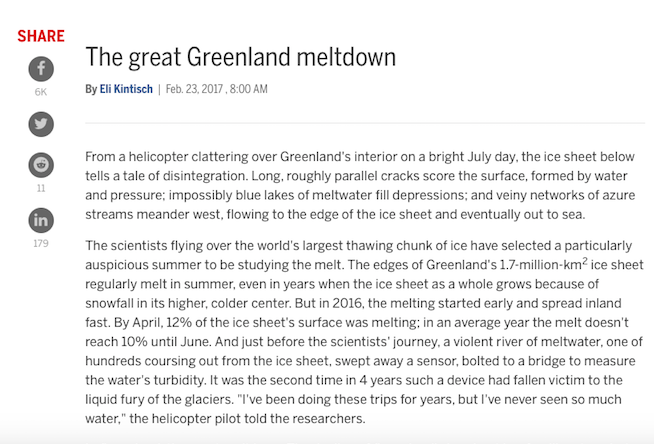
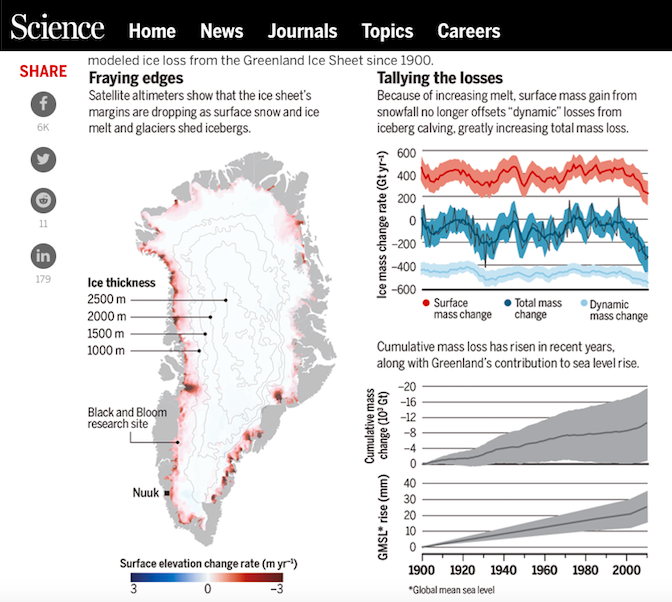
Today, according to a report out by experts…

…1,000m or 3,200 ft around the edges and 2,500m at the center or 8,200ft, roughly a 10% reduction from 75 years ago. Bear in mind, the instruments used to measure the thickness of the ice was rudimentary at best, back in 1932, so there must be some margin for error. Having said that, given the frantic panic, this is hardly a rate of change worthy of panic.

Here are some other articles from yesteryear.

Circa 1933, NY Times

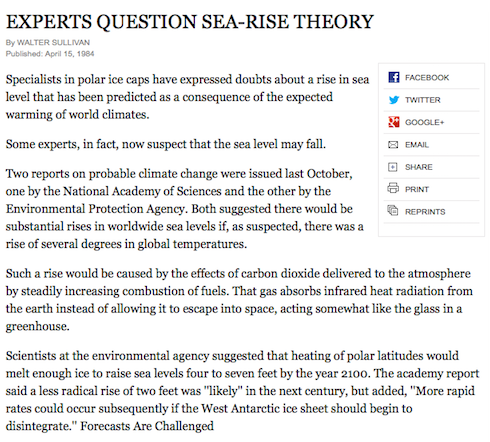
Lastly, back in 1984, there were some skeptics — those who called out the global warming panickers of the 1960s and instead claimed that that ice sheets were instead getting ticker.

EXPERTS QUESTION SEA-RISE THEORY

Specialists in polar ice caps have expressed doubts about a rise in sea level that has been predicted as a consequence of the expected warming of world climates.

Some experts, in fact, now suspect that the sea level may fall.

Two reports on probable climate change were issued last October, one by the National Academy of Sciences and the other by the Environmental Protection Agency. Both suggested there would be substantial rises in worldwide sea levels if, as suspected, there was a rise of several degrees in global temperatures.

Such a rise would be caused by the effects of carbon dioxide delivered to the atmosphere by steadily increasing combustion of fuels. That gas absorbs infrared heat radiation from the earth instead of allowing it to escape into space, acting somewhat like the glass in a greenhouse.

Scientists at the environmental agency suggested that heating of polar latitudes would melt enough ice to raise sea levels four to seven feet by the year 2100. The academy report said a less radical rise of two feet was ”likely” in the next century, but added, ”More rapid rates could occur subsequently if the West Antarctic ice sheet should begin to disintegrate.” Forecasts Are Challenged

These predictions were challenged last week at the latest in a series of seminars on global habitability being held at Columbia University. It brought together Government and academic specialists to discuss the future of the Antarctic ice sheet.

In the past there have been far more ominous predictions regarding that ice sheet than those suggested in last October’s reports. In 1964 it was proposed that virtually the entire ice cap at the bottom of the world sometimes slips into the sea, raising global sea levels more than 200 feet, enough to flood many coastal lands and cities.

Such dramatic predictions fell out of fashion, and attention focused on the ice covering West Antarctica, that part of the continent south of the Americas. As pointed out at the Columbia seminar by Dr. George H. Denton of the University of Maine, an authority on the ice of West Antarctica, much of it rests on land thousands of feet below sea level.

Because such ice readily breaks off into icebergs it is thought to be more vulnerable to discharge than continental ice. Since it is a mile or more thick, its entry into the oceans would raise sea levels several feet.

It has been widely assumed that, between the last two ice ages, some 125,000 years ago, the climate was hotter than it is now and sea levels were 10 or 20 feet higher. Coral reefs formed in that period on some oceanic islands suggest such a high stand of the sea. These two lines of evidence were taken to mean that the West Antarctic ice dispersed into the oceans in that period. Past Assumptions Are Questioned

New evidence, however, questions both arguments, Dr. Denton said. While sea floor sediment in the North Atlantic suggests it was unusually warm there, it is beginning to appear the climate of the Southern Hemisphere was much like that of today. The coral reefs may be high, he added, not because the oceans were high but because the islands have risen.

Likewise the response to greater warmth is difficult to predict, Dr. Denton said. More moisture may be carried to the Antarctic hinterland, increasing snowfall there and the Antarctic ice ”may even expand,” he said.

The Antarctica’s interior is so high and cold there is virtually no melting and some scientists believe there would not be much, even if the climate warms. The critical area is along the coasts, where ice discharges as icebergs.

As pointed out by Dr. Arnold Gordon of Columbia’s Lamont-Doherty Geological Observatory, the behavior of the ocean along the coast may be a controlling influence. A change in oceanic circulation in response to warming of the atmosphere could, for example, alter the extent to which deep water wells upward along the rim of Antarctica and beneath its coastal ice shelves.

The two shelves through which most West Antarctic ice reaches the sea are considered keys to the fate of that region’s ice cover. They are the Ross Ice Shelf on the Pacific side and the Filchner and Ronne ice shelves facing the Weddell Sea on the Atlantic side. Each shelf is fed by broad ice streams flowing from the hinterland.

The shelves are thought to hold back the flow of ice and there has therefore been concern that they might be unstable. As stated by Dr. Robert H. Thomas, manager of the polar oceans program of the National Aeronautics and Space Administration, the conclusion seems ”unambiguous” that, if the shelves go to sea, the ice of West Antarctica ”will collapse.”

The seaward edge of the shelves breaks off into icebergs. Should this process accelerate, specialists believe it could drain much of the ice from West Antarctica in a matter of centuries. Hence, in the last few years, there have been extensive studies of the ice cover.

Dr. Ian M. Whillans of the Institute of Polar Studies at Ohio State University said these studies had revealed no ”dramatic” changes either in West Antarctica or on the Ross Ice Shelf. He cited various ”catastrophic hypothesis” regarding that ice and added, ”Perhaps we should also consider the possibility that it is stable.”

There appeared to be a consensus that too little was known about the factors controlling growth and shrinkage of the ice sheet to predict its response to warming. ”The more ingredients you put into a cake,” said Dr. Thomas, ”the more ambiguous it gets.”

I wonder what experts will be writing about 75 years hence.

Comments »

A Really Bad Analyst From Baird Just Said $AMZN Might Buy $KSS

I’ll tell you what. If AMZN actually buys the biggest piece of shit in the strip mall, KSS, I will reveal my identity from inside the fucking vortex of Hurricane Irma. I will fly down to Miami, tie myself to a strong tree, and give you shit-heads the play by play, whilst holding an American flag.

On this analyst note, shares of KSS jumped by 5%. This is a good example of an analyst being irresponsible beyond belief.

There is no way Amazon will buy Kohls. There is no way Amazon will buy Kohls. There is no way Amazon will buy Kohls. There is no way Amazon will buy Kohls. There is no way Amazon will buy Kohls. There is no way Amazon will buy Kohls. There is no way Amazon will buy Kohls. There is no way Amazon will buy Kohls. There is no way Amazon will buy Kohls.

There is no way Amazon will buy Kohls. There is no way Amazon will buy Kohls.

There is no way Amazon will buy Kohls. There is no way Amazon will buy Kohls. There is no way Amazon will buy Kohls. There is no way Amazon will buy Kohls. There is no way Amazon will buy Kohls. There is no way Amazon will buy Kohls. There is no way Amazon will buy Kohls. There is no way Amazon will buy Kohls. There is no way Amazon will buy Kohls. There is no way Amazon will buy Kohls. There is no way Amazon will buy Kohls. There is no way Amazon will buy Kohls. There is no way Amazon will buy Kohls. There is no way Amazon will buy Kohls.

There is no way Amazon will buy Kohls. There is no way Amazon will buy Kohls.

There is no way Amazon will buy Kohls. There is no way Amazon will buy Kohls.There is no way Amazon will buy Kohls. There is no way Amazon will buy Kohls.There is no way Amazon will buy Kohls. There is no way Amazon will buy Kohls.

Comments »

Traders Who Profit Off Natural Disasters Are Evil

On the news of Hurricane Irma shattering an old record for sustaining winds of 185mph, I bought some PGTI — because people will need them HURRICANE RESISTANT windows in the not-too-distant future. In the event a miracle happens and Florida isn’t shredded down to the sewer pipes, I bought an insurance outfit, UVE, in order to profit from the lack of destruction post Irma.

If the ‘Cane should swing left and barrel down the Gulf of Mexico sideways, I suspect the oil industry will enter a period of extreme crisis — which is why I am long OAS.

My final two ways to profit off of Hurricane Irma is to be long FIZZ — because people will become parched after running for cover. I suspect they’re cleaning out their local grocery stores right now, as we speak, to buy out all of the La Croix inventory. Am I right?

Lastly, some estimates suggest that the damages inflicted upon Florida could amount to a clownish figure of $300 billion. If you paired that number with the ~$200 billion inflicted by Harvey, I imagine our banking sector might become impaired, at least for a short while. To hedge the downside, I am long FAZ.

These are all my new discretionary trading ideas. My quantitative strategies are all jogging on fine, comporting themselves with both dignity and honor.

Comments »

Latest Settlement Boosts Madoff Victims Payout to 72 Cents on the Dollar

For all the drama, the Madoff fiasco, helped by unprecedented clawbacks, has resulted in victims of Bernie being reimbursed for 72 cents on the dollar of principal invested. Some of you have lost more than 28 cents on the dollar during the past month.

The latest settlement was with the Irish Investment Fund, who was accused of helping ‘open up the floodgates’ for European cash to invest with evil Bernie. They settled out of court for $687 million — the largest settlement in 6 years.

Thanks to the tremendous work of Picard, to date, $12.7b of $17.5b of principal has been recovered.

The deal “is the latest in a series of highly successful negotiations and mediations,” Oren Warshavsky, one said Picard’s lawyers at Baker& Hostetler LLP, said in a statement. Two recent settlement with funds related to Thema put total recoveries since June at more than $1 billion, he said.

Wait, it gets better. The US Department of Justice will set up a $4 billion fund to compensate the victims, essentially making them whole.

The trustees who’ve been toiling away to recover the money are reportedly getting paid $850 per hour — amounting to well over $1b in fees.

The good news? Zero dollars come from the victims, instead from a fund overseen by SIPC designed to support customers of failed broker dealers.

In other words, the lawyer fees are being booted by tax payers.

Comments »