Some of you will talk shit about Einhorn — but you’d be disrespecting one of Wall Street’s most successful managers — who’s one of the good guys. His performance has been lackluster in recent years, because of his investment style. Value investing is dead, and has been dead for some time now. Buying into stocks trading at 20x sales, traditionally, is a ruinous way to play with one’s money. But all of the hazards of buying into hot stocks have been tossed by the wayside in recent years, especially since Trump’s win.
In a letter to clients, Einhorn lamented over the demise of value investing — while posting 6.2% returns for the third quarter, lifting gains to just 3.3% for 2017.
“The persistence of this dynamic leads to questions regarding whether value investing is a viable strategy,” Einhorn wrote in a letter to clients of his Greenlight Capital that was seen by Bloomberg News. While the “knee-jerk instinct” is to think that the cycle must be about to turn around, he said he doesn’t know if that’s going to happen.
“After years of running into the wind, we are left with no sense stronger than ‘it will turn when it turns,’” Einhorn said. “Perhaps there really is a new paradigm for valuing equities and the joke is on us. Time will tell.”
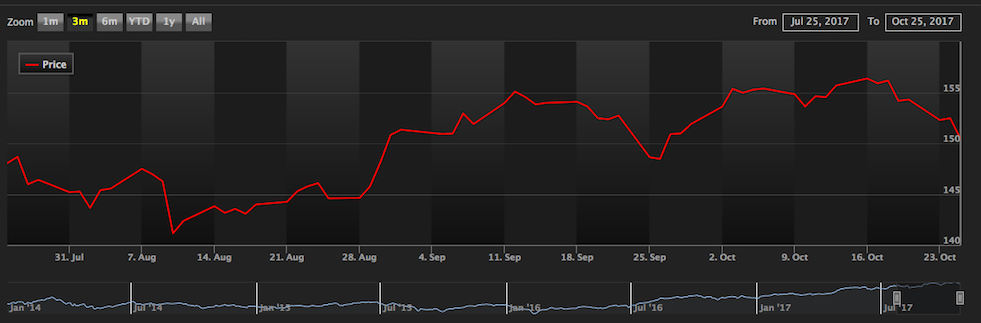
Einhorn reported new positions in TPX and HPE.
Here is the full letter below.
Dear Partner
The Greenlight Capital funds (the “Partnerships”) returned 6.2%,1 net of fees and expenses, in the third quarter of 2017, bringing the year-to-date net return to 3.3%. During the third quarter, the S&P 500 index returned 4.5%, bringing its year-to-date return to 14.2%.
The Partnerships had a good quarter. The long portfolio had strong absolute and relative performance, the short portfolio had losses but generated positive alpha, and the macro book contributed a small gain.
Even so, the market remains very challenging for value investing strategies, as growth stocks have continued to outperform value stocks. The persistence of this dynamic leads to questions regarding whether value investing is a viable strategy. The knee-jerk instinct is to respond that when a proven strategy is so exceedingly out of favor that its viability is questioned, the cycle must be about to turn around. Unfortunately, we lack such clarity. After years of running into the wind, we are left with no sense stronger than, “it will turn when it turns.”
For a moment, let’s consider the alternative. Might the cycle never turn? Our strategy relies on the assumption that the equity value of a company equals the market’s best assessment of the current and future profits discounted at the company’s cost of capital. Our ability to outperform often comes from our skill in finding opportunities where the market has misestimated current or future profitability or miscalculated the cost of capital by over- or underestimating the risks.
Given the performance of certain stocks, we wonder if the market has adopted an alternative paradigm for calculating equity value. What if equity value has nothing to do with current or future profits and instead is derived from a company’s ability to be disruptive, to provide social change, or to advance new beneficial technologies, even when doing so results in current and future economic loss? It’s clear that a number of companies provide products and services to customers that come with a subsidy from equity holders. And yet, on a mark-to-market basis, the equity holders are doing just fine.
When we consider the business performance of our three most well-known “bubble” shorts, we wonder if this alternative paradigm is in play. Last quarter, we noted Amazon.com’s (AMZN) earnings estimates had fallen over the prior few quarters. This quarter, AMZN revealed a much lower level of long-term structural profitability, causing consensus estimates for the next five years to drop by 40%, 22%, 18%, 14% and 8%, respectively. Ordinarily, stocks trading at nosebleed multiples fall sharply when such a dramatic reassessment happens. Instead, AMZN fell less than 1% during the quarter. Our view is that just because AMZN can disrupt somebody else’s profit stream, it doesn’t mean that AMZN earns that profit stream. For the moment, the market doesn’t agree. Perhaps, simply being disruptive is enough.
esla (TSLA) had an awful quarter both in its current results and future prospects. In response, its shares fell almost 6%. We believe it deserved much worse. So much went wrong for TSLA in the quarter that it is hard to only provide a brief summary. The main near-term problems are poor demand for its legacy vehicles and manufacturing challenges for the new Model 3. Notably, TSLA dramatically reduced its gross margin assumption for the September quarter and publicly blamed ramp-up costs for the new Model 3 sedan. More quietly, the company used the lower gross margin hurdle to offer incentives and to lower the cost of options on the Model S and Model X vehicles, and even offered significant markdowns on showroom models. Given the depth of the price cuts, we were surprised that demand for the Model S and Model X only improved modestly.
Meanwhile, it is becoming clear that scale manufacturing is actually a skill. While the CEO makes bold claims about TSLA’s superior prowess, continued production shortfalls, defects and product recalls disprove him. TSLA faces competition from established OEMs that have decades of scale manufacturing experience. Some of TSLA’s presumed market lead in areas like autonomous driving may more likely reflect TSLA’s willingness to put inadequately tested and dangerous products on the road rather than a true technological advantage.
Finally, there is Netflix (NFLX), where the quarterly results beat expectations and the shares advanced 21%. Competition is heating up and media companies such as Disney will be removing their content from NFLX to compete directly (bulls used to believe that Disney would pull a Time Warner/AOL and pay-up for the highly promoted but profitless business). NFLX continues to accelerate its cash burn as it desperately tries to compensate for its inability to rely longer-term on licensed content. On the second quarter conference call, the CEO stated, “In some senses the negative free cash flow will be an indicator of enormous success.” To us, all it indicates is that NFLX is capable of dramatically changing the economics of stand-up comedy in favor of the comedians. Perhaps, there really is a new paradigm for valuing equities and the joke is on us. Time will tell.
Turning to the significant quarterly winners and losers, CONSOL Energy (CNX), General Motors (GM) and Uniper (Germany: UN01) were the largest contributors, while our Caterpillar (CAT) short and Mylan (MYL) were detractors.
CNX shares continue to trade in a narrow range and recovered the loss from the prior quarter, ending at $16.94. We expect the separation between the coal and natural gas businesses to be completed this year and we are surprised that the shares have not re-rated much in anticipation of that event. We believe this position is particularly promising in the near-term as the market focuses on the new math. Notably, CNX announced its first share repurchase program in many years.
GM advanced 16% to $40.38 as it continued to post strong results, closed the sale of its money-losing European business, and showed progress on its ‘Auto 2.0’ positioning. There was one notable postscript to our proxy contest. Recall that our primary proposal was for GM to distribute Dividend Shares (akin to perpetual preferred stock) to its shareholders. Much of the debate with GM about the merit of our idea centered on how much the new security would need to yield – the lower the yield, the better our idea. We conservatively thought the yield would be 7-9%. Without providing much analysis, GM’s financial advisors concluded that the yield would be in the double digits. On September 13, GM’s finance subsidiary issued $1 billion of perpetual preferred stock.2 We were impressed that with minimal marketing, the new security was priced to yield 5.75% and promptly traded to about 5.25%. We don’t know why the Board chose to do this or what else it has planned. We do know that the math on a sub 6% perpetual preferred security indicates our proposal was even more attractive than we had claimed.
UN01 advanced 41% in the third quarter. On the surface, the move higher appeared to reflect the market’s continued appreciation for the attractive valuation, combined with modest improvement in the power markets. However, rumors that UN01 was a buy-out target began circulating and at the end of the quarter, Finnish utility Fortum announced an agreement to purchase E.ON’s 47% stake in UN01 at €22 per share. UN01 management revealed that Fortum had approached the company directly and UN01 had rebuffed the bid, as it was materially below management’s estimate of fair value. We believe that if Fortum wants to acquire UN01, it will need to pay a higher price. The stock closed the quarter at €23.20, about 8.5x times our estimate of 2019 earnings and 0.7x book value per share.
CAT shares rose 16% in the third quarter to $124.71 as the company raised earnings guidance for the year from $3.75 to $5.00 on its late July conference call (excluding expenses for restructuring). This was the company’s second straight “beat and raise,” which has led analysts to conclude that CAT is entering a new upcycle. At its current share price, CAT trades at 26x this year’s earnings, implying investors believe it is still well below mid-cycle earnings.
We are skeptical. We continue to believe that the biggest drivers of CAT’s business are mining, where the industry is plagued by overcapacity from the China-led super-cycle in steel production over the past decade; the energy sector, where oversupply is leading to materially slower investment; and construction, where we are already at or near the cycle peak. We believe some of CAT’s strength this year comes more from self- induced product shortages driven by all the factory closures it has made over the past several years in a frantic attempt to protect earnings as demand fell. Although dealers are not seeing much end-demand growth this year, they are double ordering equipment because they doubt CAT’s ability to fulfill orders in a timely fashion. We believe this will result in higher costs for CAT (as it scrambles to add back the workers it cut) and lower revenue (as orders slow once CAT catches up with its backlog) next year.
MYL fell 19% to $31.37 as it suffered delays in new drug approvals and more rapid pricing degradation on existing products, which led to reduced guidance. MYL’s P/E ratio is now 7x this year’s earnings and 6x next year. We believe that from here, estimates are likely to be achieved and possibly exceeded and we remain excited about the upside potential from MYL’s pipeline of complex generics.
2 To be sure, there are differences between this security and our Dividend Shares, including the issue size, the entity issuing it (GM’s finance subsidiary actually has a lower standalone credit rating), a transition from a fixed coupon to a floating coupon after 10 years, and call-ability.
We added three notable long positions this quarter:
We established a new long position in Hewlett Packard Enterprise (HPE), a collection of enterprise hardware, services and software businesses spun off from Hewlett Packard in 2015. To further unlock value, HPE spun off and sold its outsourced services and software businesses earlier this year. Today HPE is an enterprise hardware business selling servers, storage and networking equipment, with very profitable maintenance and leasing operations. We purchased our position at an average price of $13.29, or about 8x earnings of $ 1.00 per share (after backing out net operating cash of approximately $4 per share and $1.60 of value per share in a Chinese JV). Earnings have been depressed by higher input costs and separation-related expenses, but HPE has an opportunity to significantly reduce its cost base. We believe the company has earnings power of $1.40-$1.70 in the next few years. HPE shares closed the quarter at $14.71.
When we first purchased shares of Micron (MU) several years ago, the DRAM industry had consolidated from seven players down to three. The three participants (MU, Samsung and Hynix) seemed relatively satisfied with their market share and were content to grow capacity through technology upgrades in line with industry demand. Unfortunately, a combination of slower-than-expected demand growth from the PC market, along with faster-than-expected capacity growth from Samsung, led to steep pricing declines. At the same time, MU had difficulty integrating Elpida, the Japanese competitor it had acquired out of bankruptcy, and fell further behind on the cost curve. As a result, MU had much worse earnings than we had expected and faced the prospect of needing to accelerate capital spending to gain back the ground it had lost to its peers. Rather than wait this out, we chose to exit our position at an average price of $22.14 and a mid-teens IRR, which would have been much larger had we sold the stock at the cyclical top. The stock price later troughed under $10 in early 2016.
A year and a half later, the situation looks quite different. Not only have MU’s investments in technology allowed it to improve its cost position, but its competitors have seen their progress slow. We are getting quite close to the physical limits of Moore’s Law (which describes the pace at which cost reductions in semiconductors follow from advances in technology) as the latest DRAM chips are made up of layers of insulators and transistors that are just a handful of atoms in thickness. Industry capacity growth has therefore been slowing, while at the same time industry demand has improved. Though the outlook for PC demand remains lousy, mobile phones and data center servers have much stronger prospects and are now, collectively, three times larger than the PC market as a source of DRAM demand. Also, advances in software (particularly for a new wave of applications involving artificial intelligence) need continually increasing amounts of DRAM to perform, a dynamic we expect to continue for some time.
Meanwhile, investors have reacted to MU’s improving earnings with a shrug. The company is now earning more than twice as much as it did at the peak of the last cycle, and we re-entered the stock at $29.21. While DRAM will always be cyclical, we believe investors are underappreciating the dynamics of the current cycle and the long-term structural improvements in the industry. MU shares ended the quarter at $39.33.
We added Tempur Sealy International (TPX) at an average price of $56.11 per share. TPX manufactures and markets premium mattresses and bedding products under the Tempur-Pedic,
Stearns & Foster, and Sealy brands. Early in 2017, TPX shares fell precipitously after the company terminated its relationship with retailer Mattress Firm, its largest customer at 21% of sales. We believe that brand strength and customer loyalty (particularly for Tempur-Pedic mattresses) will allow the company to recapture lost sales through other retailers and direct and online channels. Additionally, our work suggests that TPX earns significantly higher margins selling through these other channels, as Mattress Firm had used its scale to negotiate large discounts from TPX.
Bears argue that the growing willingness of consumers to buy mattresses online (as evidenced by the rise of so-called “Bed-in-a-Box” products sold by Casper, Leesa and others) will erode TPX market share and pricing power. However, we note that (a) TPX earns up to 2-3x as much profit on a mattress sold online as opposed to through a retail partner, (b) TPX’s U.S. direct business is arguably the fastest-growing bedding e-commerce business of any material size, and
(c) the Bed-in-a -Box products are a lower quality mattress sold at a lower price to address a different market segment. Led by a CEO with a remarkable record of margin expansion in prior roles, we see potential for TPX sales recapture and margin improvement to drive earnings to north of $6 per share by 2019-2020, compared to consensus expectations of $4.05 in 2019. TPX shares closed the quarter at $64.52.
We exited a few positions:
We earned a high-teens compounded return on Axiare Patrimonio, a Spanish property developer and manager, over a three year holding period. We exited as the shares achieved fair value.
We exited a short of Best Buy (BBY) with a loss. We believed TV and gaming cycle weakness would hurt results. Instead BBY’s strength in high-end computing and the Nintendo Switch led to some of its best sales in years.
Calpine announced it would be acquired by Energy Capital Partners. While we received a decent premium and exited with a modest gain, we believe the buyer is getting the better side of the transaction.
We closed a profitable position in PVH. Last year, fears of North American department store apparel weakness weighed on the stock. This year, the market finally gave PVH credit for excellent brand management and growth in Europe and Asia.
Simon Hillary left our London office to start a new long/short fund within Lancaster Investment Management. Simon wants to try his hand as a Portfolio Manager, and he couldn’t pass up a great opportunity. The Partnerships will make a small investment in Simon’s fund at favorable terms, and we will continue to have an open dialogue with him. It appears that at least this Brexit is a win-win. We wish Simon success with his new venture!
Bryan Nowicki joined us as a research analyst. He previously worked at Marianas Fund Management and Taconic Capital. Bryan began his career as an analyst at Lazard, and he is the first Lazard alumnus to join Greenlight since Vinit Sethi almost 20 years ago. We would say
that Bryan has big shoes to fill, but Vinit is only a size 7. Bryan has a B.S. in Finance from NYU. Welcome Bryan!
Florence Colgate joined us as our U.K office manager last quarter. Florence has a B.Sc. in Health Studies and had been working in a variety of administrative support roles in London prior to joining us. Welcome Flo!
Please save the date for our 22nd annual partner meeting, which will be held on January 16 at the American Museum of Natural History.
At quarter-end, the largest disclosed long positions in the Partnerships were AerCap, Bayer, CONSOL Energy, General Motors and gold. The Partnerships had an average exposure of 118% long and 73% short.
“You can stand me up at the gates of hell But I won’t back down.”
— Tom Petty
Best Regards,
Greenlight Capital, Inc.
Comments »