
When a group of 150 “high valuation” stocks collapsed in April, catching me off guard, the life of the market was damaged. A lot of you trollop types like to say these stocks are nothing more, or less, than trash. But that couldn’t be further from the truth. If you knew anything about investing, you’d know that speculation is the life blood of any bull market. After these stocks dropped by 30-70% inside of 8 weeks, I became convinced that this wasn’t your ordinary run of the mill decline (shocker).
The last time speculation was punished so severely was in April of 2000. The parallels are startling. The difference between then and now was the mega-cap nature of the dot com collapse, which directly affected the major indices. This time around, AAPL, ORCL, MSFT, INTC and CSCO are mature companies, stodgy like utilities. They dominate the NASDAQ weighting–and as a result stymie any dramatic decline.
Understand the dynamics of overvalued stocks collapsing, then rebounding, and try to discern whether or not a large group of widely unprofitable start ups can withstand the test of time, as it relates to a simmering time bomb of bearish sentiment at the precipice of explosion.
Here is the NASDAQ action from April-Oct of 2000. I do not want you to compare it to our NASDAQ. Instead, compare the price action to stocks like FEYE, WDAY and SPLK.
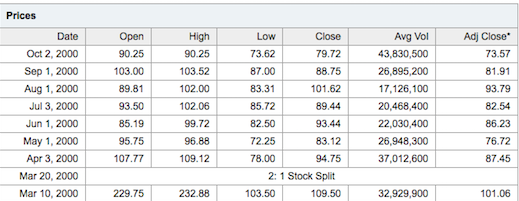
If I am right, we are about to enter the final phase of high valuation jubilance, followed by the top of tops, which will lead to the complete and indelible destruction of these vagrant stocks.
As discussed earlier, I intend to make a large deposit into my personal account soon for two reasons.
1. Take advantage of the August ramp higher via swing trades.
2. Hopefully get a chance to buy non-high valuation stocks into a trough of over bearish vulgarity.
At the end of the day, profitable businesses will be fine and the indices shouldn’t drop by too much. But the bubble stocks: they are entering the final salvo in what can only be described as the second coming of the dot com crash.
Comments »