iBankCoin
Home / Dr. Fly (page 608)

Dr. Fly

18 years in Wall Street, left after finding out it was all horseshit. Founder/ Master and Commander: iBankCoin, finance news and commentary from the future.

Know the Name: Purdue Pharma, Privately Held by the Sacklers of NYC — Biggest Opioid Drug Dealers in America

Talk about blood money. The opioid crisis has touched so many people in this country. It is on par with the tobacco scourge that broke countless families over the past hundred years. But many people know where big tobacco started, due to the public nature of the corporations. But in the pain killer world, the main culprit is, by design, privately held — secretive and by all means as evil as Phillip Morris.

Name of the company is Purdue Pharma, and it’s owned by the Sacklers of NYC.

I strongly advise you to read this article in order to get a better feel for who these moneyed people are, hiding behind their charitable contributions, paying meaningless fines, whilst releasing a terror onto America.

Purdue under Mortimer and Raymond, and Raymond’s son Richard, sold OxyContin in the US as a revolutionary, slow-release narcotic, rooted in the opium poppy but approved by regulators as safe.

Via aggressive marketing to doctors and misleading use of research, according to the US government, Purdue promoted OxyContin to block out chronic pain. But it was addictive even when taken as instructed and was easily abused, as was their late 80s forerunner drug MS Contin.

“The regulators were asleep at the switch,” said lawyer Mike Moore.

Forbes magazine estimates that a core group of 20 Sacklers in the Mortimer and Raymond branches of the family are collectively worth $13bn.

Arthur’s daughter Elizabeth Sackler, 69, benefactor of an eponymous gallery at the Brooklyn Museum, called her aunts’ and cousins’ $13bn fortune “morally abhorrent”.

And of course this epic piece by the New Yorker, the Family that Built an Empire of Pain.

This is a long except. The entire article is a must read for anyone with an interest.

When the Met was originally built, in 1880, one of its trustees, the lawyer Joseph Choate, gave a speech to Gilded Age industrialists who had gathered to celebrate its dedication, and, in a bid for their support, offered the sly observation that what philanthropy really buys is immortality: “Think of it, ye millionaires of many markets, what glory may yet be yours, if you only listen to our advice, to convert pork into porcelain, grain and produce into priceless pottery, the rude ores of commerce into sculptured marble.” Through such transubstantiation, many fortunes have passed into enduring civic institutions. Over time, the origins of a clan’s largesse are largely forgotten, and we recall only the philanthropic legacy, prompted by the name on the building. According to Forbes, the Sacklers are now one of America’s richest families, with a collective net worth of thirteen billion dollars—more than the Rockefellers or the Mellons. The bulk of the Sacklers’ fortune has been accumulated only in recent decades, yet the source of their wealth is to most people as obscure as that of the robber barons. While the Sacklers are interviewed regularly on the subject of their generosity, they almost never speak publicly about the family business, Purdue Pharma—a privately held company, based in Stamford, Connecticut, that developed the prescription painkiller OxyContin. Upon its release, in 1995, OxyContin was hailed as a medical breakthrough, a long-lasting narcotic that could help patients suffering from moderate to severe pain. The drug became a blockbuster, and has reportedly generated some thirty-five billion dollars in revenue for Purdue.

But OxyContin is a controversial drug. Its sole active ingredient is oxycodone, a chemical cousin of heroin which is up to twice as powerful as morphine. In the past, doctors had been reluctant to prescribe strong opioids—as synthetic drugs derived from opium are known—except for acute cancer pain and end-of-life palliative care, because of a long-standing, and well-founded, fear about the addictive properties of these drugs. “Few drugs are as dangerous as the opioids,” David Kessler, the former commissioner of the Food and Drug Administration, told me.

Purdue launched OxyContin with a marketing campaign that attempted to counter this attitude and change the prescribing habits of doctors. The company funded research and paid doctors to make the case that concerns about opioid addiction were overblown, and that OxyContin could safely treat an ever-wider range of maladies. Sales representatives marketed OxyContin as a product “to start with and to stay with.” Millions of patients found the drug to be a vital salve for excruciating pain. But many others grew so hooked on it that, between doses, they experienced debilitating withdrawal.

Since 1999, two hundred thousand Americans have died from overdoses related to OxyContin and other prescription opioids. Many addicts, finding prescription painkillers too expensive or too difficult to obtain, have turned to heroin. According to the American Society of Addiction Medicine, four out of five people who try heroin today started with prescription painkillers. The most recent figures from the Centers for Disease Control and Prevention suggest that a hundred and forty-five Americans now die every day from opioid overdoses.

Andrew Kolodny, the co-director of the Opioid Policy Research Collaborative, at Brandeis University, has worked with hundreds of patients addicted to opioids. He told me that, though many fatal overdoses have resulted from opioids other than OxyContin, the crisis was initially precipitated by a shift in the culture of prescribing—a shift carefully engineered by Purdue. “If you look at the prescribing trends for all the different opioids, it’s in 1996 that prescribing really takes off,” Kolodny said. “It’s not a coincidence. That was the year Purdue launched a multifaceted campaign that misinformed the medical community about the risks.” When I asked Kolodny how much of the blame Purdue bears for the current public-health crisis, he responded, “The lion’s share.”

Although the Sackler name can be found on dozens of buildings, Purdue’s Web site scarcely mentions the family, and a list of the company’s board of directors fails to include eight family members, from three generations, who serve in that capacity. “I don’t know how many rooms in different parts of the world I’ve given talks in that were named after the Sacklers,” Allen Frances, the former chair of psychiatry at Duke University School of Medicine, told me. “Their name has been pushed forward as the epitome of good works and of the fruits of the capitalist system. But, when it comes down to it, they’ve earned this fortune at the expense of millions of people who are addicted. It’s shocking how they have gotten away with it.”

Before releasing OxyContin, Purdue conducted focus groups with doctors and learned that the “biggest negative” that might prevent widespread use of the drug was ingrained concern regarding the “abuse potential” of opioids. But, fortuitously, while the company was developing OxyContin, some physicians began arguing that American medicine should reëxamine this bias. Highly regarded doctors, like Russell Portenoy, then a pain specialist at Memorial Sloan Kettering Cancer Center, in New York, spoke out about the problem of untreated chronic pain—and the wisdom of using opioids to treat it. “There is a growing literature showing that these drugs can be used for a long time, with few side effects,” Portenoy told the Times, in 1993. Describing opioids as a “gift from nature,” he said that they needed to be destigmatized. Portenoy, who received funding from Purdue, decried the reticence among clinicians to administer such narcotics for chronic pain, claiming that it was indicative of “opiophobia,” and suggesting that concerns about addiction and abuse amounted to a “medical myth.” In 1997, the American Academy of Pain Medicine and the American Pain Society published a statement regarding the use of opioids to treat chronic pain. The statement was written by a committee chaired by Dr. J. David Haddox, a paid speaker for Purdue.

Richard Sackler worked tirelessly to make OxyContin a blockbuster, telling colleagues how devoted he was to the drug’s success. The F.D.A. approved OxyContin in 1995, for use in treating moderate to severe pain. Purdue had conducted no clinical studies on how addictive or prone to abuse the drug might be. But the F.D.A., in an unusual step, approved a package insert for OxyContin which announced that the drug was safer than rival painkillers, because the patented delayed-absorption mechanism “is believed to reduce the abuse liability.” David Kessler, who ran the F.D.A. at the time, told me that he was “not involved in the approval.” The F.D.A. examiner who oversaw the process, Dr. Curtis Wright, left the agency shortly afterward. Within two years, he had taken a job at Purdue.

Mortimer, Raymond, and Richard Sackler launched OxyContin with one of the biggest pharmaceutical marketing campaigns in history, deploying many persuasive techniques pioneered by Arthur. Steven May, who joined Purdue as an OxyContin sales representative in 1999, recalled, “At the time, we felt like we were doing a righteous thing.” He used to tell himself, “There’s millions of people in pain, and we have the solution.” (May is no longer working for Purdue.) The company assembled a sales force of as many as a thousand representatives and armed them with charts showing OxyContin’s benefits. May attended a three-week training session at Purdue’s headquarters. At a celebratory dinner following the training, he was seated at a table with Richard Sackler. “I was blown away,” he recalled. “My first impression of him was ‘This is the dude that made it happen. He has a company that his family owns. I want to be him one day.’ ”

A major thrust of the sales campaign was that OxyContin should be prescribed not merely for the kind of severe short-term pain associated with surgery or cancer but also for less acute, longer-lasting pain: arthritis, back pain, sports injuries, fibromyalgia. The number of conditions that OxyContin could treat seemed almost unlimited. According to internal documents, Purdue officials discovered that many doctors wrongly assumed that oxycodone was less potent than morphine—a misconception that the company exploited.

A 1995 memo sent to the launch team emphasized that the company did “not want to niche” OxyContin just for cancer pain. A primary objective in Purdue’s 2002 budget plan was to “broaden” the use of OxyContin for pain management. As May put it, “What Purdue did really well was target physicians, like general practitioners, who were not pain specialists.” In its internal literature, Purdue similarly spoke of reaching patients who were “opioid naïve.” Because OxyContin was so powerful and potentially addictive, David Kessler told me, from a public-health standpoint “the goal should have been to sell the least dose of the drug to the smallest number of patients.” But this approach was at odds with the competitive imperatives of a pharmaceutical company, he continued. So Purdue set out to do exactly the opposite.

Sales reps, May told me, received training in “overcoming objections” from clinicians. If a doctor inquired about addiction, May had a talking point ready. “ ‘The delivery system is believed to reduce the abuse liability of the drug,’ ” he recited to me, with a rueful laugh. “Those were the specific words. I can still remember, all these years later.” He went on, “I found out pretty fast that it wasn’t true.” In 2002, a sales manager from the company, William Gergely, told a state investigator in Florida that Purdue executives “told us to say things like it is ‘virtually’ non-addicting.”

May didn’t ask doctors simply to take his word on OxyContin; he presented them with studies and literature provided by other physicians. Purdue had a speakers’ bureau, and it paid several thousand clinicians to attend medical conferences and deliver presentations about the merits of the drug. Doctors were offered all-expenses-paid trips to pain-management seminars in places like Boca Raton. Such spending was worth the investment: internal Purdue records indicate that doctors who attended these seminars in 1996 wrote OxyContin prescriptions more than twice as often as those who didn’t. The company advertised in medical journals, sponsored Web sites about chronic pain, and distributed a dizzying variety of OxyContin swag: fishing hats, plush toys, luggage tags. Purdue also produced promotional videos featuring satisfied patients—like a construction worker who talked about how OxyContin had eased his chronic back pain, allowing him to return to work. The videos, which also included testimonials from pain specialists, were sent to tens of thousands of doctors. The marketing of OxyContin relied on an empirical circularity: the company convinced doctors of the drug’s safety with literature that had been produced by doctors who were paid, or funded, by the company.

David Juurlink, who runs the division of clinical pharmacology and toxicology at the University of Toronto, told me that OxyContin’s success can be attributed partly to the fact that so many doctors wanted to believe in the therapeutic benefits of opioids. “The primary goal of medical practice is the relief of suffering, and one of the most common types that doctors see is pain,” he said. “You’ve got a patient in pain, you’ve got a doctor who genuinely wants to help, and now suddenly you have an intervention that—we are told—is safe and effective.”

Keith Humphreys, a professor of psychiatry at Stanford, who served as a drug-policy adviser to the Obama Administration, said, “That’s the real Greek tragedy of this—that so many well-meaning doctors got co-opted. The level of influence is just mind-boggling. Purdue gave money to continuing medical education, to state medical boards, to faux grassroots organizations.” According to training materials, Purdue instructed sales representatives to assure doctors—repeatedly and without evidence—that “fewer than one per cent” of patients who took OxyContin became addicted. (In 1999, a Purdue-funded study of patients who used OxyContin for headaches found that the addiction rate was thirteen per cent.)

Within five years of its introduction, OxyContin was generating a billion dollars a year. “There is no sign of it slowing down,” Richard Sackler told a team of company representatives in 2000. The sales force was heavily incentivized to push the drug. In a memo, a sales manager in Tennessee wrote, “$$$$$$$$$$$$$ It’s Bonus Time in the Neighborhood!” May, who was assigned to the Virginia area, was astonished to learn that especially skillful colleagues were earning hundreds of thousands of dollars in commissions. One year, May’s own sales were so brisk that Purdue rewarded him with a trip to Hawaii. As prescriptions multiplied, Purdue executives—and the Sackler family members on the company’s board—appeared happy to fund such blandishments. Internal budget plans described the company’s sales force as its “most valuable resource.” In 2001, Purdue Pharma paid forty million dollars in bonuses.

The truth was that the dangers of OxyContin were intrinsic to the drug—and Purdue knew it. The time-release formula meant that, in principle, patients could safely ingest one giant dose every twelve hours. They could sleep through the night—a crucial improvement over conventional painkillers, such as morphine, which require more frequent dosing. One of Purdue’s initial advertising campaigns featured a photograph of two little dosage cups, one marked “8 a.m.” and the other “8 p.m.,” and the words “Remember, Effective Relief Just Takes Two.” But internal Purdue documents, which have emerged through litigation, show that even before the company received F.D.A. approval it was aware that not all patients who took OxyContin were achieving twelve-hour relief. A recent exposé by the Los Angeles Times revealed that the first patients to use OxyContin, in a study conducted by Purdue, were ninety women recovering from surgery in Puerto Rico. Roughly half the women required more medication before the twelve-hour mark. The study was never published. For Purdue, the business reason for obscuring such results was clear: the claim of twelve-hour relief was an invaluable marketing tool. But prescribing a pill on a twelve-hour schedule when, for many patients, it works for only eight is a recipe for withdrawal, addiction, and abuse. Notwithstanding Purdue’s claims, many people who were not drug abusers—and who took OxyContin exactly as their doctors instructed—began experiencing withdrawal symptoms between doses. In March, 2001, a Purdue employee e-mailed a supervisor, describing some internal data on withdrawal and wondering whether or not to write up the results, even though doing so would only “add to the current negative press.” The supervisor responded, “I would not write it up at this point.”

In testimonials collected by Purdue Pharma in 2001, pain patients praise OxyContin, but they also describe needing more than the recommended dose—once every twelve hours.

Doctors who prescribed OxyContin were beginning to report that patients were coming to them with symptoms of withdrawal (itching, nausea, the shakes) and asking for more medication. Haddox had an answer. In a 1989 paper, he had coined the term “pseudo-addiction.” As a pain-management pamphlet distributed by Purdue explained, pseudo-addiction “seems similar to addiction, but is due to unrelieved pain.” The pamphlet continued, “Misunderstanding of this phenomenon may lead the clinician to inappropriately stigmatize the patient with the label ‘addict.’ ” Pseudo-addiction generally stopped once the pain was relieved—“often through an increase in opioid dose.”

“When you promote these very massive doses of opioids, the more of it that is out there the more abuse there will be,” David Kessler said. “It’s almost linear.” U.S. sales of OxyContin soon exceeded those of Viagra. Everywhere the drug spread, addiction followed. To Steven May, the sales representative in Virginia, it seemed as if the problems associated with OxyContin were metastasizing, “like a cancer.”


Comments »

KICKED OUT OF REITS, DOUBLED DOWN IN SEMIS SHORT

I feel like a fucking clown sitting on a sill getting pies tossed at my face. My basis for SOXS has been reduced to $13.22 after a double down today. If you’ve been paying attention, I don’t throw good money after bad any longer, something I used to practice with a reckless regularity. However, given the stretched nature of this move, coupled with the hybrid oscillator inside Exodus, I felt it was my duty to do so.

Also, I tossed away my DRN position, after a healthy moved up in REITs. It should be noted, the REITs are a perfidious industry, one beset by innumerable and penetrating negative inputs which has made the sector uninvestable for longer term durations. They should be traded and that’s all.

My quant portfolio is higher more than 1% today and I am pleased with the blend of securities that presently make up my portfolio. The only albatross around my neck now is this fucking SOXS. Ideally, markets will plummet, say 5,000 points tomorrow morning, then close up. Under that scenario, I could swing trade my way out from this anchored loss and jog on to much greener pastures.

As we speak, markets are collapsing. The gains are being dissipated and the era of the short approaches.

Comments »

Before You Chase Oil Stocks Here, Take a Look at This Chart

Candidly, I missed out on this trade. As a point in fact, I cannot recall the last time I played oil correctly. The irony of it all is that I have the keys to the future for this sector, the blueprint that mints money on an annual basis, but because of my proclivities for short term trading, I fall victim to emotion and capitulate before the big wins are enjoyed.

“What the fuck is this guy talking about?”, you ponder? I’ll show you now.

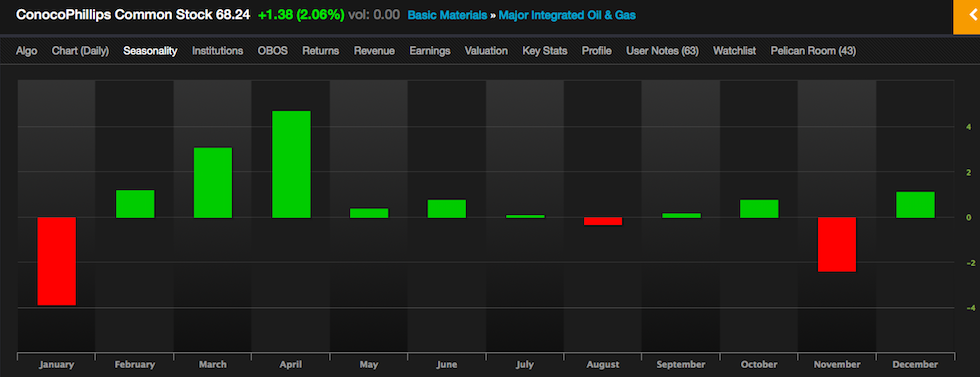
These are the seasonal returns for the oil and gas drilling sector and also COP, which is a great representation for all of crude. Behold as the secrets of the crude trade are reviewed via simple data collection analysis via Exodus. If you only bought oil stocks in Feb and sold in May, your gains would be bountiful and your cock would be swinging very low indeed.

I know what you’re thinking: “this time is different.” But it’s not. The allure of buying at the highs is always strong and new suckers are minted every day. Have a look at the actual price of crude on a seasonal chart. Look how infantile this market is and how easy it is to predict.

This is child’s play. At the very latest, sell all of your crude stocks by June and don’t come back until late January. If you overstay your welcome, I look forward to seeing you fall victim to a Saudi Arabian saber angling sideways and strongly at your manlet neck.

Comments »

Morning Poppers (Orwellian Nonsense Edition)

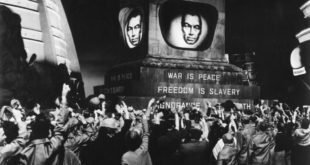
The ‘high level’ US trade delegation is back in the US and by the looks of the futures markets, people like what they see. The US demand is to reduce the US-China trade deficit by ~$200b by 2020, a very reasonable demand. On the other hand, China, in all of its grand fuckery, is demanding US airlines quit referring to Taiwan as a separate nation, which drew a most humorous rebuke from team Trump.

“This is Orwellian nonsense and part of a growing trend by the Chinese Communist party to impose its political views on American citizens and private companies,” Sanders said, adding that the Trump administration is calling on China “to stop threatening and coercing American carriers and citizens”.

Futures are +87, Nasdaq +35. More importantly, WTI is above $70. Quite frankly, and this goes without saying, it warms my heart to see the price of gasoline edging higher at the pump. I enjoy paying a higher fee because it means jobbies are being created in the shale territories, plus my good friend Putin is ballin’ like a mother-llama.

The dollar is sharply higher by 0.4% v the Euro. This should equate to carnage in the gold markets. Since I am long DUST, I look forward to that eventuality.

The only other news that caught my eye was Nestle paying SBUX $7.5b for the rights to sell their coffee products in stores. Considering the entire product line only does $2b in revenues per annum, one has to believe the good folks at Nestle are fucking retarded.

Also, MDLZ is buying Tate’s Cookies for $500m. Not a fan.

NOTE: CNBC launched the Buffett archives. Wow, great job.

Comments »

I Lost a Friend Yesterday — An Important Post About Loss and Addiction

Yesterday afternoon I was informed that a childhood friend of mine, one of my very best friends growing up, had taken his own life. The juxtaposition of this news against the backdrop of the beautifully catered party I was attending couldn’t be more drastic. There I was engorging myself with an array of delicacies and my good friend was gone — because of years of addiction, which led to the disintegration of both his body, mind, and his soul.

The first time I met him was in 2nd grade. It was the first day of school and he had just urinated all over himself and was crying because of his shame. The teacher consoled him and asked how she could make him feel better. He turned around from his first row seat and pointed to me in the back and said “I want to sit next to him.” From that day on, we became best friends. His parents always sheltered him and never let him outside. He once reminded me of a story I had forgotten about how I freed him from his parental captivity.

One day I visited his apartment, which I did at least 5 times per week and grabbed him and looked at his Mother and said ‘we’re going out.’ His Mother turned to us and said, ‘wait just a second. He can’t go out.’ And I said, ‘I am taking him out to play with us and there’s nothing more to be said’ and we walked out. He always liked to tell that story and it made me feel good that he remembered me so fondly.

When we were 11 years old, we became obsessed with ninjas, to the point where we dressed up like them and even made Chinese stars out of wood and ran around the neighborhood hitting other kids with our swords, which were stickball bats. To make a dashing escape, we’d light a smoke bomb and kindly ask our enemies to wait the allotted time for the smoke to disseminate before we disappeared into the thin air. We even went to school dressed like ninjas one day, much to the chagrin of our principal.

In our early teens, we used to chase down girls and he always thought every one was in love with him. It could be 10 of us in a group and one girl glancing over at us and he’d say ‘look, she’s checking me out. She wants me.’ And we’d say, ‘how the fuck do you know that — there’s 10 of us here?’ Then he’d reply with a smirk, ‘trust me, she wants me.’

When the neighborhood got bad, his parents moved him to upstate NY. One of the funnier moments I can remember when we visited him up there was when one of our friends was sleeping, he said ‘watch this’ and proceeded to place a hot sauce bottle in his mouth with his zipper down. He nudged my friend awake, and immediately zipped up his pants and said ‘thanks bro, good looking out.’ Bear in mind, this sleeping teenager was a giant, maybe 6’3, 220lbs. He shot up and chased him down the hall, kicking couches out of the way like they were small toys. We quickly diffused it and told him it was a joke and only hot sauce and laughed until our stomachs hurt for a solid 20 minutes.

He was the type of person that everyone liked, easy going, funny, incredibly generous, and kind hearted. He was the life of every party.

Years later when I was starting out in the business and enjoying some success, I hired him to work under me as a stockbroker. We had great times — because he was always adventurous and brave enough to go for the kill. At one point he became slightly obsessed with the movie American Psycho, which spilled into his demeanor at work. After seeing the movie, we both went to the local print shop to upgrade our business cards, in order to attain supremacy over the other plebs at the office. One time during lunch, someone made the egregious error of complimenting him for his dashing navy suit, and actually touched his right shoulder to get a better feel for the high thread fabric. Channeling Patrick Bateman, he looked at this gent dead panned and said ‘the suit, look, but don’t touch’. We then laughed to tears, from the harrowing expression on the face of the poor man who merely wanted to pay a nice compliment.

We had big dreams of making it big on Wall Street, our kids playing together, and growing old with an empire underneath us. He looked up to me like an older brother, always eager to learn and follow in my footsteps; but after the market had crashed in 2001-2002, and the bills started to pile up, he couldn’t stay in a commission only business much longer and he quit the business in favor of a salaried job.

My wife and I used to take the kids and visit him during his summer BBQ’s, which were attended by all of the people who loved him. He’d meet people on the bus and take them home to dinner on the same night. I thought he was crazy for doing that; but he loved to meet new people and really get to know them, not just superficially.

When I moved into my Staten Island home in 2003, he helped me lug my furniture out from Brooklyn, and even drove the truck for me. All he wanted was a few beers and some laughs. When I needed a new bannister sanded and stained, he came over and showed me how to do it. He was a good man and could be trusted with things, but he also had this burning desire to fit in, which I believe was the nascency of his downfall.

I used to compare him to a chameleon — because he’d mimic whoever he was around. When with me, he was Mr. Professional stockbroker. When with losers at a strip club, he acted like them, and so on and so forth. He started smoking weed at any early age, which was encouraged by his parents. We always felt that was a super cool thing, being able to smoke pot with Dad — but with the benefit of hindsight and some years of maturity, I know now it was dysfunctional.

He’d ‘party’ on occasion, dabbling with cocaine, and it got to the point that by 2006 I didn’t want to bring my kids around him anymore. We kept in touch by phone and I was pleased to find out he entered a new career and enjoyed varying degrees of success. With his new found money, he bought a modest home in NJ, a few cars, and a boat. He was very proud of his possessions and his family, and was always entertaining, cooking steaks and lobsters for his guests, denying his 3 children nothing. Then out of the blue, sometime around 2009, he got fired from his high paying job and had to find a new one. Resilient and always up for a fight, my friend hit the pavement and found a new gig within a month. It didn’t pay as much, but it was a job and he was glad to have it.

Money was always a struggle for him, partly due to lack of income, but mostly because he enjoyed to spend whatever he made. He was a pleaser and he really liked to throw big parties.

In 2014, like a complete maniac, he was speeding out of his companies parking lot, and crashed into a car backing out. The subsequent result of this accident led to a serious back injury, which required surgery, and a prescription for oxycontin. The details of what transpired from 2014 until now are somewhat murky to me, mainly because I had not been in contact with him much. But from what I’ve gathered, the injury led to an opioid addiction, which led to him losing his job, his house, his wife and kids, and eventually his life.

When money ran out, he was asking all of his friends for loans, myself included, which were denied because everyone thought the money would be used for drugs. I’m very good friends with his wife’s brother and knew the issues he was battling, but I never reached out because I felt he needed tough love. Everyone struggles and who the hell was he to deserve special treatment? He needed to wake up from his slumber, get back to work, and provide for his family.

His Facebook timeline is the saddest thing a person could ever see — the slow, but subtle, degradation of a once proud and handsome man — reduced to an avatar of his former self.

The last time he asked me for money was in a text and it read something along the lines of ‘hey Fly, I hope all is well with you and your family. I hate to ask this from you — but I really need to borrow some money. I am getting a job in a few weeks and I’ll pay it back. I want to show my children that I can provide for them, pay some bills, and put some food on the table. I love you man.’

At the time my Mother was undergoing open heart surgery and I was in a panicked state for her health. I asked his wife’s brother if any of this was true and he told me it wasn’t — he was merely using this lie to get money for drugs. I can’t say for sure if he was lying or not, but I denied him the loan and said sorry.

On a side note, for those of you who read my books, he was my cold caller named Eric.

About a year ago, he reached out to my former partner and said he was going to kill himself. He said that he had a gun and was in the woods and didn’t want to live anymore. My former partner contacted me and I immediately tried calling him, but my calls were rejected. He instead texted me and we had a sincere back and forth and he told me he wasn’t going to do it. He explained how losing his family was the hardest thing to deal with and that life wasn’t worth living anymore. I replied with the typical platitudes, telling him how much his kids needed him to be strong — not only for clothes and food, but also to be a role model for them.

His Facebook posts have been scarce the past year and the only photos he posted depicted a person I didn’t recognize. My friends told me he had been trying to borrow money for years and that suicide was regularly discussed and one of his very best friends felt he was a lost cause.

Yesterday, on a beautiful spring day in New Jersey, he took his life in a quiet park by strangulation. I can’t help but to feel like I failed him when he needed help most. It’s hard to say, especially since I’ve been a hermit for nearly a decade now. But the signs were everywhere and he was never entered into a drug rehab program, or provided with the level of care a person in his condition required. Instead, he was treated like a malcontent and whisked away.

His favorite foods were filet mignon, lobsters, and carrots with ranch dressing. He sucked at sports and threw like a girl. He loved motorcycles, skateboards, and being outdoors with his boys and dogs. He considered his daughter a princess and wanted only the best for her. He was misguided and too eager to please. In the end, his addiction to opioids led to a nightmarish life and a bad heroin addiction, and his pride didn’t allow the two to coexist.

If by chance you’re reading this my friend, I am sorry for the way things ended and I hope you find the peace in death that you couldn’t find in life.

Comments »

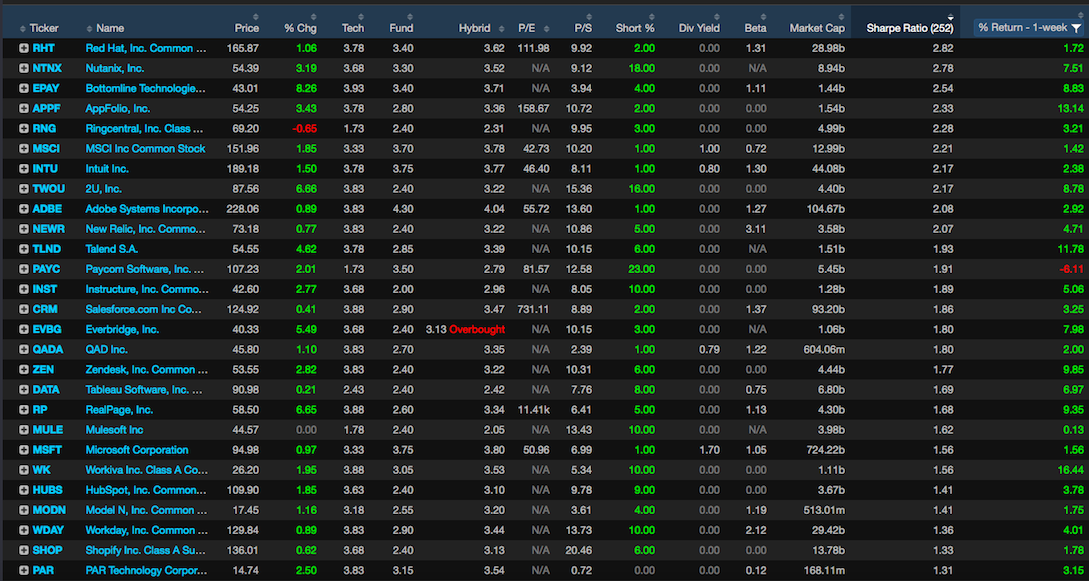
Application Software Stocks, Ranked by Sharpe Ratio

This is so an under talked about sector that is crushing the market for the past year. I have my excuses, as I was scarred for life in some of these stocks during my Great Apocalyptic Collapse, via the Horsemen of Death, circa 2014. It was a period in time that I dove in sideways and came out mangled like a pretzel, with gargantuan, larger than life, losses in DATA, SPLK, FEYE, and WDAY.

Ever since then, the sector has done quite good and have made plenty of people rich. What’s your excuse for ignoring the sector — too stupid to figure it all out, or too lazy?

Tell me, I’m so interested.

Off to a derby party.

Comments »

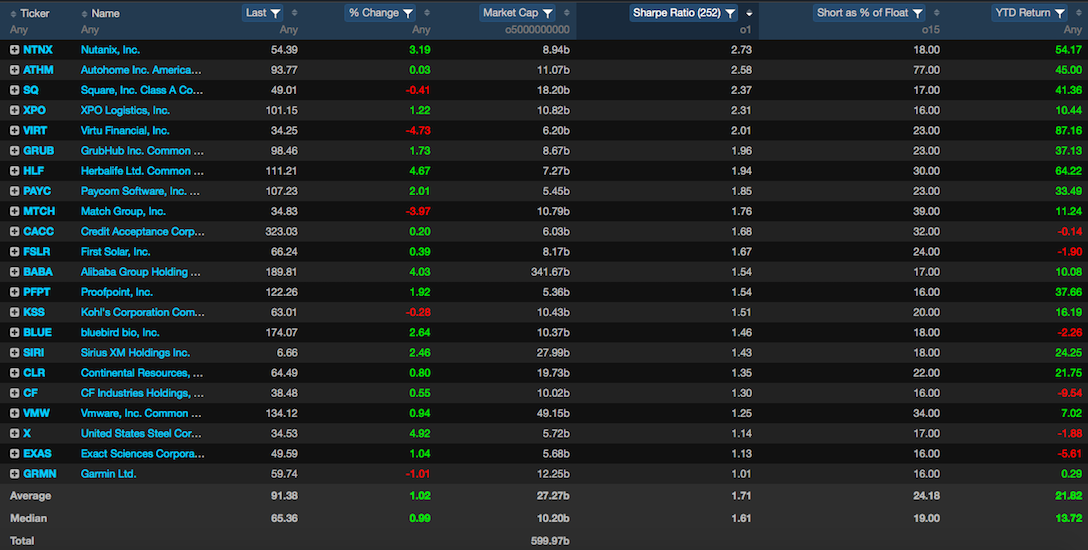
Year to Date Fact: Buying Heavily Shorted Stocks with High Sharpe Ratios Performs Best

I love modeling. The quant strategy in Exodus is based off a model I discovered. Members are more than welcomed to create their own models. Tonight I was reading Elon Musk talking EXTREME shit on Twitter, warning shorts of a terrible carnage.

This is ridiculous.

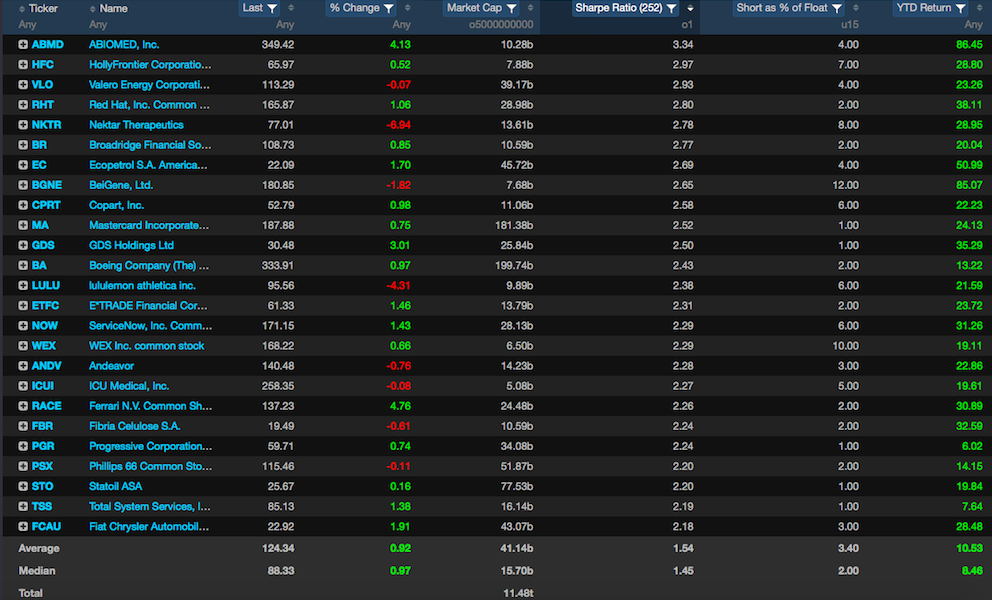
So I started to run some cursory short screens, coupled with our new Sharpe ratio tool and found that stocks that are heavily shorted, with market caps larger than $5b, outperforms that market — bigly. You can dial down the market cap and fiddle with different metrics to find the best combination. While all of this is backwards looking, in my experience trending markets following a neatly knit narrative most of the time, which is why using a quantitative strategy makes so much sense.

Comments »

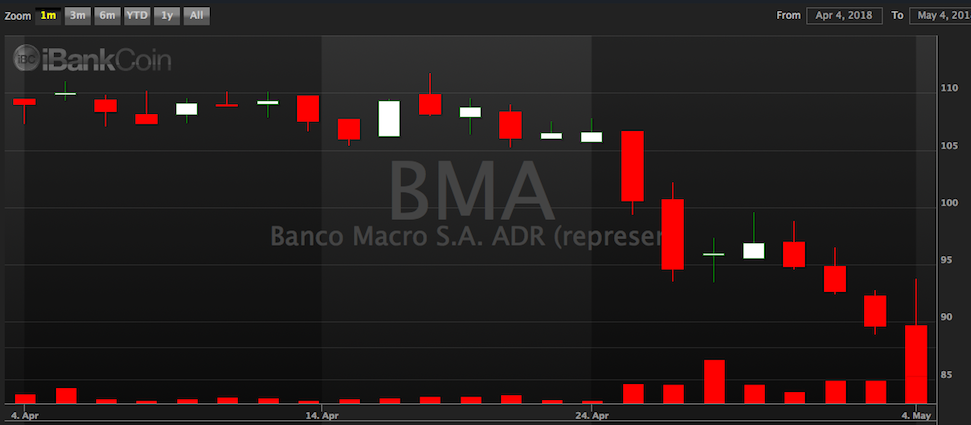
ARGENTINA IS COLLAPSING — RAISES INTEREST RATES TO 40%

This is not a drill. America better build that wall, for all of S. America is on the brink of destruction.

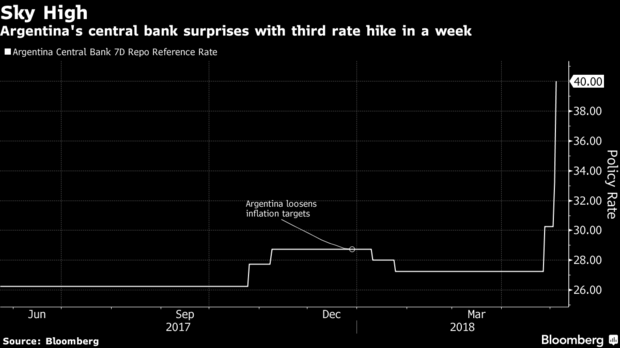
On Friday, the bank hiked rates to 40% from 33.25%, a day after they were raised from 30.25%. A week ago, they were raised from 27.25%.

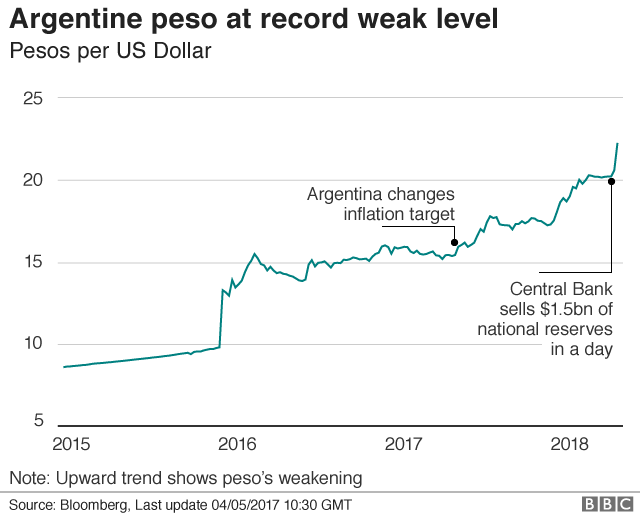
The rises are aimed at supporting the peso, which has lost a quarter of its value over the past year.

Analysts say the crisis is escalating and looks set to continue.

Argentina is in the middle of a pro-market economic reform programme under President Mauricio Macri, who is seeking to reverse years of protectionism and high government spending under his predecessor, Cristina Fernandez de Kirchner.

Inflation, a perennial problem in Argentina, was at 25% in 2017, the highest rate in Latin America except for Venezuela.

This year, the central bank has set an inflation target of 15% and has said it will continue to act to enforce it.

Argentinian pesos are literally toilet paper.

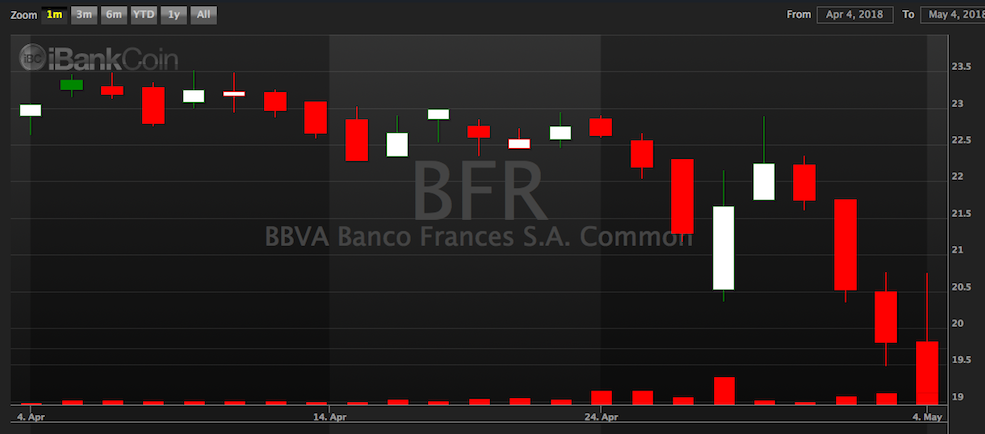
Best way to see the carnage is via two Argentinian banks traded here: BFR and BMA.

Just last year, Argentina issued 100 yr bonds.

The joint lead managers on this doozy was the usual suspects: BofA Merrill Lynch, Erste Group, Goldman Sachs International , NatWest Markets, and Société Générale CIB.

Comments »

BEHOLD THE POWER OF EXODUS — COME SEE “THE FLY’S” FUCKING SANDBOX

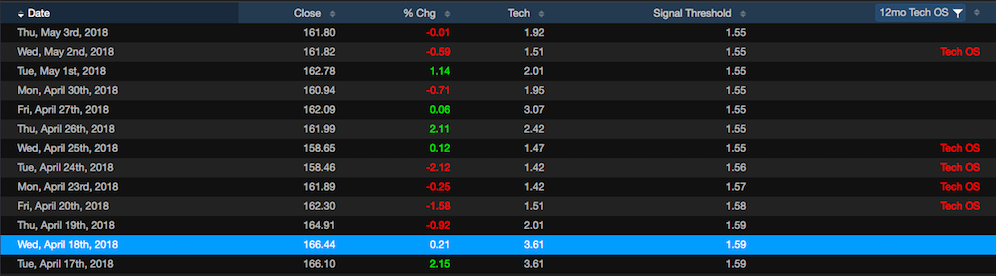
At the epicenter of the Exodus platform are mean reversion algorithms. For those new jacks on the site who are unfamiliar, it is a method of measuring stress points in the market, cross referencing it against historical movements, and then deducing some intelligence from it.

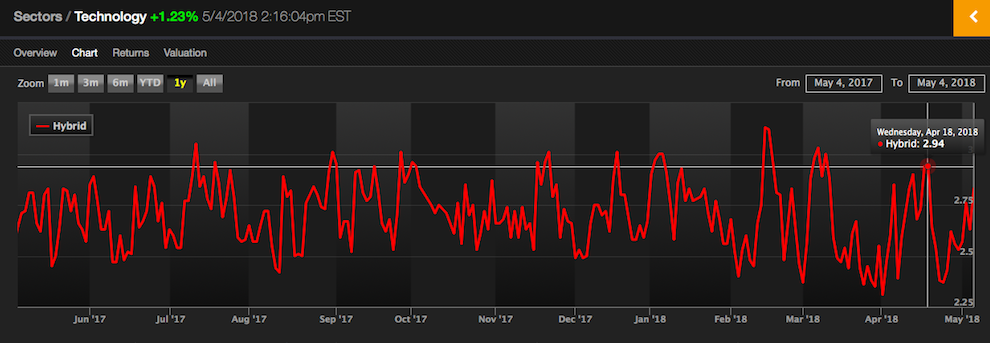
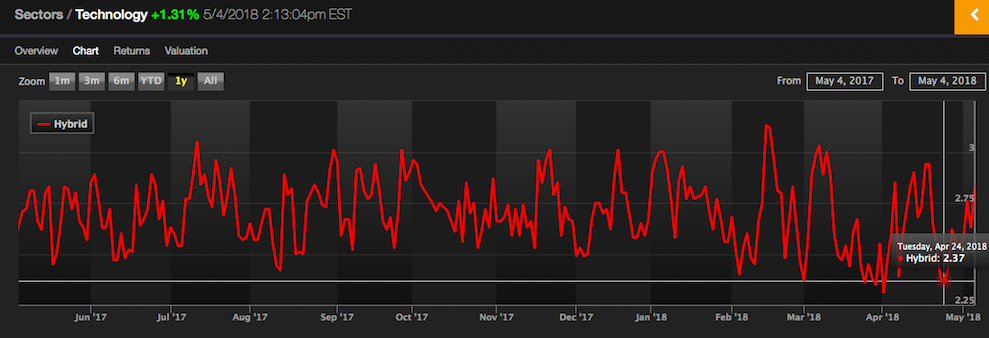
We do this for the overall market down to the individual stock. One of my favorite tools is the hybrid (cross between fundies and tech) oscillator that shows you the overbought/oversold condition of the sector. From this you can determine whether or not the sector is worth gambling on.

Quit kissing your teeth and BEHOLD what I’m about to show you.

For this demonstration, I am using the price action of QQQ and our tech oscillator. On April 18th, 2018, the QQQ was trading $166, a short term top clearly demonstrated by the chart below. If you saw this on the 18th, you might’ve lightened up or at least held off on any new purchases, yes?

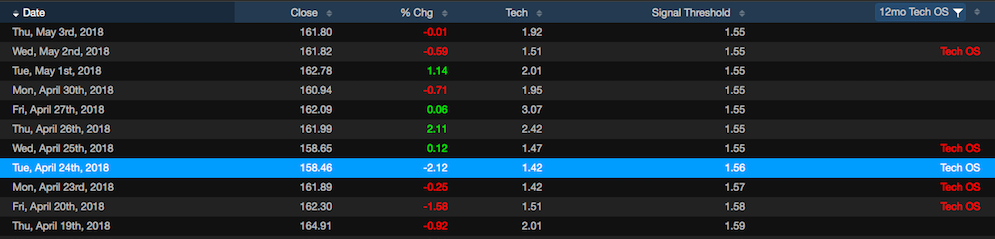
Now for the bottom.

On April 24th, 2018, stocks were sucking dick and the QQQ was knifing lower, trading $158. Look at the chart below you fucking FAGlord — that’s what you call SHOMP (sublime harmony of mathematical precision). None of you ham and eggers can come close to matching this shit here. That was a bottom and markets melted up from there.

Any questions?

Comments »

NOT RIGGED: Markets Green Bar All Day — Lift Off to the Fucking Stratosphere

What a stupid expression, ‘taking off to the fucking stratosphere’. What am I some rube from Brooklyn, intermingling the price of equities with physical atmosphere? There’s a lot of expressions that should be banned, such as ‘ciao’, or ‘bro’, or ‘having another case of the Mondays I see.’

Markets just legged higher all day…just because. There wasn’t a catalyst. Headlines imply the Buffett buying of Apple as a reason, but that’s poppycock. I suspect it has to do with Trump delegation in China. If those talks are successful, we’ll be off to the races on Monday.

Or, if they fail, we’ll all have a terrible case of the Mondays and might say ciao to any idea of gains. Know what I’m saying, bro?


Just green candles and shit, all day

My quant is +1.1% — but my active portfolio is flat — thanks to getting hemmed up nicely in SOXS. That shit is really nailing the ram to the fucking wall, if you know what I mean.

It’s a very clean rally, very nice, very good — with 75% of stocks higher. Only retail is soft for the day, and of course precious metals — because who needs them?

Comments »