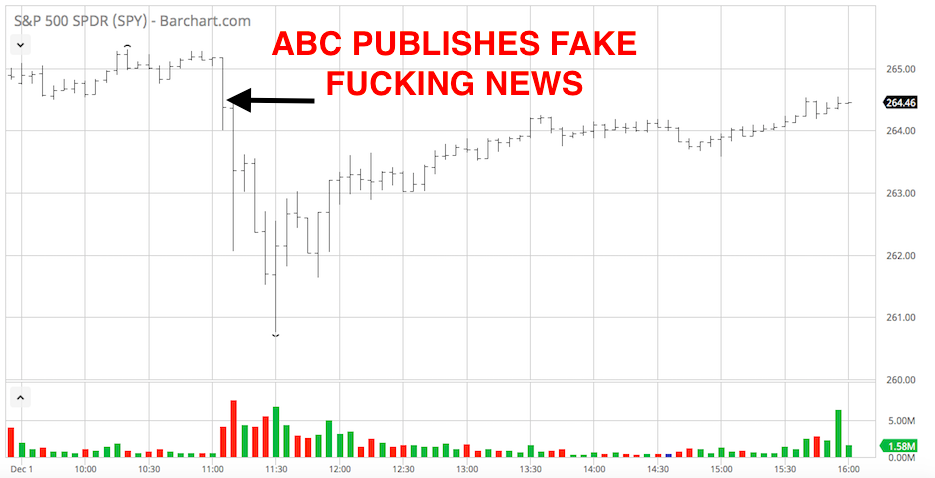

This is probably why the Nasdaq got smashed to fucking pieces yesterday and is indicated lower today. The tax bill is somewhat confusing — but here’s the gist of what’s going on and how it will hurt tech firms.
The Senate draft showed an AMT at 20%, not a repeal. Tech firms who get tax credits for IP, new equipment, and research and development would lose their potency, since the corporate tax rate would remain at the same level.
“The stock market, I think, is going to have a very big day based on the massive tax cut that we’re very much in the process of getting approved,” the president said Monday morning. The only thing that hurts share prices, Trump said, “is the fake news, and there’s plenty of that.”
A simple “drafting error” most likely left the AMT in the Senate bill at 20 percent, said Jennifer McCloskey, director of government affairs at the Information Technology Industry Council, a group that represents tech companies including Google, Oracle and Amazon. Congress should repeal the AMT completely or cut it to a level proportionate to the new 20 percent corporate tax rate, she said.
Under existing rules, every corporation must calculate its tax bill according to both the regular corporate income tax and the AMT, and pay whichever’s higher. With the AMT at 20 percent and the current corporate rate at 35 percent, most companies end up paying tax calculated at the higher regular corporate rate.
“As a policy matter, the AMT rate is supposed to be lower than the regular income tax rate,” said Neil Barr, head of the tax department at law firm Davis Polk & Wardwell LLP.
Backing the corporate AMT out of the Senate bill now would mean giving up roughly $40 billion worth of revenue over 10 years — an amount that’s not prohibitive in the context of legislation that’s estimated to cut federal revenue by roughly $1.4 trillion over a decade.
“It would be nice if we could figure out a way” to dump the tax in a House-Senate conference committee that will aim to merge the chambers’ differing versions into a final bill, said Senator John Thune, the chamber’s third-ranking Republican leader. Thune, of South Dakota, said lawmakers were analyzing the AMT’s impact on Monday.
By retaining the AMT companies would be prevented from using tax write-offs, as such tech stocks are under pressure.
Some believe the AMT will get eliminated in the final draft, since it doesn’t work with other elements of the bill.
Comments »Because the AMT “doesn’t seem to work with some core elements of the overall tax reform package, it can’t survive conference in its current form,” said Michael Mundaca, the co-leader of the Ernst & Young Americas Tax Center.
Keeping the AMT “eviscerates the impact of certain pro-growth policies like the R&D tax credit and exacerbates the international anti-abuse rules,” wrote the Chamber’s Harris.