
This article is a corollary that describes everything that is wrong with corporate America — caitiffs basing decisions on share prices gains instead of the safety and security of its employees. In a way, it’s indicative of a larger civilizational struggle, one that juxtaposes the people against the elite.
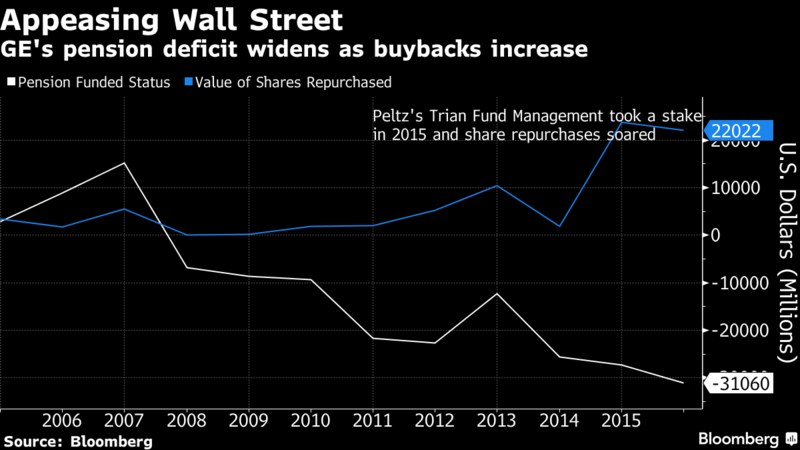
For years, the CEO of GE had been ignoring GE’s ballooning pension deficit. When the financial crisis hit in 2008, there was little Immelt could do, other than right the ship. But in the years following, he should’ve deleveraged the company. Unlike all of his peers, GE’s balance sheet is fucking screwed, sporting a pension hole of $31 billion — blown out by an astounding $45 billion in buybacks in order to fend off hedge fund activist Nelson Peltz.
What loser looks like
Over the past 5 years, GE’s stock price rose by 70%, which sounds great until you realize it underperformed the S&P by 30% over the same time period.
Due to the low interest rate environment, GE’s pension fund, similar to other funds, only measurably worse, performed dreadfully.
The $31 billion shortfall is the largest in the S&P 500, and 50% more than any other company in the country.
Why would Immelt do such a stupid thing? Because his compensation was tethered to how well the share price performed. He’s walking away with a retirement package upwards of $200m. During his tenure at the company, Immelt made upwards of $30m per annum and upwards of $300m during his time at the company — based upon three criteria.
Operating cash flow
Return on capital compared to peers
Money returns to Investors via Dividends and Buybacks
Stock price performance was also a key factor in triggering stock options. In other words, Immelt’s decision to waste $45 billion in company share buybacks directly correlated with the amount of money he’d receive in compensation. He had a vested interest in doing this, as opposed to ensuring that the pensions of the 300,000 employees of GE were secure. No one on the GE board challenged him; and as a result, the company is on track for their pension hole to swell to $50 billion over the next decade. If the market should ever go down, that pension hole will grow in an exponential manner.
Comments »