Subway’s prides themselves on serving the ‘freshest’ ingredients. The main question is, what exactly are in the ingredients?
According to DNA tests conducted by Trent University and the Canadian Broadcasting Corporation (CBC), Subway’s chicken fillets, found in their Oven Roasted Chicken sandwich, had just 53.6% chicken in it, while their sumptuous strips, found in their delicious Sweet Onion Chicken Teriyaki sandwich, contained only 42.8% chicken.
In case you’re wondering, the remainder of the ‘chicken’ substance is made from soy.
Subway’s Canada responded to the findings with the following statement.
“SUBWAY Canada cannot confirm the veracity of the results of the lab testing you had conducted,” the company said, adding, “Our chicken strips and oven roasted chicken contain 1% or less of soy protein. We use this ingredient in these products as a means to help stabilize the texture and moisture. All of our chicken items are made from 100% white meat chicken which is marinated, oven roasted and grilled.”
Related: CBC and Trent also tested the chicken from fast food chains, including A&W, McDonald’s, Tim Horton’s and Wendy’s — most of which contained 80-90% chicken.
Surprise, surprise. Do you mean to tell me that President Obama, the only former President since Woodrow Wilson who has decided to stay in DC after his term, is interfering with Trump’s administration? Some conspiracy theorists believe he has set up a ‘shadow government.’
President Trump thinks so, apparently.
“I think President Obama’s behind it, because his people are certainly behind it.” –@POTUS on some of the protests around the country pic.twitter.com/YC3SEAYFts
.@POTUS: We have hundreds of massive deals that are tied up with the EPA. Once Pruitt gets going, those projects are going to be freed up. pic.twitter.com/YoCNcPOrMJ
It looks like Target is having some pricing issues — as the welfare states of America bargain shop elsewhere. To remedy this, the company has announced a ‘new financial model’ and 12 new brands, investing in ‘lower gross margins’ to ensure competitiveness.
In other words, the company is very worried about the sales trends and have decided to retail items at lower prices — even though it hurts their margins.
What in the fuck is going on here?
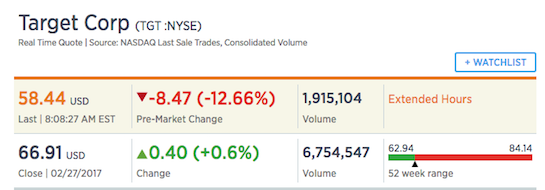
Shares are being menaced in the pre-market, off by 13%
Reports Q4 (Jan) earnings of $1.45 per share, excluding non-recurring items, $0.06 worse than the Capital IQ Consensus of $1.51; revenues fell 4.3% year/year to $20.69 bln vs the $20.69 bln Capital IQ Consensus, reflecting a 1.5 percent decline in comparable sales combined with the removal of pharmacy and clinic sales from this year’s results.
Comparable digital channel sales grew 34 percent and contributed 1.8 percentage points of comparable sales growth.
Segment earnings before interest expense and income taxes (EBIT), which is Target’s measure of segment profit, were $1,344 million in fourth quarter 2016, a decrease of 13.5 percent from $1,554 million in 2015. Fourth quarter EBITDA and EBIT margin rates were 9.5 percent and 6.5 percent, respectively, compared with 9.8 percent and 7.2 percent, respectively, in 2015.
Fourth quarter gross margin rate was 26.9 percent, compared with 27.9 percent in 2015, reflecting markdown pressure from promotional and clearance activity and costs associated with the mix shift between the Company’s store and digital channels, partially offset by the benefit of the sale of the Company’s pharmacy and clinic businesses, a favorable merchandise mix, and cost of goods savings.
Warned on Jan 18: Guided Q4 EPS $1.45-1.55 vs. $1.65 consensus; comps (1.5)-(1%).
Co issues downside guidance for Q1, sees EPS of $0.80-1.00, excluding non-recurring items, vs. $1.33 Capital IQ Consensus Estimate.
Co issues downside guidance for FY18, sees EPS of $3.80-4.20, excluding non-recurring items, vs. $5.33 Capital IQ Consensus Estimate.
Target’s 2017 guidance reflects the impact of the Company’s transition to a new financial model, which will be covered in the Company’s meeting with the financial community later today.
Under the current program, the Company invested $264 million in the fourth quarter, leaving ~$4.7 billion remaining under the current program at the end of the quarter.
“Our fourth quarter results reflect the impact of rapidly-changing consumer behavior, which drove very strong digital growth but unexpected softness in our stores,” said Brian Cornell, chairman and CEO of Target. “At our meeting with the financial community this morning, we will provide detail on the meaningful investments we’re making in our business and financial model which will position Target for long-term, sustainable growth in this new era in retail. We will accelerate our investments in a smart network of physical and digital assets as well as our exclusive and differentiated assortment, including the launch of more than 12 new brands, representing more than $10 billion of our sales, over the next two years. In addition, we will invest in lower gross margins to ensure we are clearly and competitively priced every day. While the transition to this new model will present headwinds to our sales and profit performance in the short term, we are confident that these changes will best-position Target for continued success over the long term.”
This will be the biggest challenge for developed nations over the next hundred years: depopulation.
Expect strange things to happen in the western world and developed nations in Asia over the next fifty years — marked by unusual foreign policy moves — and a craven, almost desperate clamoring for middle eastern, south american and african migrants to replace their withering and decadent societies.
Why?
Credit expansion, or at a minimum, stasis.
Due to one of the lowest birth rates in the world (1.5p per family), thanks to the one child policy, China is now considering offering incentives to its citizens to get out there and ‘screw for China’, a la Denmark.
Source: Reuters
The potential move was revealed by Wang Peian, vice-minister of the National Health and Family Planning Commission at a social welfare conference on Saturday, the newspaper said on Tuesday.
Birth rates rose to 17.86 million in 2016, the highest level since 2000, after the country issued new guidelines in late 2015 allowing all parents to have two children amid growing concerns over the costs of supporting an aging population.
“That fully met the expectations, but barriers still exist and must be addressed,” Wang was quoted as saying.
“To have a second child is the right of each family in China but affordability has become a bottleneck that undermines the decision.”
A poll conducted by the commission in 2015 found that 60 percent of families surveyed were reluctant to have a second baby largely due to financial constraints.
China’s birth rate, one of the world’s lowest, is fast becoming a worry for authorities, rather than the achievement it was considered at a time when the government feared over-population.
China began implementing its controversial “one-child policy” in the 1970s in order to limit population growth, but authorities are now concerned that the country’s dwindling workforce will not be able to support an increasingly aging population.
Elon Musk has been an outspoken advocate about depopulation and ‘population implosion’.
Watch:
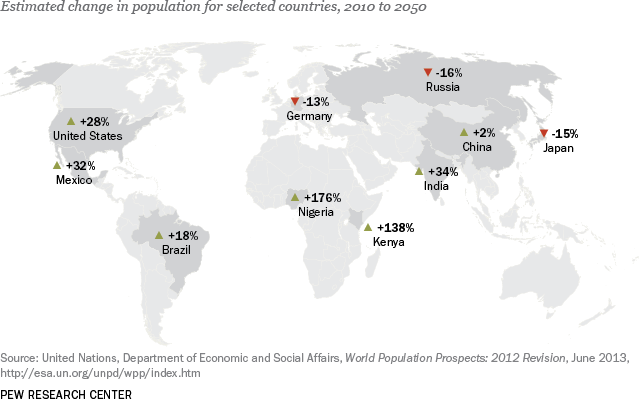
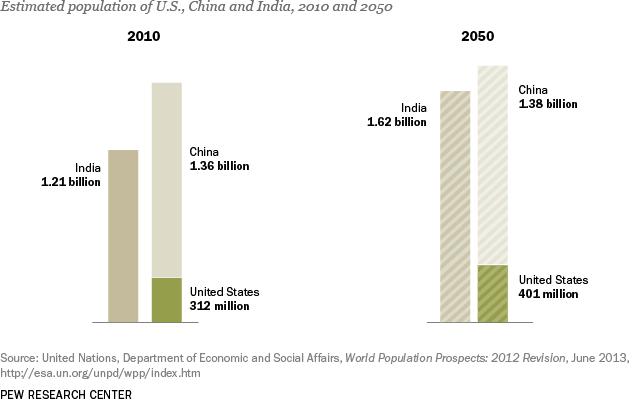
By 2050, India will surpass China in population — essentially leveling China’s population flat for the next 33 years.
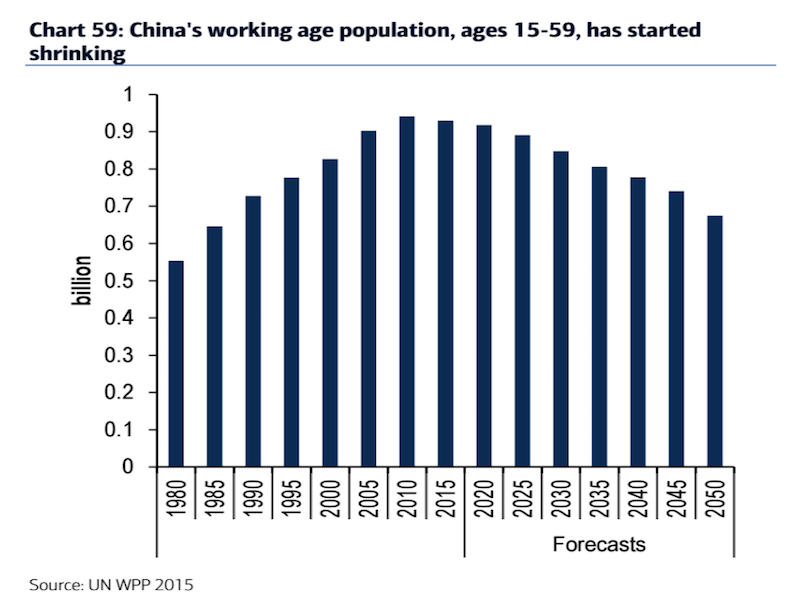
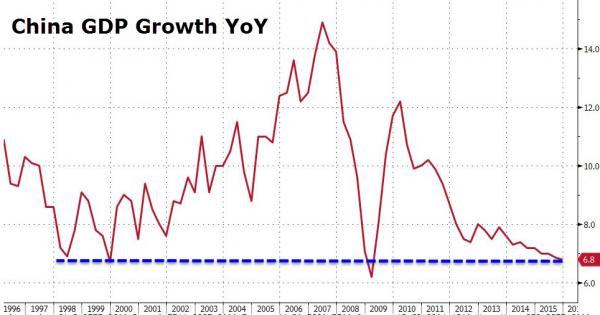
The deleterious effect upon China’s demographic trends was predicted by Brookings Institute in 2010 — saying its ‘dividend growth rate’ would erode to the point that by 2013 it would hamper economic growth. This is not only a Chinese problem, mind you, but a developed world problem. Both Japan and Italy is expected to lose half its population over the next 40 years — based on current trends. If this persists, what do you think this will do to global GDP?
Looks legit to me.
Source: Brookings Institute (2010)
By 2013 China’s demographic dividend growth rate will turn negative: That is, the growth rate of net consumers will exceed the growth rate of net producers. Starting in 2013, such a negative growth rate will reduce the country’s economic growth rate by at least half a percentage point per year. Between 2013 and 2050, China will not fare demographically much better than Japan or Taiwan, and will fare much worse than the United States and France.
As a result of China’s very low fertility over the past two decades, the abundance of young, inexpensive labor is soon to be history. The number of workers aged 20 to 29 will stay about the same for the next few years, but a precipitous drop will begin in the middle of the coming decade. Over a 10-year period, between 2016 and 2026, the size of the population in this age range will be reduced by about one-quarter, to 150 million from 200 million. For Chinese aged 20 to 24, that decline will come sooner and will be more drastic: Over the next decade, their number will be reduced by nearly 50 percent, to 68 million from 125 million.
Such a drastic decline in the young labor force will usher in, for the first time in recent Chinese history, successive shrinking cohorts of labor force entrants. It will also have profound consequences for labor productivity, since the youngest workers are the most recently educated and the most innovative.
As the young population declines, domestic demand for consumption may weaken as well, since young people are also the most active consumers of everything from wedding banquets to new cars and housing units. And because China is a major player in the global economy, the impact of the country’s demographic changes will not be limited by its borders.
Fragile families, fragile society
So far, observers of China’s demographic changes have focused most of their attention on consequences at the aggregate or societal level: the size of the labor force, of the elderly population, and of the number of men who will not be able to marry. Worries at this level of analysis generally relate to the country’s future economic growth and social stability. But the challenges that China will face as a result of its changing demographics go far beyond economic growth and other aggregate concerns.
China’s unprecedented population control policy, the one-child policy, turned 30 this year. It has forcefully altered the family and kin structure of hundreds of millions of Chinese families. And families, in addition to their other functions, are first and foremost the primary source of support for dependents, the young and the elderly.
Although the full extent of the one-child policy’s societal consequences will not be known until later, it is safe to predict that the social costs that China will need to pay, especially in terms of family support for aging parents, will be exceedingly high. In no small part due to implementation of the one-child policy, China by 2005 had accumulated nearly 160 million only children aged 0 to 30. That number has further grown in the past five years. These figures imply that over 40 percent of Chinese households have only one child.
More generally, ever more Chinese parents in the future will not be able to count on their children in their old age. And many parents will face a most unfortunate reality: outliving their children and therefore dying alone. Given the current mortality schedule, the likelihood that an 80-year-old Chinese man will see his 55-year-old son die before he does is 6 percent. Because women live longer, the likelihood that an 80-year-old woman will outlive her 55-year-old son is 17 percent.
Because of China’s continued mortality decline, and especially its sustained fertility decline to below replacement levels, the country has effectively entered an era of population decline.China’s current TFR of 1.5 implies that, in the long run, each future generation will be 25 percent smaller than the one preceding it. China’s population is still growing, albeit very slowly, because the country still has a relatively young age structure, which produces more births than deaths, even though on average each couple has fewer than two children. Had it not been for China’s relatively young age structure, the population would have begun declining in the early 1990s, almost two decades ago. The current growth, in other words, is a result of population momentum.
The same force of momentum will work in the opposite direction soon. Given current mortality and fertility rates, and with a population age structure that is growing increasingly older, the number of deaths will soon exceed the number of births. China’s population is likely to peak less than 15 years from now, below a maximum of 1.4 billion. After that will come a prolonged, even indefinite, population decline and a period of accelerated aging.
Even if China can restore fertility to replacement level within 10 years after the country reaches its population peak, population will still exhibit a decline nearly half a century long, with a net population loss of over 200 million, if not more. The median age of the Chinese population, at its peak, could be as high as 50 years.
China is by no means unique in experiencing below-replacement fertility. In the past decade, below-replacement fertility has become a new global reality. Whereas in some parts of the world high fertility rates continue to pose severe challenges to women and children’s health, for more than half of the world’s population, below replacement fertility is now the norm.
In Europe, North America, and East Asia, prolonged below-replacement fertility has already set in motion a negative population growth momentum.In the most extreme cases, such as Italy and Japan, population could be reduced by half in as few as 40 years or so if current rates of reproduction persist. A gradual but substantial reduction in population, especially with a concomitant aging of populations in the world’s richest countries, constitutes an unprecedented shift that is redefining the global demographic, economic, and political landscape.
What makes China unique, however, is that it still has a state policy, unique in human history, that restricts the majority of Chinese families to one child per couple. At the time the policy was announced 30 years ago, it provoked great controversy both within and outside China; over the years it has extracted great sacrifices from Chinese families and individuals, especially from women. And although the policy was designed as an emergency measure to slow down China’s population growth, and was intended to last for only one generation, the government has not yet shown the willingness, or courage, to phase it out.
China’s slow recognition and inaction in the face of its impending demographic crisis—inaction that persists despite appeals by almost all the country’s population experts to phase out the one child policy quickly—reflect policy makers’ lack of understanding of the changing demographic reality. Inertia also results from the resistance of the country’s birth-control bureaucracy, which formally employs half a million people.
This exemplifies a characteristic feature of China’s regime—relegating difficult, long-term, structural challenges to the back burner, while giving priority to short-term crisis management and concerns about stability. The looming demographic crisis will largely define China in the twenty-first century. Given that demographic changes take time to develop, and that their ramifications are not only massive but also long-lasting, China’s inaction has already proved costly—and will only grow more so the longer it persists.
For a moment there, people got to thinking David Seaman was suicided out — Ben Swann’d from the internets. Searching through the darkest corners of the internets were people proclaiming that he was ‘as dead as Julian Assange’ and that any video of him would simply be a Spielberg moment of CGI excellence.
Well, apparently, straight from the studios of Dreamworks Animation, I give you David Seaman, professional Pizzagate investigator — man solely interested in seeing fuckers getting a fair trial — and then fucking publicly hanged.
Quick question for you home gamers out there. What do you think of Pizzagate?
Jim Grant has been talking greasy for decades. I’m sure this ghoul, before putting on his obnoxious bow tie, eats human flesh for breakfast.
Now I’ve listened to what this guy had to say for a long time, most of which was comprehensible and thoughtful. But calling the automobile lending area ‘a place of trouble’ is going too far — and it’s fucking ridiculous. I can’t let him get away with it any longer.
The gig is up, Grant.
Jim Grant, SAD!
Whilst markets are hitting record highs, he’s warning you, the loser glued to CNBC, of skyrocketing auto loan delinquency rates, +0.05% to 0.87%. He furthered his diatribe, all but casting a gloomy pall on the auto sector, an homage to detrimentality and the like, with the forbearance of a stoic winter owl — that used car prices had fallen by 6.5%!
JESUS FUCKING CHRIST.
Any idea how small 0.87% is in the big scheme of things?
To summarize today’s moribund day in the markets is to make note to the celebratory salutes inside the Pentagon right now — after President Trump announced a carte blanche $54b increase in defense spending — a 9% lift over the present budget. The ancillary result for markets has been a notable lift in defense shares — particularly those related to aviation.
Some of my favorite names include $LMT, $ATRO, $TGI and $RTN.
Overall, the Defense sector was higher by 1.4% — a pleasant respite for a sector up only 142% under Evil Obama’s last 5 years of unnecessary peace.
The basic gestalt is that drones and unnamed weapons are the way of the future. They can be controlled, absolutely, without apology. Naturally, these weapons systems pose an ‘extinction level threat’ to mankind — especially those who oppose the military-industrial power apparatus. But I’m sure by the time these systems are fully integrated, you’ll be an old man and won’t really give a shit about freedom anymore.
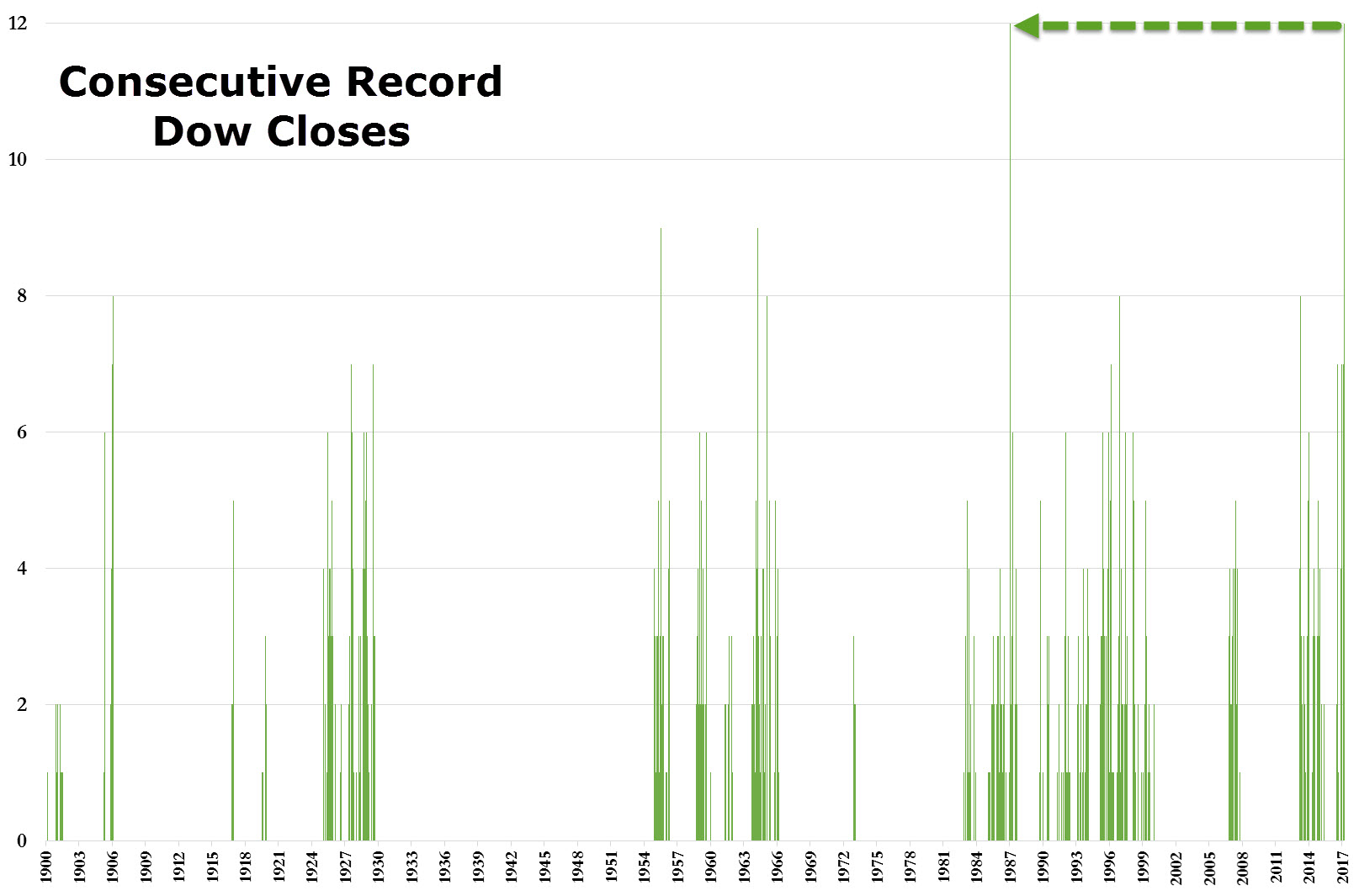
As for the meaningless Dow Jones streak, it’s now the longest on record — matching the one made in 1987 — the sublime year marked with rack and ruin.
Stolen from Zerohedge
As for me, it was a boring day, with mixed results. Shares of $TECK continue to head lower — while $CLR, $UEC and $URG raised my spirits. The nuclear sector is on fire today.
Stay tuned for your regularly scheduled dose of politics and world events during tonight’s iBankCoin content extravaganza.
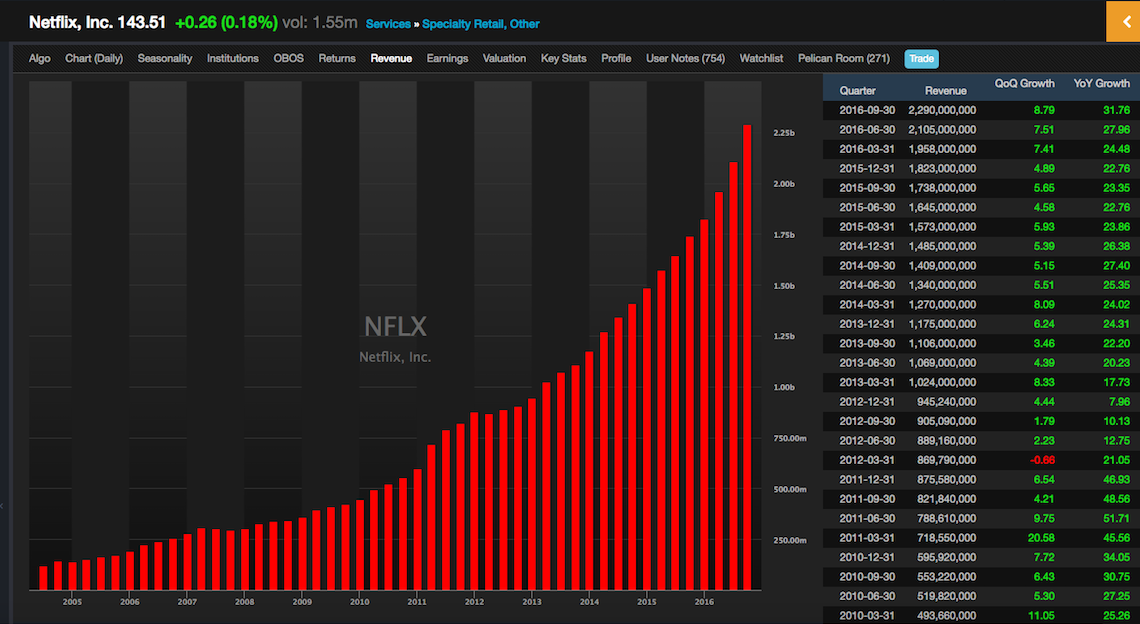
Before you pile on and say ‘fuck yeah, no one watches Netflix content’, take a look at this chart.
That’s a harmonious symphonic melody of uninterrupted growth. Pray tell me, how do you think that happened? Do you believe people enjoy watching 5 year old, stale, movies, or maybe the original content?
Enter Michael Pachter from America’s worst investment bank, Wedbush.
In the clip below, Michael takes exception with Netflix’s cash flow negative situation, concluding that the company is making investments that aren’t paying off on the balance sheet. Where have I heard this argument before? Oh, that’s right, $AMZN for the past 20 years.
While it’s true, the valuation for Netflix’s shares are extreme and perhaps a little rich, this Wedbush retard is making wild eyed assumptions without backing them up with facts. This is fake news, via bad investment bank.
The whole premise behind the story is subscription growth — which is directly buoyed by original content. You cannot have one without the other.
Another case of retard level thinking, courtesy of Wedbush.
The French Presidential elections are very reminiscent of this past American one — with an establishment shill running up against an anti-globalist muckraker. In this case, France’s Hillary Clinton is Macron, a former investment banker for Rothschild & Cie Banque, a man who believes ‘great migrations’ from the middle east into Europe are unstoppable and will continue to get worse — thanks to geopolitical events and GLOBAL WARMING (Jesus Christ).
He told the crowd: “We have entered a world of great migrations and we will have more and more of it.”
“In the coming decades we will have migrations from geopolitical conflicts that will continue to play, and we will have climate migrations because the planet is in a state of deep imbalance,” he said.
“France will not be able to stem it, and Europe will be affected immediately. We will see a migratory phenomenon far greater than what we have seen [with migrants from] Syria.”
According to recent ‘polls’, if Macron faced off against Le Pen today, he’d win by 21%. In other words, Le Pen is probably up by 5.
She’s taken exception to Macron’s ‘ultra-liberal’ ways and the media sycophantism.
“The media have chosen their candidate. They are campaigning hysterically for their darling.
“They take the moral high ground, pretend to only analyse the facts and then shout about the freedom of the press as soon as you criticise them,” she said to cheers.
Two new polls published Sunday showed Le Pen still winning the first round of the election on April 23 with 27 percent, but Macron closing the gap on her with 25 percent.
In the run-off vote set for May 7, despite her belief that Trump’s victory and Brexit point to a revival of nationalism and anti-elite movements like hers, Le Pen would lose by 20 points to Macron if it were held today, the polls suggested.
“Mr Macron went to Germany recently to express the admiration he had for their decision to welcome 1.5 million migrants,” she said, referring to Chancellor Angela Merkel’s open-door policy for refugees last year.
“French people can’t put up with mass immigration any more!” she said, again to cheers from the crowd waving French flags.
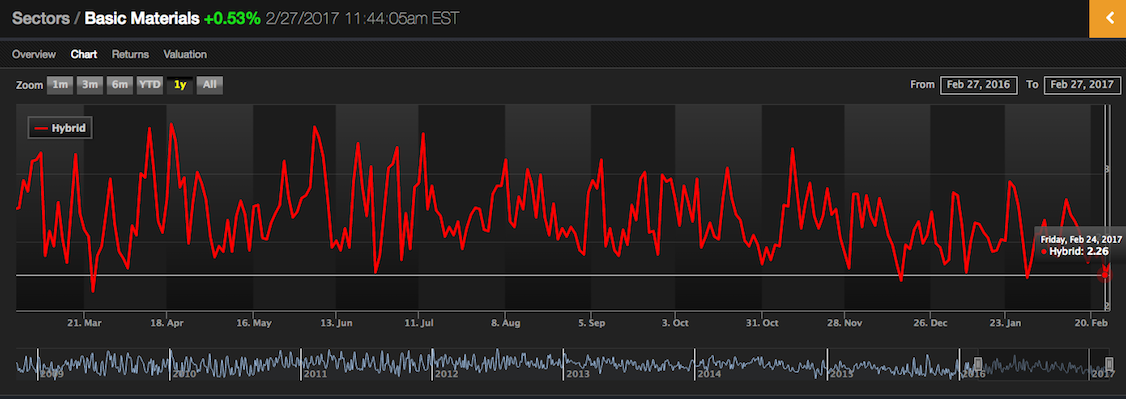
Our sector oscillator in Exodus is the mean of all the technical ranking scores of the underlying sector. In this case, we’re examing the basic materials, which encompasses everything from copper to gold to oil to chemicals. The chart is below and all instances of outlier events, based off the chart, are listed below — accompanied by the share price of $XME at the time of the event and 5 days afterward.
Based upon all events over the past year in basic materials, trading solely off Exodus yielded a 90% win rate — the last of which was just flagged on Friday.
2/24/17: 2.26
price $32.33
1/30/17: 2/24
price: $33.27 (5 days later) –> $34
1/09/17: 2.28
price: $31.37 (5 days later) –> $32.32
12/15/16: 2.22
price: $31.90 (5 days later) –> $31.07
11/29/16: 2.31
price: $30.99 (5 days later) –> $33.11
10/31/16: 2.34
price: $25.41 (5 days later) –> $26.43
7/5/16: 2.37
price: $24.41 (5 days later) –> $27.20
6/28/16: 2.28
price: $22.66 (5 days later) –> $25.06
4/5/16: 2.31
price: $19.98 (5 days later) –> $21.64
3/23/16: 2.14
price: $19.45 (5 days later) –> $20.29