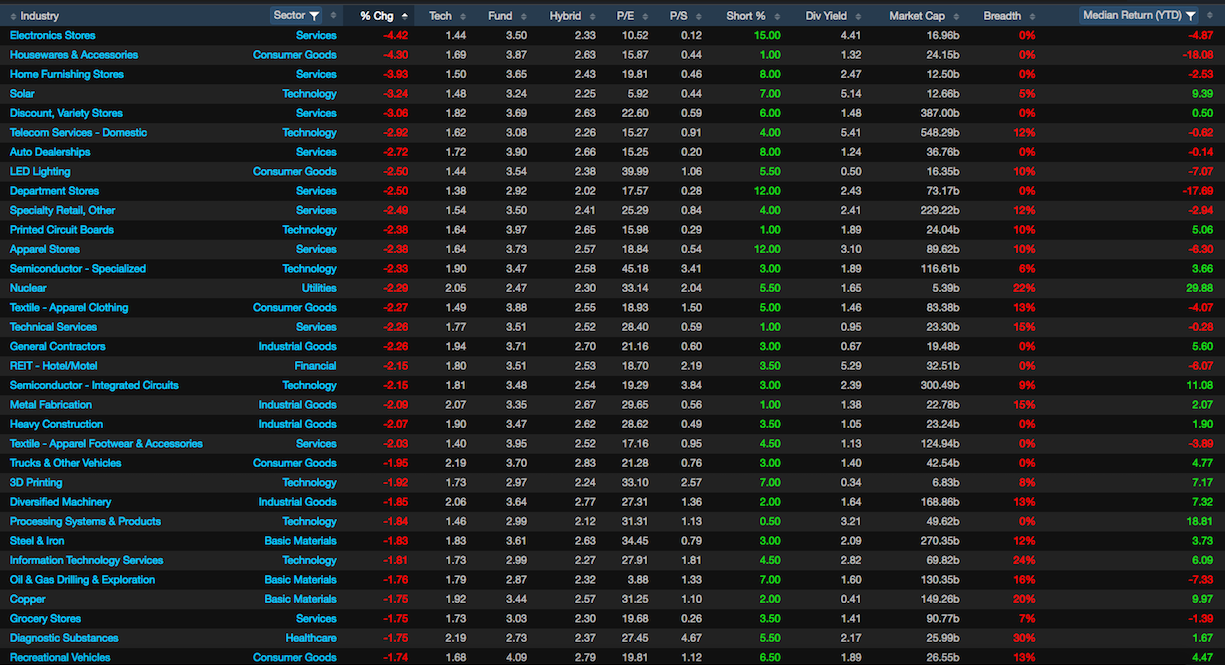
My portfolio was ripped apart to pieces today — as if rabid dogs had attacked a sack of meat dripping with blood. Boldly, I’ve tied my fate to the so called ‘Trump trade’, a gamble on the prospects of big government spending and a wanton relief of Obama’s absurdities.
At last glance, I was off by 2% at 160% long, or down by 3.2%.
The entire construct of Trump’s swag is on trial now — as the winter winds abate, so does the frost on the brain. Ergo, people are waiting for tangible action and results. Our do nothing republican congress has offered zero support for any of Trump’s policies — because they’re horrible people and shills.
Take a gander.
The highlight of my day was reveling in the agony of Amazon s3 users — down as the CIA updates their firmware into their cloud. Other than that, 75% of stocks were down — tentatively, ahead of tonight’s speech, which is sure to rattle a few cages and cause some people to undergo conniption fits.
A few years ago, iBankCoin was hosted at a big corporate data center. It was great, with lots of bells and whistles, but very little service and I wanted to have someone responsible for the site’s functionality. I switched over to a small firm and have been very happy since I’ve made the decision.
Today, Amazon’s s3 cloud corporate server farm is offline — taking with it a sundry of sites and apps — like Stocktwits, Amazon’s echo, Medium, Trello and many, many more.
If you’re having an issue logging onto a site, blame the fuckers from Amazon.
The corraling of sites into these corporate ghettos leaves the very fabric of the internet itself at risk. If you’re running a site and rely upon it as your sole source of income, reconsider the alluring marketing pages of Amazon’s AWS or GoDaddy and stay local instead.
The cloud never goes down, until it does, and then you’re fucked.
Populism and nationalism continues to spread the globe, like a wildflower amidst a field of shit. Any of you lads familiar with Geert Wilders? He’s been under 24hr surveillance for the past 13 years — ever since Van Gogh was stabbed to death in the streets of Netherlands for having an anti-muslim opinion. Wilders, a party leader in Netherlands, was thought to be next on the list for his views — which are fuck the EU, cease all Islamic hordes into Netherlands, ban all mosques and the koran wherever he might rule.
The Centre for European research gives Mr. Wilders an 80% chance of winning the March 15th elections. It is, however, unlikely that he can form a coalition and become Prime Minister. No one really knows what will happen once he wins.
It is abundantly clear that there is something happening in the world now, an anti-globalist, anti-multiculturalism movement — which is as old as humanity itself. It is normal for French people to take pride in their culture, just like it’s normal for southerners in the United States to celebrate General Lee’s birthday over a large serving of buttery grits.
As investors, none of these changes have made a single difference in the trajectory of markets. For a brief while, both BREXIT and the Trump win jarred markets — but soon quickly reverted to its fake ways and jimmy-rigged its way back upwards.
But what will happen when Geert wins and his dynamism spreads into France — further convincing the French people to become great again and to reject German hegemony via the EU by voting Le Pen?
For now, ABN Amro thinks Europe is mesmerized by Trump — ignoring the perils of EU disintegration.
Leave it to the French to dredge up unnecessary drama. Below is a clip of fuckery of the first order. Apparently, a police sniper’s rifle fired a round, injuring a waiter and a working attendant, one shot to the leg and the other in the ankle, while the President was trying to give a god damned speech.
It appears the policeman left his safety off and was probably snap chatting himself when the shot fired off into the help.
Enjoy.
A French police officer accidentally fires a shot during a speech by President Hollande, slightly injuring 2 people https://t.co/FE51fCWatq
Don’t even think about selling your stocks you fucking cave apes. We’ve got walls to build and toxic pipelines to lay down. Once the EPA is dismantled and Trump’s right wing goon squads hit the streets to take out the trash, America will be great again.
Also, the Mexicans will be financing mostly everything, while the Chinese will owe us bigly for permitting them to keep those fake islands in the south China sea.
Both silver and gold stocks are ripping higher — mostly by 3%, because panic. Second to that is the cleaning product space, with sexy names like $CLX, $DAR and $SCL. It’s a shoot yourselves in the face type of tape.
Bonds are higher and so are utilities. You get the picture.
Oil and gas stocks continue to get hammered, now down by almost 10% for the month. Mind you, this is an extremely oversold situation and will not stand for too much longer.
According to Exodus, the following stocks are oversold.
$TECK, $FSM, $CZZ, $PRTY, $HL, $DLB — amongst many others.
RELATED: Exodus is also flagging the euro, via $FXE, overbought. The track record for this signal is zero losses, 6 wins, over the past 6 months. Look for a dollar spike soon.
Aside from fake news revelations and how poorly the failing NY Times is doing, we should all be cognizant that certain sectors have already forecasted huge windfalls — which need to be fulfilled by the President, else they’ll be annihilated.
I know this is hard for many of you 75IQers to grasp, but stocks do trade on fundamentals, ultimately.
Banks: Need to hear about Dodd-Frank and big growth talk. The more shit Trump talks about America being great again, the higher $BAC will go.
Retail: The border tax idea will positively fuck retailers — since most of their crap is made overseas in slave factories. Any mention of China or Mexico will lower the market caps of $WMT, $GPS and $TGT appreciably.
Nuclear: I know some of you are worried about Trump getting his hands on the nuclear football codes, but that’s the least of your problems. We’re gonna have Saddam styled nuclear missile bomb parades, not before long — covered by the only news agency left in America: Breitbart.com. We want to hear about nuclear energy and the rebuilding of our nuclear arsenal. From what I’ve gathered, at present strength, we could only destroy the world 109 times over, sending the planet into an ice aged which would last 15,000 years. Clearly, this isn’t enough. We need MOAR. Look for moves in $UEC, $CCJ and $URG should Trump tout uranium.
Infrastructure: We want to hear about the wall and oil pipelines heading into the loyalist cesspool known as Canada. Also, we want to hear about superfluous things, like new bridges and airports, highways and tunnels. Bold words might help buoy the shares of $ATRO, $X, $FCX, $TECK and $HBM — amongst many others. But it’s important to note that this sector is already up big. The downside would be material should his infrastructure schemes be delayed.
Healthcare: Trump will defecate all over Obamacare tonight. It’s one of his favorite things to do, ever. Whether he has a better national plan remains to be seen. Personally, I rather miss the days when I’d pay just $1,200 per month for family insurance. I don’t think there’s any upside to the insurance companies involved here. If anything, look for big downside in big pharma and enterprising biotechs who’ve made a living off gouging the system. Names like $ENDP, $AGN, $GILD, $MNK and $VRX should be watched.
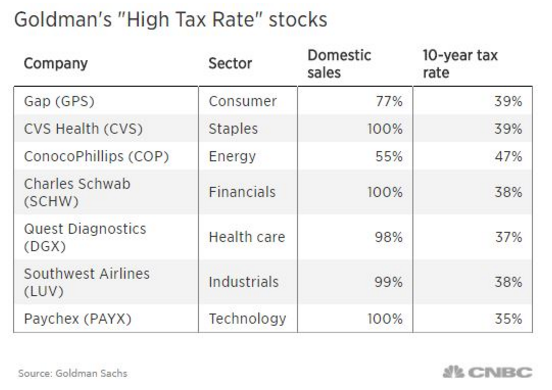
Additionally, we want to hear about lower tax rates — which helps almost all major companies. And, we want to hear about a tax holiday for money held overseas: repatriation.
According to Bloomberg, the following companies have the most cash overseas, as a percentage to their respective market caps.
$XRX, $MAT, $WU, $HPQ, $FSLR, $IR, $MUR, $WDC, $GLW, $HES
Subway’s prides themselves on serving the ‘freshest’ ingredients. The main question is, what exactly are in the ingredients?
According to DNA tests conducted by Trent University and the Canadian Broadcasting Corporation (CBC), Subway’s chicken fillets, found in their Oven Roasted Chicken sandwich, had just 53.6% chicken in it, while their sumptuous strips, found in their delicious Sweet Onion Chicken Teriyaki sandwich, contained only 42.8% chicken.
In case you’re wondering, the remainder of the ‘chicken’ substance is made from soy.
Subway’s Canada responded to the findings with the following statement.
“SUBWAY Canada cannot confirm the veracity of the results of the lab testing you had conducted,” the company said, adding, “Our chicken strips and oven roasted chicken contain 1% or less of soy protein. We use this ingredient in these products as a means to help stabilize the texture and moisture. All of our chicken items are made from 100% white meat chicken which is marinated, oven roasted and grilled.”
Related: CBC and Trent also tested the chicken from fast food chains, including A&W, McDonald’s, Tim Horton’s and Wendy’s — most of which contained 80-90% chicken.
Surprise, surprise. Do you mean to tell me that President Obama, the only former President since Woodrow Wilson who has decided to stay in DC after his term, is interfering with Trump’s administration? Some conspiracy theorists believe he has set up a ‘shadow government.’
President Trump thinks so, apparently.
“I think President Obama’s behind it, because his people are certainly behind it.” –@POTUS on some of the protests around the country pic.twitter.com/YC3SEAYFts
.@POTUS: We have hundreds of massive deals that are tied up with the EPA. Once Pruitt gets going, those projects are going to be freed up. pic.twitter.com/YoCNcPOrMJ
It looks like Target is having some pricing issues — as the welfare states of America bargain shop elsewhere. To remedy this, the company has announced a ‘new financial model’ and 12 new brands, investing in ‘lower gross margins’ to ensure competitiveness.
In other words, the company is very worried about the sales trends and have decided to retail items at lower prices — even though it hurts their margins.
What in the fuck is going on here?
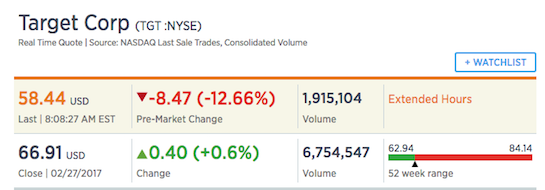
Shares are being menaced in the pre-market, off by 13%
Reports Q4 (Jan) earnings of $1.45 per share, excluding non-recurring items, $0.06 worse than the Capital IQ Consensus of $1.51; revenues fell 4.3% year/year to $20.69 bln vs the $20.69 bln Capital IQ Consensus, reflecting a 1.5 percent decline in comparable sales combined with the removal of pharmacy and clinic sales from this year’s results.
Comparable digital channel sales grew 34 percent and contributed 1.8 percentage points of comparable sales growth.
Segment earnings before interest expense and income taxes (EBIT), which is Target’s measure of segment profit, were $1,344 million in fourth quarter 2016, a decrease of 13.5 percent from $1,554 million in 2015. Fourth quarter EBITDA and EBIT margin rates were 9.5 percent and 6.5 percent, respectively, compared with 9.8 percent and 7.2 percent, respectively, in 2015.
Fourth quarter gross margin rate was 26.9 percent, compared with 27.9 percent in 2015, reflecting markdown pressure from promotional and clearance activity and costs associated with the mix shift between the Company’s store and digital channels, partially offset by the benefit of the sale of the Company’s pharmacy and clinic businesses, a favorable merchandise mix, and cost of goods savings.
Warned on Jan 18: Guided Q4 EPS $1.45-1.55 vs. $1.65 consensus; comps (1.5)-(1%).
Co issues downside guidance for Q1, sees EPS of $0.80-1.00, excluding non-recurring items, vs. $1.33 Capital IQ Consensus Estimate.
Co issues downside guidance for FY18, sees EPS of $3.80-4.20, excluding non-recurring items, vs. $5.33 Capital IQ Consensus Estimate.
Target’s 2017 guidance reflects the impact of the Company’s transition to a new financial model, which will be covered in the Company’s meeting with the financial community later today.
Under the current program, the Company invested $264 million in the fourth quarter, leaving ~$4.7 billion remaining under the current program at the end of the quarter.
“Our fourth quarter results reflect the impact of rapidly-changing consumer behavior, which drove very strong digital growth but unexpected softness in our stores,” said Brian Cornell, chairman and CEO of Target. “At our meeting with the financial community this morning, we will provide detail on the meaningful investments we’re making in our business and financial model which will position Target for long-term, sustainable growth in this new era in retail. We will accelerate our investments in a smart network of physical and digital assets as well as our exclusive and differentiated assortment, including the launch of more than 12 new brands, representing more than $10 billion of our sales, over the next two years. In addition, we will invest in lower gross margins to ensure we are clearly and competitively priced every day. While the transition to this new model will present headwinds to our sales and profit performance in the short term, we are confident that these changes will best-position Target for continued success over the long term.”
This will be the biggest challenge for developed nations over the next hundred years: depopulation.
Expect strange things to happen in the western world and developed nations in Asia over the next fifty years — marked by unusual foreign policy moves — and a craven, almost desperate clamoring for middle eastern, south american and african migrants to replace their withering and decadent societies.
Why?
Credit expansion, or at a minimum, stasis.
Due to one of the lowest birth rates in the world (1.5p per family), thanks to the one child policy, China is now considering offering incentives to its citizens to get out there and ‘screw for China’, a la Denmark.
Source: Reuters
The potential move was revealed by Wang Peian, vice-minister of the National Health and Family Planning Commission at a social welfare conference on Saturday, the newspaper said on Tuesday.
Birth rates rose to 17.86 million in 2016, the highest level since 2000, after the country issued new guidelines in late 2015 allowing all parents to have two children amid growing concerns over the costs of supporting an aging population.
“That fully met the expectations, but barriers still exist and must be addressed,” Wang was quoted as saying.
“To have a second child is the right of each family in China but affordability has become a bottleneck that undermines the decision.”
A poll conducted by the commission in 2015 found that 60 percent of families surveyed were reluctant to have a second baby largely due to financial constraints.
China’s birth rate, one of the world’s lowest, is fast becoming a worry for authorities, rather than the achievement it was considered at a time when the government feared over-population.
China began implementing its controversial “one-child policy” in the 1970s in order to limit population growth, but authorities are now concerned that the country’s dwindling workforce will not be able to support an increasingly aging population.
Elon Musk has been an outspoken advocate about depopulation and ‘population implosion’.
Watch:
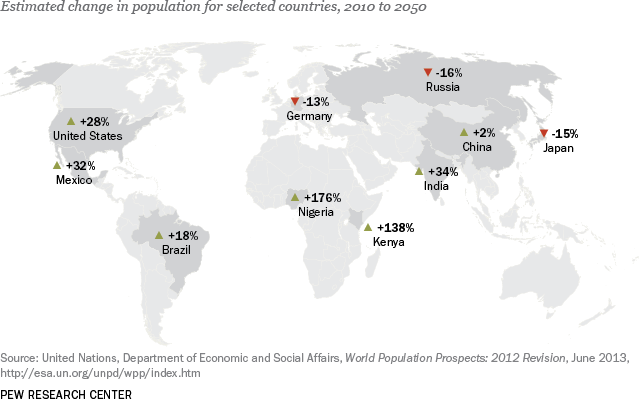
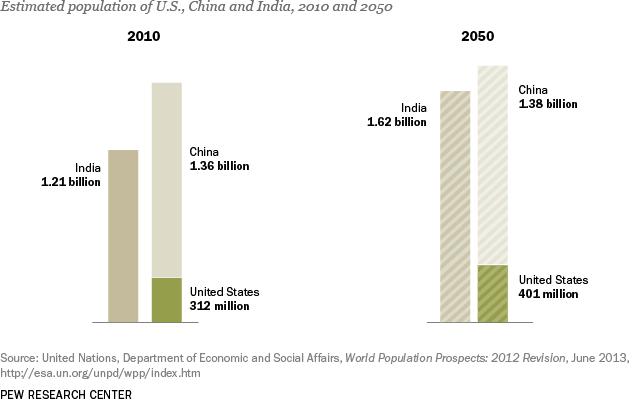
By 2050, India will surpass China in population — essentially leveling China’s population flat for the next 33 years.
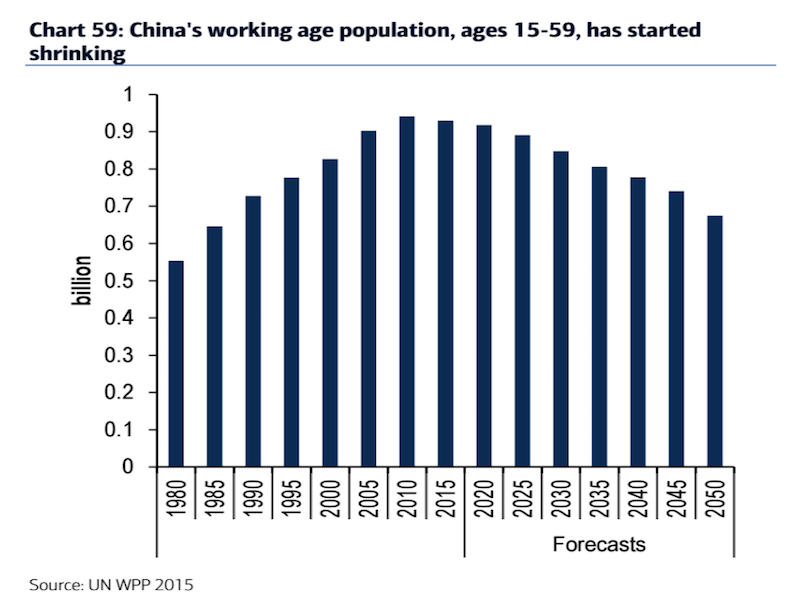
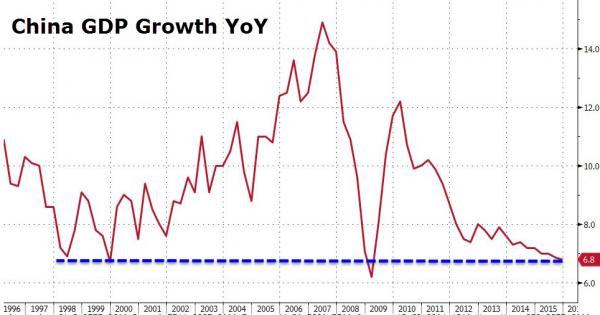
The deleterious effect upon China’s demographic trends was predicted by Brookings Institute in 2010 — saying its ‘dividend growth rate’ would erode to the point that by 2013 it would hamper economic growth. This is not only a Chinese problem, mind you, but a developed world problem. Both Japan and Italy is expected to lose half its population over the next 40 years — based on current trends. If this persists, what do you think this will do to global GDP?
Looks legit to me.
Source: Brookings Institute (2010)
By 2013 China’s demographic dividend growth rate will turn negative: That is, the growth rate of net consumers will exceed the growth rate of net producers. Starting in 2013, such a negative growth rate will reduce the country’s economic growth rate by at least half a percentage point per year. Between 2013 and 2050, China will not fare demographically much better than Japan or Taiwan, and will fare much worse than the United States and France.
As a result of China’s very low fertility over the past two decades, the abundance of young, inexpensive labor is soon to be history. The number of workers aged 20 to 29 will stay about the same for the next few years, but a precipitous drop will begin in the middle of the coming decade. Over a 10-year period, between 2016 and 2026, the size of the population in this age range will be reduced by about one-quarter, to 150 million from 200 million. For Chinese aged 20 to 24, that decline will come sooner and will be more drastic: Over the next decade, their number will be reduced by nearly 50 percent, to 68 million from 125 million.
Such a drastic decline in the young labor force will usher in, for the first time in recent Chinese history, successive shrinking cohorts of labor force entrants. It will also have profound consequences for labor productivity, since the youngest workers are the most recently educated and the most innovative.
As the young population declines, domestic demand for consumption may weaken as well, since young people are also the most active consumers of everything from wedding banquets to new cars and housing units. And because China is a major player in the global economy, the impact of the country’s demographic changes will not be limited by its borders.
Fragile families, fragile society
So far, observers of China’s demographic changes have focused most of their attention on consequences at the aggregate or societal level: the size of the labor force, of the elderly population, and of the number of men who will not be able to marry. Worries at this level of analysis generally relate to the country’s future economic growth and social stability. But the challenges that China will face as a result of its changing demographics go far beyond economic growth and other aggregate concerns.
China’s unprecedented population control policy, the one-child policy, turned 30 this year. It has forcefully altered the family and kin structure of hundreds of millions of Chinese families. And families, in addition to their other functions, are first and foremost the primary source of support for dependents, the young and the elderly.
Although the full extent of the one-child policy’s societal consequences will not be known until later, it is safe to predict that the social costs that China will need to pay, especially in terms of family support for aging parents, will be exceedingly high. In no small part due to implementation of the one-child policy, China by 2005 had accumulated nearly 160 million only children aged 0 to 30. That number has further grown in the past five years. These figures imply that over 40 percent of Chinese households have only one child.
More generally, ever more Chinese parents in the future will not be able to count on their children in their old age. And many parents will face a most unfortunate reality: outliving their children and therefore dying alone. Given the current mortality schedule, the likelihood that an 80-year-old Chinese man will see his 55-year-old son die before he does is 6 percent. Because women live longer, the likelihood that an 80-year-old woman will outlive her 55-year-old son is 17 percent.
Because of China’s continued mortality decline, and especially its sustained fertility decline to below replacement levels, the country has effectively entered an era of population decline.China’s current TFR of 1.5 implies that, in the long run, each future generation will be 25 percent smaller than the one preceding it. China’s population is still growing, albeit very slowly, because the country still has a relatively young age structure, which produces more births than deaths, even though on average each couple has fewer than two children. Had it not been for China’s relatively young age structure, the population would have begun declining in the early 1990s, almost two decades ago. The current growth, in other words, is a result of population momentum.
The same force of momentum will work in the opposite direction soon. Given current mortality and fertility rates, and with a population age structure that is growing increasingly older, the number of deaths will soon exceed the number of births. China’s population is likely to peak less than 15 years from now, below a maximum of 1.4 billion. After that will come a prolonged, even indefinite, population decline and a period of accelerated aging.
Even if China can restore fertility to replacement level within 10 years after the country reaches its population peak, population will still exhibit a decline nearly half a century long, with a net population loss of over 200 million, if not more. The median age of the Chinese population, at its peak, could be as high as 50 years.
China is by no means unique in experiencing below-replacement fertility. In the past decade, below-replacement fertility has become a new global reality. Whereas in some parts of the world high fertility rates continue to pose severe challenges to women and children’s health, for more than half of the world’s population, below replacement fertility is now the norm.
In Europe, North America, and East Asia, prolonged below-replacement fertility has already set in motion a negative population growth momentum.In the most extreme cases, such as Italy and Japan, population could be reduced by half in as few as 40 years or so if current rates of reproduction persist. A gradual but substantial reduction in population, especially with a concomitant aging of populations in the world’s richest countries, constitutes an unprecedented shift that is redefining the global demographic, economic, and political landscape.
What makes China unique, however, is that it still has a state policy, unique in human history, that restricts the majority of Chinese families to one child per couple. At the time the policy was announced 30 years ago, it provoked great controversy both within and outside China; over the years it has extracted great sacrifices from Chinese families and individuals, especially from women. And although the policy was designed as an emergency measure to slow down China’s population growth, and was intended to last for only one generation, the government has not yet shown the willingness, or courage, to phase it out.
China’s slow recognition and inaction in the face of its impending demographic crisis—inaction that persists despite appeals by almost all the country’s population experts to phase out the one child policy quickly—reflect policy makers’ lack of understanding of the changing demographic reality. Inertia also results from the resistance of the country’s birth-control bureaucracy, which formally employs half a million people.
This exemplifies a characteristic feature of China’s regime—relegating difficult, long-term, structural challenges to the back burner, while giving priority to short-term crisis management and concerns about stability. The looming demographic crisis will largely define China in the twenty-first century. Given that demographic changes take time to develop, and that their ramifications are not only massive but also long-lasting, China’s inaction has already proved costly—and will only grow more so the longer it persists.