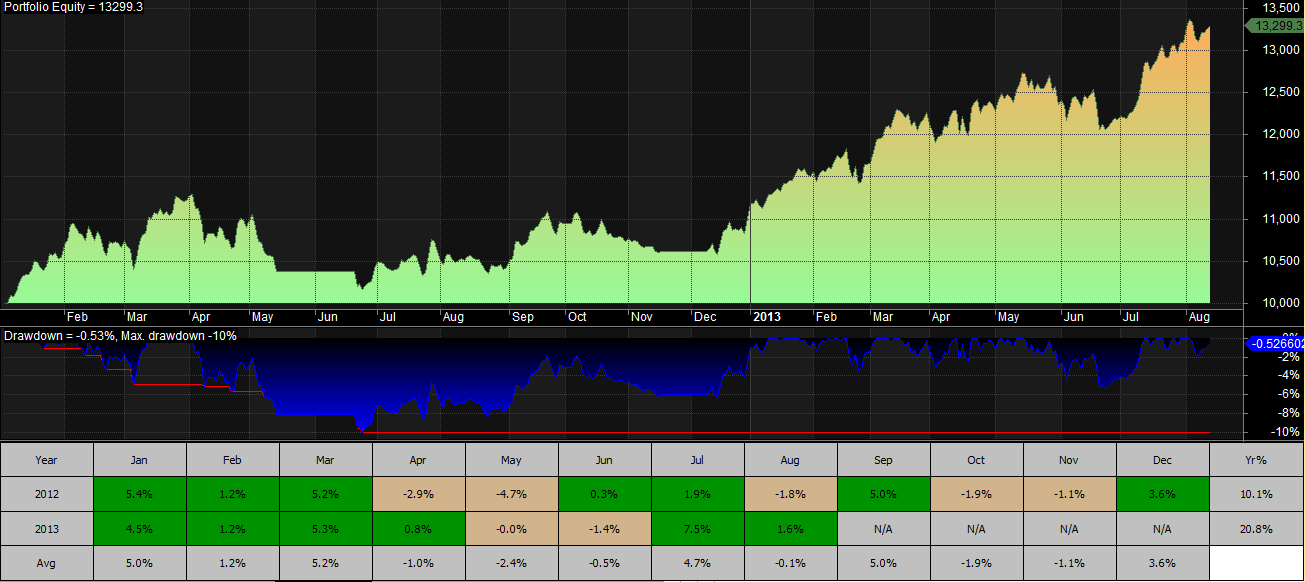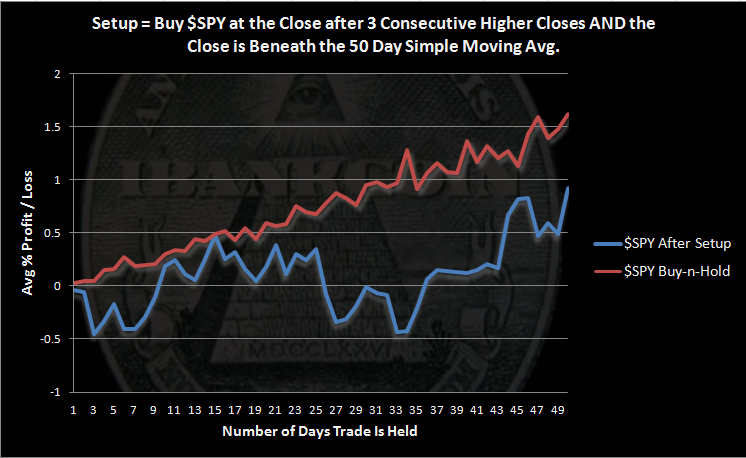

Faber’s Timing Model- Get Long at the Close
If you are a short-term trader and you aren’t familiar with Mebane Faber’s Timing Model, you are excused. However, if you manage your own 401K, or consider yourself a long-term investor more-so than a trader, you MUST read up on this timing model. I cannot over-emphasize the importance of it for the aforementioned types of investors.
Here are the rules, which cover 5 asset classes:
BUY RULE: Buy when monthly price > 10-month SMA.
SELL RULE: Sell and move to cash when monthly price < 10-month SMA.
- All entry and exit prices are on the day of the signal at the close. The model is only updated once a month on the last day of the month. Price fluctuations during the rest of the month are ignored.
Simple, right?
Since today is the last trading day of the month, I think we should pay attention to what the model is saying.
It is looking as if we are going to get a buy signal on US Stocks (tradeable with VTI) and Foreign Stocks (tradeable with VEU).
This will put the hypothetical portfolio 80% invested, (already being long 10 Year Gov’t Bonds and Real Estate) with Commodities still sitting on the sidelines.
As you were…
Respect the Major Moving Averages
Don’t worry about why the major moving averages work. We could stay up all night discussing it and still not arrive at absolute answers.
Often the markets are so deceptively simple that traders over-think things.
Just know that when the market is vacillating around the 50 day and 200 day moving averages, they have to be respected.
We are now looking at the 50 day average, currently at 108.42, for support. If this level holds, I believe the market will make another attempt at breaking above the 200 day moving average over the next 3-5 days.
Top Eight Short Setups – Best on the Interwebs
There are some pretty ones tonight! Remember that shorts are called shorts because they are meant to be quick trades.
Each symbol is linked to a Stockcharts chart, for your convenience.
Finally, I challenge you to find better short setups, anywhere on these interwebs.
1. PEI
2. MGM
3. BKD
4. SKX
5. SNDK
6. VCI (My personal favorite)
7. SHO
8. COLB
SPY Closes a Penny Beneath 200 Day Average
With the 200 day simple moving average delineating bear and bull markets, the SPY closed just a penny into bearish territory. However, the $SPX did close above its 200 day moving average.
The downtrend line (light blue) has been broken, and the upper Bollinger Band has turned upward. It is possible that we could be seeing the beginning of an extended move upward.
The lower four panes all show various measures of volatility. With all of them decreasing or stable, this environment would make it easier for the market to go on an extended run.
On the other hand, volume has decreased each day as the market has move upward, and the markets are likely to experience some resistance in the area of the 200 day average. Also, the June high is likely to provide some overhead resistance.
In the very short-term, I think the market has a day or two of steam left before there will be a pullback or consolidation. It will soon be time to look for short setups to catch a few days of weakness.
In the intermediate term, the market needs to clear these areas of resistance. Should it be able to trade above the 200 day average and take out the June high, we might be setting up for a late Summer rally that would take us to the area of the April high.
Using Volatility to Switch Between Follow Through and Mean Reversion Strategies
In Part 4 of this series, I revealed volatility to be the secret ingredient that drives performance of a follow-through and mean-reversion strategy. We now need to examine the affect of volatility on daily follow-through.
As discussed in Part 4, I will be starting with a fairly standard measure of Historic Volatility (HV), although I intend to substitute some other measures in the future. For you AmiBroker users who are playing along at home, here is the code:
HistVolPer=Param(“HistVolPer”,30,2,252,1);
HistVol= StDev(log(C/Ref(C,-1)),HistVolPer)*sqrt(252)*100;
Note that I have allowed the lookback parameter to be adjustable from 2 to 252 days. I also multiply the result by 100 just because I prefer it that way.
Identifying a threshold for 30 day HV is a bit of a subjective endeavor. There is likely a more scientific method, but for these initial tests, I just eyeballed it based on the chart below, and settled on 15 as the threshold. By threshold, I’m simply saying that anytime 30dHV is above 15, we will switch to daily mean-reversion (DMR) and anything less than 15 we will switch to daily follow-through (DFT). Please review part 1 if you are not sure what I mean when I refer to “daily mean-reversion” and “daily follow-through.”
The chart above shows 30dHV plotted beneath all of the SPY history.
To Be Clear…
When 30dHV is above 15, we will be using the DMR setup and when it is below 15 we will be using the DFT setup. This is the crux of this entire series. We want to know if volatility can help us know when to follow the market or trade against it.
To get the results, I ran the same tests as I used in Part 2 and Part 3 except that I added the code to account for 30dHV. Specifically, the DFT will not take trades unless 30dHV is below 15 and the DMR will not take trades unless 30dHV is above 15. I used all SPY history to test over which means testing started in 1993.
The Results:
The above chart simply compares the average trade of each strategy without and then with volatility switching. The asterisk denotes that the 30dHV threshold of 15 was applied.
Without exception, accounting for volatility improved the results.
At this point, I think it is important to highlight 2 things:
- Daily Follow-Through has not worked well at all since about 2000.
- Short selling, even with the superior DMR strategy, has not worked well at all.
Digging Deeper…
Let’s forget about short-selling, since it hasn’t worked very well with either DFT or DMR. We will focus on the long side. Using only long trades, let’s examine the relationship between DFT and 30dHV.
The graph below is for the SPY covering ~17 years. The graph shows what happens to the average % profit/loss when the DFT strategy is used with varying levels of 30dHV.
There were 1056 total trades made on the SPY with 522 of them made with 30dHV <= 15.
Summary:
I have shown that volatility affects the performance of a daily follow-through and daily mean-reversion strategy. We see clearly that volatility is not friendly to a daily follow-through strategy.
While we are now getting somewhere, these results lead to more questions such as the ones below:
- What is the affect of 30dHV on daily mean-reversion? At some point will DMR be hurt by extremely high levels of volatility? (I predict that it will be hurt when volatility gets too high, which means there might be a volatility “sweet spot” for daily mean-reversion).
- What happens when we adjust the lookback period for HV?
- What happens when volatility is rising or falling? How does that affect returns?
- What happens when we rank volatility instead of using raw figures?
I hope to answer these questions (and more) in the future.
Some Recent Power Dip Winning Trades
So far, every trade picked in July by The Power Dip System has been closed profitably.
Here is a look at some of the recent winners.
Every trade is opened at the open and closed at the close. The green up arrow shows the buy and the red down arrow shows the sell.
Subscribers are alerted to new buys and sells through email and through the website. Every afternoon at 3:30 subscribers are alerted with an email of any open positions that have exceeded their exit thresholds. Exit thresholds are updated every evening so that subscribers can sell their positions going into the next close, even if they miss the email, or the position exceeds the threshold after 3:30.
The Power Dip System is the quintessential swing trading system, as you will see from the closed trades below.
Part 4: The Secret Ingredient
Okay, okay, enough already. You all want the secret ingredient. The fact is that in Part 3, a couple of you, based on my hint (nice work guys), were able to guess what the secret ingredient is. But just in case you are just now picking up this series, you might want to start by reading Part 1 and Part 2.
The secret ingredient is volatility. I know, what a disappointment. You were probably hoping for some new indicator with a fancy name. The fact of the matter is that most of what makes a trader profitable in the market has already been discovered. It is simply learning how to use these things that makes the difference. I am here to help you learn how to use volatility, or at the very least, learn how it affects a stock (or market’s) ability to trend or mean-revert.
Volatility is going to be key in determining whether you should be looking for daily follow-through or daily mean-reversion.
Volatility can be measured in a variety of ways, but for the formal approach, here is the wikipedia link.
To keep things simple, I will be using a relatively standard formula for measuring historic volatility:
Historic Volatility = (Standard Deviation(log(Close/Yesterday’s Close))30)*SquareRoot(252)
In the above formula, 30 is equal to the length of the period at which we are looking back, and 252 is equal to the number of trading days in the year. 30 is adaptable meaning that to measure historic volatility we can look back at as little or as long a length of time as suits our purpose.
We could certainly use ATR to measure volatility, or TSI, as Danny and David Varadi have recently written about, and we would still only be scratching the surface. Jeff Pietsch from Market Rewind has a great article on this subject here where he ranks historic volatility rather than using a raw measure (or “fixed level analysis”, as he calls it).
I like to keep things simple in order to build a strong foundation of knowledge. Once the foundation is established, then we can get more complicated. (In the markets, always remember that more complex does not necessarily equal better.) Therefore, I will continue to use a raw measure of volatility applied to a basic measure of follow through (trendiness) or mean reversion. I trust that my readers will benefit from this bottom up approach.
Honestly, I’m tired this evening, so before I present the results of the tests using volatility to switch between daily-follow through and daily mean-reversion, I want to show a chart of SPY with 30 day historic volatility plotted beneath it. Examine it for the relationship between volatility, trendiness, and mean-reversion.
I promise that the next post will have some cool statistics.