iBankCoin
Home / 2015 (page 36)

Yearly Archives: 2015

What the Hell is This Shit?

One of my partners on the site hates when I cuss and rant on the headline title, as he likes to show friends and family the site. iBankCoin isn’t a family site. This isn’t Disneyworld. Speaking of which, one of my favorite attractions at Disney is the Tower of Terror, broken elevator pin action for the entire family to enjoy.

My sister is absolutely mortified of elevators. She actually opts out and climbs up stairs, like an ape. I’d love to get her into that Tower of Terror ride, so that I could video record her terror.

“The Fly” isn’t scared of anything, not even ruinous stock prices. I’m down 1.3% today, led by the fuckheads at COST. Retail is truly shit.

Do you what’s not shit?

Biotech.

Who could’ve figured that out, eh? The market rips through the fucking floor boards and the best performing sector, aside from gold, is biotech. If you tried to create a more diabolical tape, you could not. This is the perfect trap.

Pray pardon, keep sending money into your 401k plans, so that your local Blackrock fund managers can spread that shit, like creamed cheese, across the capital landscape.

LISTEN TO ME. The Option Addict is holding a 5 day clinic for those who missed out on the iBankCoin Conference. Actually, conference attendees are more than welcomed to join too, since lots of new material will be touched upon, as the markets have been making some big moves since then. The iBC Online conference will take place from November 16th to the 20th, each session lasting anywhere from 60-90 mins, all live.

ACT NOW

NOTE: Members of any iBC service will receive a 25% rebate.

Comments »

CRISIS EMERGES: ORANGE JUICE FUTURES SOAR

Filthy, Asian, bugs are to blame.

Just when you thought it was safe to head on over to the store for a box of orange’d juice, all of the fucking groves get destroyed and prices spike.

When will the inflation subside?

“The market is scrambling to find a new equilibrium price to reflect what’s happening on the ground,” Joe Nikruto, a senior market strategist at RJO Futures in Chicago, said in a telephone interview. “You may see speculators entering this market in anticipation that prices are going to go much higher.”

Futures have soared 35 percent from a three-year low of $1.0345 a pound on Sept. 29 as investors weighed slowed demand against declining output. Brazil is the world’s top orange-juice producer, followed by Florida.

No Solution

There’s no solution the citrus disease, which has caused billions of dollars in losses across Florida since 2005. By some estimates, “the industry needs to put more than 20 million trees in the ground over the next 10 years to support existing infrastructure and get production back to where it was” before greening, Michael W. Sparks, chief executive officer of Florida Citrus Mutual, the state’s biggest producer group, said in an e-mail on Friday.

The most “pessimistic” scenario in a recent study by the Florida Department of Citrus has the crop falling to 27 million boxes by 2026. A box weighs 90 pounds or 41 kilograms.

image

What else could be added? NO SOLUTION. Kiss your orange sliced dessert, at your local chinese restaurant, goodbye.

Comments »

Christmas Has Been Canceled For Wall Street’s Bankers

This is lost puppy, starving in the woods, sad.

Year-end compensation will be lower by 5 percent to 10 percent broadly throughout the financial services industry, the report said on Monday, with fixed-income traders experiencing an even larger drop as bond trading revenue continues to be weak.
Payouts to investment bankers who advise companies on mergers could rise 15 percent to 20 percent as the global market for dealmaking remains strong.

Compensation for debt traders, meanwhile, could fall as much as 20 percent from a year ago as doubts about Federal Reserve interest rate policy and China’s economic slowdown have negatively affected banks’ bottom lines.

Morgan Stanley said last quarter that bond trading revenue had fallen 42 percent, while Goldman Sachs Group Inc reported a 33 percent decline.

Investment bankers who help companies underwrite initial public offerings may experience a pay decline of 5 percent to 15 percent. Many companies have decided to stay private for longer amid choppy markets.

Banks are setting aside less money for pay. Goldman said it had earmarked 16 percent less money for compensation in the third quarter than it had for the same period last year. JPMorgan Chase & Co also said it had set aside 13 percent less money for compensation.

One could argue this is Fred Wilson’s fault too. Had Fred and his San Fransican friends not been so damn greedy, hoarding all of the cool, kick ass, tech companies in private holdings, our beloved Wall Street bankers could be making enough money to treat Tiny Tim and maybe even buy a nice turkey for the holidays.

Instead, Tiny “fucking” Tim is hobbling about the room, on the verge of death. Bankers are sad, without cocaine. All the while, Fred wilson and his San Franciscan friends get fatter (gluten free range, organically) and richer.

What is this world coming to?

Comments »

Citron Tweets About $MNK; Stock Craters

MNK is now down 17% after Citron fucking Tweeted that they had more downside than VRX, at these levels.

Pray tell, how does one have more downside than “the next Enron?”

It must be good to be a Citron gangster.

image

Citron’s tweet regarding MNK has erased more than $1.5 bill in market capitaliation in 5 minutes, now off by 22%.

Comments »

You Won’t Believe Which Sector is Bucking the Trend Today

You’ve got to be fucking kidding me. It’s like the market has an author and his name is Stephen King, the horror novel guy. If you told me a few weeks ago that stocks would knife lower by 200+ and biotech would be up, I’d think you were nuts. That’s exactly what’s transpiring today, the lowest probability trade is the imperial one. This is Murphy’s law 101: whatever could go wrong, will go wrong.

How does one prepare for a series of never-ending black swan events, low probability strategies that randomly changes directions for the ultimate “fuck you market”?

You don’t. Trading this mess requires space magic, Goldman Sachs branded crystal balls. If you’ve relegated your investments for long term holds, then this is simply vaudeville for you– a good, wretched show.

biotech

Comments »

STOCKS KICK DOWN THE GATES OF HELL AND MAKE THEMSELVES AT HOME

Eighty percent of stocks are lower today. What else more is there to say? I knew when I saw SHAK reverse Friday’s gains that all would be lost. It’s not so much that SHAK controls the world, in that, SHAK is a litmus test for risk. Despite a multitude of reasons to buy stocks, people are still panicked out over the specter of higher interest rates.

We can go through the motions and discuss how fucking idiotic the Fed is for wanting to raise rates, just so they could lower them later–“when they really need to.” But this whole cat and mouse game with the shorts is quixotic. There isn’t a debate here, or a back and forth about who’s winning.

Look, if you haven’t been long FANG (Facebook, Amazon, Netflix, Google), or something similar to them, you’ve been shining shoes for the past year, a giant sucker in a sea of suckers.

That’s the bad news.

The good news is Option Addict has caved into popular demand and will be doing a clinic for those who missed the iBC Conference. It will last for several days, one hour per day, touching on all of the salient points that he made then with some updates to reflect what the market has done since then. This is a great opportunity for those who couldn’t come to the event. Don’t miss it.

Comments »

Goldman Predicts the Future and There’s a Boatload of Money In It

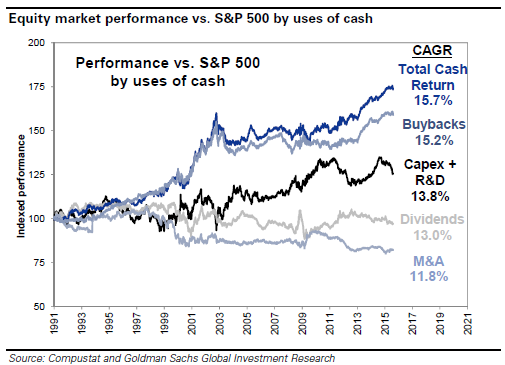
Goldman is out with a research note, of the crystal ball varietal–predicting US corporations will spend upwards of $2 trillion next year. They even bothered to tell us exactly how it might play out.

BEHOLD.

1. Capital expenditure, research and development
Goldman is calling for $650 billion in capex and $256 billion in R&D spending, reflecting growth of 1 percent and 5 percent respectively. The firm points out that the energy sector accounts for 30 percent of S&P 500 capex, which means “lower for longer” oil prices are weighing on capital spending. “Our forecast of a roughly $50 per barrel Brent crude price in 2016 and recently slashed spending budgets by both Chevron and Exxon suggest a further decline of 20 percent in energy capex during 2016,” the team says in the note. R&D is a different story, however, with energy only accounting for 2 percent of total S&P 500 R&D spending.

2. Mergers and acquisitions
After a blockbuster 2015, Goldman expects cash M&A spending to come in at $300 billion in 2016, that’s an 8 percent increase but still lower than previous growth rates. “The pace of growth in S&P 500 cash M&A spending will decelerate in 2016 relative to the 50 percent surge experienced in 2015. Although two months of the year still remain, cash M&A has totaled $191 billion year-to-date, higher than the 2014 full-year total of $185 billion. Healthcare accounted for almost 50 percent of cash deal activity this year. We expect cash M&A during the second half will decelerate considerably relative to activity in the first half,” Kostin and team say.

3. Buybacks, buybacks and more buybacks
Goldman says companies will spend $608 billion on buybacks in 2016 even in the face of increasing valuations. “Despite weak activity during the first half of 2015, buyback activity will remain robust. Following 9 percent growth in 2014 and an estimated 10 percent growth in 2015, we expect S&P 500 gross buybacks will rise by another 7 percent to $608 billion in 2016. More than 80 percent of S&P 500 firms engage in share repurchases, roughly double the number of firms buying back stock 20 years ago.”

4. Dividends for everyone
Led by financials and tech, Goldman expects dividends to increase 7 percent to $432 billion. “Consensus forecasts imply that the financials sector will grow dividends by 10 percent in 2016, the highest growth rate of any sector, while energy dividends are expected to come under pressure. Slowing global growth has weighed on long-term dividend prospects,” the note says.
Goldman has some recommendations for investors seeking to capitalize on its spending predictions. Even though the bank has vocally opposed hefty buybacks, the analysts recommend investors buy firms that have high total cash returns relative to those investing in growth, as the former group is typically rewarded by markets.

-1x-1

There’s no debating: US corporations are flush with cash and have no idea how to spend it. Typically, they cavort on the golf course and smoke cigars with their mates, then order their underlings to buy back billions of dollars in share repurchases, whilst “cutting the fat” by firing people and reducing “overhead”.

Good shit.

Comments »

Saudia Arabia is Winning the Oil Game

Without question, House Saud’s deliberate plans to break the backs of non-OPEC producting nations, specifically the U.S. and its shale oil, is working.

The oil and gas industry has cut $200 billion from investments this year as low prices discourage new projects, leading to cuts in crude supplies equal to half the daily output of Saudi Arabia, according to the kingdom’s Prince Abdul Aziz bin Salman.

Nearly 5 million barrels a day of projects have been deferred or cancelled, Bin Salman, who is also vice oil minister for Saudi Arabia, said in prepared remarks set to be delivered to energy ministers meeting in Doha Monday. Saudi Arabia pumped 10.38 million barrels a day in October, according to data compiled by Bloomberg.

Oil prices have dropped 42 percent in the past year as Saudi Arabia led the Organization of Petroleum Exporting Countries in maintaining production in the face of a global glut rather than make way for booming U.S. output. Supply from outside the 12-member group will start to decline next year, after oil prices near $150 a barrel in 2008 proved unsustainable, Bin Salman said, according to the prepared remarks.

Saudi Commitment

“A prolonged period of low oil prices is also unsustainable, as it will induce large investment cuts and reduce the resilience of the oil industry, undermining the future security of supply and setting the scene for another sharp price rise,” Bin Salman said in the remarks. “As a responsible and reliable producer with long-term horizon, the kingdom is committed to continue to invest in its oil and gas sector, despite the drop in the oil price.”

In the meantime, our big oil conglomerates will buy up distressed assets, while the chaff simply go away. Jobs will be lost, investments ruined. In the end, Saudi Arabia will be left standing, with our military by their side ready to protect their fields from danger, the same fields that caused pink slips to be doled out, generously, in the Bakken Shale.

Happy Monday.

Comments »

Apache Rejects Takeover Bid; Hires Goldman to Circle Jerk Them

I am not dismissive of this news, because big oil likes to buy quality distressed assets when oil is cheap. They’ll let the offal flush down the toilet; then buy their assets in liquidation. But companies like Apache have staying power, despite the fact they’ve been shedding billions in losses over the past year.

The Houston-based company rejected the initial offer and is working with financial adviser Goldman Sachs Group Inc. on defense, said the people, who asked not to be identified because deliberations are private. The potential buyer, who couldn’t immediately be identified, sent a letter to Apache in the past few weeks and it’s unclear whether talks will resume, one of the people said.

APA’s market cap is $18 billion, whose shares have fallen over 35% over the past year. Other stocks that might move in sympathy, if at all, include DVN and PXD.

APA is up 12% in pre-market trade.

Comments »

“Coal is in Terminal Decline,” Endures its Largest Consumption Drop Ever

I recall about a decade ago, ‘clean coal’ was all the rage, as men with the black lung shoveled their way onto the CNBC to dicuss their revolutionary “green” coal that was going to change the world. Now we can see, all of that shit was a lie.

Global use of the most polluting fuel fell 2.3 percent to 4.6 percent in the first nine months of 2015 from the same period last year, according to a report released Monday by the environmental group Greenpeace. That’s a decline of as much as 180 million tons of standard coal, 40 million tons more than Japan used in the same period.

“These trends show that the so-called global coal boom in the first decade of the 21st century was a mirage,” said Lauri Myllyvirta, Greenpeace’s coal and energy campaigner.

China Declining

In China, responsible for about half of global coal demand, use in the power sector fell more than 4 percent in the first three quarters and imports declined 31 percent, according to the report. Since the end of 2013, the country’s electricity consumption growth has largely been covered by new renewable energy plants.

“The coal industry likes to point to China adding a new coal-fired power plant every week as evidence that coal demand will pick up in the future, but the reality on the ground is rather different,” according to the report. “Capacity utilization of the plants has been plummeting. China is now adding one idle coal-fired power plant per week.”

U.S. Electricity

The share of coal used to generate electricity in the U.S. will fall to 36 percent this year from 50 percent a decade ago. More than 200 coal-fired power plants, with total capacity of 83 gigawatts, have been scheduled for retirement, including 13 gigawatts expected to retire this year.

Coal consumption in the 28-nation European Union was flat in the first nine months, after declining a record 6.5 percent in 2014, according to Greenpeace.

In India, domestic coal production has been on the rise, with sales by Coal India increasing 7 percent in the first nine months, and consumption increasing about 5 percent. India’s efforts to promote renewable energy is also eating into demand for coal, and stockpiles in the country have increased sharply.

“Coal is in terminal decline, and those countries investing in coal for export markets are making reckless decisions,” Myllyvirta said.

With ACI on the verge of bankruptcy and BTU highly distressed, I say “good riddance” to this arcane industry, one that selfishly enslaves the morons from W. Virginia and stymies human innovation. These coal men, these relics from antiquity, should all perish under the fires of their own making.

The last thing that I care about is saving the world from global warming. Fuck the planet and everyone on it. However, I am sick and tired of seeing coal mines and people go into them. On the teevee, we get to see Iron Man and his kickass energy sources, revolutionary stuff that powers robots to destroy villains. Once I turn off the teevee, I see my fucking utility bill that derives from the usage of Victorian era technology.

What’s up with that?

Pray pardon as I get my calash and horses ready to deliver bankruptcy notices to all of the luddite coal men in the Appalachia.

Comments »