iBankCoin

NYC Fires All of Their Hedge Fund Managers, Cites Underperformance and Exorbitant Fees

As a teenager I interned at the NYC comptrollers office. During my career managing money, I’ve done business with pension funds and a relative of mine was the administrator for his union, whose job it was to oversee investments, many of which were tossed into fucked up hedge funds. I recall looking at his union’s investment performance, circa 2002, and it was dreadful-20-30% declines across the board.

When I was at the comptrollers office, they were very conservative, only investing the people’s money in bond fund and super conservative  mutual funds.

Alas, 2008 hit them like a bag of bricks and they got scared. They ran to the hedge fund industry, who, incidentally, doesn’t hedge anymore, and invested billions–only to find out later that they were all drug addled morons.

NYC joins California in revoking their commitment to the lackluster hedge fund industry. This is the beginning of this trend, not the end.

The move by the fund, which had $51.2 billion in assets as of Jan. 31, follows a similar actions by the California Public Employees’ Retirement System (Calpers), the nation’s largest public pension fund, and public pensions in Illinois.
“Hedges have underperformed, costing us millions,” New York City’s Public Advocate Letitia James told board members in prepared remarks. “Let them sell their summer homes and jets, and return those fees to their investors.”
Luxor Capital Group, a long-time favorite with many pensions, lost an average 18.3 percent a year for the last two years.
New York city’s public pension system has five separate pension funds with individual governing structures. The system has total assets of $154 billion, with about $3 billion invested in hedge funds as of Jan. 31.
NYCERS had $1.7 billion invested in hedge funds at the end of the second quarter 2015, according to its financial report. That amounted to 2.8 percent of total assets and was the smallest portion of its ‘alternative investments’ portfolio, which included $8.1 billion in private equity.
Unaudited data from the city Comptroller’s office showed NYCERS’ hedge fund exposure was $1.4 billion as of Jan. 31.
Comptroller Scott Stringer, a trustee, said eliminating hedge funds would a help NYCERS construct a “responsible portfolio that meets our long-term investment objectives”.
NYCERS paid nearly $40 million in fees to hedge funds during its 2015 financial year, while its hedge fund portfolio returned 3.89 percent over the year, according to its financial report.
“Hedge funds are charging exorbitant fees for high-risk and opaque investments,” said James.
Public pensions started to invest heavily in hedge funds after the financial crisis in 2008-2009 to diversify their assets. A CEM Benchmarking survey of public pensions with a total of $2.4 trillion in assets found 5.2 percent of assets were invested in hedge funds in 2014, compared to 1 percent a decade earlier.

Poor hedge funders. How will they afford their $150 mill beach homes without tax payers dollars to slush around?

Comments »
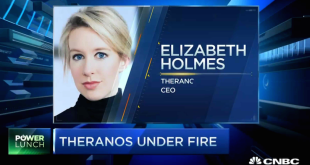
The End is Near for Elizabeth Holmes and Theranos

Regulators want to ban Elizabeth Holmes for 2 years for the sins she’s committed in the blood testing field. Her license to operate in California is under scrutiny and may be revoked. A giant storm has hit her shores and Bill George from Harvard is here to take away her safety vest.


Here are some of the reported bagholders for Theranos, whose valuation swelled to $10 billion in early 2015.
Theranos

Other rumored investors include: BlueCross BlueShield Venture Partners, Continental Properties Co., Esoom Enterprise (Taiwan), Jupiter Partners, Palmieri Trust, Partner Fund Management, Dixon Doll, Ray Bingham and B.J. Cassin.

Comments »

Offshore Oil Drillers Racked with Losses Due to New Proposed Obama Rules

The new safety regulations proposed the Obama administration has made the House of Saud very happy indeed. It will cost American producers of oil billions of dollars, at a time when they could least afford it. This is the final checkmate in a game played very patiently by President Obama. The complete and utter destruction of energy independence is underway.

“What we’re worried about is how do we make the industry do what they’re putting on paper,” said Cheryl MacKenzie, a CSB investigator.

She said safety gaps could be filled by giving the Bureau of Safety and Environmental Enforcement — the offshore regulator — more power to “challenge companies and verify that they are doing what they said they would do.”

CSB also recommended getting workers more involved in safety decisions, for instance by letting workers elect worker representatives to be part of discussions over safety.

“These are the people who have their hands on the equipment,” MacKenzie said. “They need to be involved … This is not a CSB tenet, this is a well-known concept.”

The CSB report said there were lessons to learn from places like Norway and the United Kingdom.

In a statement, Vanessa Allen Sutherland, the CSB chairwoman, called on the industry and the federal government to take “a tripartite” approach where workers, companies and regulators are entwined in improving safety.

“Ultimately, this will require a culture shift for everyone,” Sutherland said.

Ken Arnold, an expert on offshore drilling and member of the National Academy of Engineering, said the industry, through an American Petroleum Institute committee, is looking at revising the industry’s safety standards. He said more oversight of contractors is being considered.

However, he questioned the practicality of some of the CSB’s recommendations.

For instance, he said U.S. offshore workers are not unionized and are “culturally anti-union.” He said it would be difficult to duplicate the safety regimes of Norway and the U.K.

“In the U.S. we have a system that is a blame culture,” he said. “Norway and the U.K. have a culture of working with industry to make things better rather than focus on who to blame. We have to work within the culture of the United States.”


Yes, indeed. We need to be like Europe and have all competitive advantages stripped from the playing field. God forbid the United States become energy independent, how would the House of Saud fund terrorist groups that force us into brainless wars?

Here are some of the losses in the space today.
Oil

Comments »

Larry Summers: ‘A Trump Presidency Would Be Gravest Threat to Our Freedom in my Lifetime’

Seeing that Larry is 61, this great fear of Trump, expressed by the former Harvard President, Treasury Secretary, and World Bank economist, covers a lot of ground. By definition of his fear and the timeline by which his illustrious life spans, Trump is a greater threat to our security than the cold war, Vietnam war, 9/11 and the recent plague of ISIS, all according to Mr. Summers of course.

“I think the prospect of Donald Trump being President would be the gravest threat to our prosperity, our security, and our freedom in my adult lifetime,” Summers said. “That’s the thing I would worry most about.”

Summers believes the rise of radicals, like Trump and Sanders, is due to a lackluster economy.

“I think people are frustrated because the economy’s grown slowly…because their wages have increased slowly…because they have a sense that there’s a small group in the society who’s done remarkably well, while most others haven’t really made great progress,” Summers said.

The Trump wall is ILLEGAL and racist.

“Trump’s proposals to wall off Mexico, abrogate trade agreements and persecute Muslims are far more popular than he is,” he wrote in a recent column.

Summers shills for slave wages and cheap shit made in China at Walmart.

“What a wage of $10 or $8 or $15 means depends completely on how much it costs to buy things. And he neglects completely that we get much cheaper goods because we have a relatively open market,” he said. “For decades the United States had relatively low trade barriers…Most of what these agreements are doing is opening up other countries’ markets for US exports.”

MOAR FEAR from Summers.

“People see a rising China,” Summers said. “They see rising emerging markets. They see tremendous new capacities coming from technology, and they worry about what the role is for them.”

Someone give Larry a scooby snack.

Comments »

Tudor Investments Hit with $1 Billion in Redemptions

So what? Paul Tudor Jones is busy doing other things and simply doesn’t have the time to manage money aggressively anymore. The fault lies with his moron portfolio managers, who seem to be dropping like flies as of late.

Co-President (WTF is that?), Michael Riccardi, is leaving after three years. Portfolio managers, Spencer Lampert and John De Palma, joined Mark Heffernan in either firing themselves, quitting or retiring from the firm over the past year.

Clearly, there is a shake up underway at Tudor, most likely due to the lackluster results.

His main fund was down 2.8% in the first quarter. It even lost money in March, if you could believe that.  Over the past two years, his flagship fund of $13 billion made 1.4 percent in 2015 and 3.5 percent in 2014. As such, it’s being reported by Bloomberg that $1 billion or so has been drawn from Tudor, in the form of face slapping redemptions.

Comments »

China to Punish 357 People for Vaccine Tainting Scandal

This is outrageous! Clearly, the Chinese government is purporting a conspiracy against the good people inside of the Chinese pharmaceutical industry. Why, all vaccines are safe and without reproach. Anyone who says otherwise is a nut!

China plans to punish 357 officials implicated in a scandal over vaccine distribution that reignited drug safety fears and highlighted the vulnerabilities in the country’s vast medical distribution chain.

The officials may face demotions or could lose their jobs, the state-run Xinhua news agency said late Wednesday. About 200 people have been detained over the scandal, Xinhua said.

Chinese Premier Li Keqiang last month called for an investigation into vaccine supplies after allegations that a mother-daughter team had been distributing shots that may have been compromised due to improper storage and transport. The scandal fueled outrage from parents on social media and on online public forums.

Twenty five vaccines were included in the scandal, including vaccines for encephalitis, hepatitis B, meningococcal disease, mumps, polio and rabies. As a result, scores of deaths have been reported; but the Chinese government have been very hush on releasing actual figures.

Comments »

Rio Tinto CEO: The Iron Ore Rally is About to End

Good afternoon lads; did you miss me?

I came across this delightful, uplifting story, regarding iron ore and how one of the CEO from the 2nd largest producers of it said it was about to ‘fizzle out.’

Here’s what he had to say.

Iron ore prices “may well soften in the second half,” Walsh told reporters after the company’s annual shareholder meeting. “I’ve said all along that we expect the iron ore prices will be volatile. That’s what we’re seeing.”

Iron ore is up 55% since December on imaginary demand from China.

When asked about being the Saudi Arabia of iron ore, messing up markets with cheap ore,  Jan du Plessis, Chairman from RIO (what is he Dutch?),  said  it was “an absolute nonsense.”  We have no desire to squeeze anybody out of the market. We’re not flooding the market. We’re not trying to be Saudi Arabia at all.”

Obviously, he’s lying.

RIO’s share price is up 30% over the past 3 months.

Comments »

Analysts Take Seagate to Task For Sucking So Bad

I can’t believe this company is stupid enough to pay a 7.4% dividend. I mean, really, who the fuck pays a 7.4% divvy in the tech space. I’m going out on a limb here and guessing that management owns a bunch of the stock. I know, I should just go look it up; but I don’t feel like it.

Will someone go check this for me? Thanks.

If they own a bunch of stock, then they’re using the companies cash flow as their personal piggy bank–via dividends that exceed normalcy. If not, they’re simply morons.

image

Analysts are slashing STX this morning off horrendous earnings. But don’t worry, the fucking dividend is still intact.

Via briefing.com

Mizuho notes STX preannounced negatively after the close, noting weaker HDD demand (down 18% q/q) with weakness in mission-critical enterprise HDD and PC desktop products. STX now sees MarQ revenue at $2.6B (versus prior $2.7B guide) with GM at 23%, 270bps below consensus, on lower utilization. They believe increasing 3D-NAND supply could remain a structural headwind for high-margin 10K/15K HDD drives. They’re not changing estimates here and they’re maintaining their Neutral rating.
Cowen lowers tgt to $35 from $36 on lower estimates following STX’s negative pre. What’s most worrisome to them, an issue they highlighted in their recent initiation, is the apparent tradeoff between servicing the $760MM/yr div’y (w/ FCF potentially <$800MM CY16) vs. making meaningful investments to offset challenges in core HDD TAM. If any, see risk to downside for WDC/MRVL, but both should fare better.
RBC Capital Mkts stays at Outperform, $36 tgt on STX following the negative pre-announcement after market close. Pre-announcement was $2.6B revs and 23% non-GAAP gross margin, on 39M units and 40% market share. Based on the preliminary results, they think co had share loss to WDC on enterprise front. They think TAM is likely to remain in the 95-98M range for JunQ (they are modeling 97M). Positively, hyperscale demand appeared to be better than expected as co saw strength in 8TB nearline products. Going into the earnings call on April 29, they think investors will focus on enterprise demand outlook and PC demand update.
Stifel now arrives at a non-GAAP EPS of ~$0.37, vs. their prior $0.61 estimate (Street: $0.63). They lowers F2016, F2017, and F2018 revenue/EPS estimates from $11.3B/$2.69, $11.4B/$3.91, and $11.4B/$4.14, respectively, to $11.1B/$2.14, $11.0B/$2.79, and $11.0B/$3.43. They maintain their Hold rating, and expect better results out of Western Digital (WDC). With $2.9B of net debt exiting F2Q16 and ~$700M/annum of dividend payments, the expect increasing investor questions/concern over Seagate’s balance sheet and/or capital allocation strategy going forward.
Maxim cuts tgt to $36 from $39. Given negative pre-announce details, we estimate mission critical HDD units likely declined ~25% y/y vs our prior estimate down 12% y/y. Their data points indicate the mission critical miss is not an issue that will subside, reducing FY17 EPS by 15%. They still see dividend as likely safe, but risk of a cut is rising, in their view. For WDC on a pro-forma basis the potential severe declines in mission critical will be neutral, in their view.
Needham cuts tgt to $41 from $47. Weak PCs and even softer mission-critical drives are not surprising to them. Their positive stance is based on: 1) maintained dividend (we continue to expect this, and it makes the >7% yield too good to ignore); and 2) manufacturing footprint consolidation of 20-30% of capacity and mix shift to a largely enterprise high-cap focus dramatically changes the business model. They see everything else in the interim as theater and would use any opportunities to build positions in the name. Maintain Buy.

Comments »

JP Morgan Likes Ecoli; Upgrades $CMG to Overweight

It’s all over for the projectile vomiting haters, apparently. JP Morgan has issued a formal decree, announcing that the worst is thereunto behind us and for all to jump back into the muddy waters of burrito land, CMG.

Via TheFly.com

Chipotle upgraded to Overweight from Neutral at JPMorgan JPMorgan analyst John Ivankoe upgraded Chipotle Mexican Grill to Overweight from Neutral and raised his price target for the shares to $510 from $465. The stock closed yesterday down 35c to $444.27. Chipotle’s same-store-sales are set to sequentially improve from their bottom in Q1, which will allow investors to focus on earnings recoverability, Ivankoe tells investors in a research note. The analyst expects the company’s earnings in its fiscal year 2017 to be very close to its fiscal year 2014 earnings. This shows that the food safety crisis caused three full years of lost earnings despite stores over the time period rising to 2,483 from 1,785, Ivankoe points out. His upgrade centers on Chipotle being a “highly meaningful brand” that can regain customer trust with time. The analyst expects normal earnings growth to resume by fiscal year 2018 and believes 20%-plus growth can be sustained through at least fiscal year 2020.


Comments »

Kuroda: ‘I Don’t Think Negative Interest Rates Backfired’

It could’ve been worse. If Woody had gone straight to the police, this would’ve never have happened.

“I really don’t think that the introduction of the negative interest rate backfired or caused the yen to appreciate and stock markets to decline in Japan,” Kuroda said during a question and answer session at Columbia University in New York. “If anything, I can say that if we didn’t introduce the QQE with the negative interest rate, financial markets in Japan would have been even worse.”

JPY

The Yen is up to the tune of 10% since Japan adopted negative rates on January the 29th, 2016.


Comments »