iBankCoin
Home / 2016 (page 340)

Yearly Archives: 2016

High Grade Spreads Are Now at Recession Levels

Investment grade spreads to U.S. Treasuries are now pricing in recession. As a matter of fact, the spreads are now higher than 4 out of the past 5 recessions.

Why?

Because people are boarding the ark, afraid of the dangers that lie ahead.

This is a very classic trade, one that is taught in every business school around the world. If you believe an economic contraction is around the bend, buy treasuries.

image

“There is a lot of value out there,” said Stephen Antczak, head of credit strategy at Citigroup. The reaction in corporate bonds “has been so drastic and so violent — above and beyond what the fundamentals and even the extreme volatility should dictate,” said Antczak, who in 2007 as a high-yield strategist at UBS AG recommended reducing holdings of risky corporate debt.

U.S. corporate bonds have lost 0.312 percent so far this year, the worst start to a year in 16. Borrowing costs for investment-grade companies have soared to a four-year high as Standard & Poor’s warned that the outlook for corporate borrowers worldwide was the worst since 2009.

Recession Worries

The risk premium on the Markit CDX North American Investment Grade Yield Index, a credit-default swaps benchmark tied to the debt of 100 of the safest companies, surged to 112.47 basis points, the most in more than three years. A similar measure for junk debt is at the highest mark since 2012.

There’s still plenty of concern that these signs are pointing to an increased chance of recession, according to Bonnie Baha, who helps oversee $80 billion at DoubleLine Capital. “We have seen a ton of borrowing that doesn’t generate revenue,” said Baha. “At some point that becomes very deflationary. And then you have to worry more about the preservation of your capital than finding value.”

Baha said that DoubleLine has reduced its holdings of investment-grade bonds in recent months.

Buy Credit

At Vanguard Group Inc., Gregory Nassour, principal and co-head of investment-grade portfolio management, is starting to buy some of those bonds. “Credit is weaker than it has been, but not everything is all bad. There are still things to buy,” Nassour said. “You are seeing a lot of volatility, you will see a lot more ebb and flow, but it’s not the end of the world.”

While commodities-related issuers have suffered the most, fears of a meltdown has also spread to other sectors. And that’s where some of the best buys are for Mark Kiesel, the chief investment officer for global credit at Pimco.

Kiesel said he favors sectors like consumer goods, housing, health care, pharmaceuticals and building materials, which have been beaten down along with commodities-related issuers and emerging markets as investors fret about a slowdown in global growth. Consumer-sector debt is down 0.5 percent in the past two weeks, with brewer Anheuser-Busch InBev NV, PepsiCo Inc. and Kraft Heinz Co. among the worst performers in the sector.

‘Bottom Line’

“The bottom line is that the U.S. consumer is almost 70 percent of the U.S. economy and we don’t see a U.S. recession this year,” Kiesel said in an e-mail. “Yet the credit markets are increasingly ‘pricing in’ a higher chance of recession, which is where the opportunity is. We want to stay ‘high quality’ and favor U.S. consumer-oriented sectors.”

“You still have to brush your teeth, wash your hair, eat and drink, and companies in those sectors have weakened along with everything else,” said Jim Caron, a managing director at Morgan Stanley Investment Management, which oversees $406 billion. “The market is pricing in a recession that when you look at fundamentals looks increasingly unlikely, and there is a whole grocery store of things that look cheaper than they ought to be.”

If take a step back and think about the scale and magnitude of the Janet Yellen Fed fuck up, it’s astounding. She has single handedly caused hundreds of billions in losses, forced investment grade spreads to blow out v treasuries and haas done nothing to remedy the situation, after having the benefit of seeing her disastrous results.

It will be interesting to see what the Fed says tomorrow.

Comments »

Crude Lift Off: Dow Pushes 250; Biotechs Hammered

Crude is forklifting higher right now, with Brent higher by 3%–so biotechs get hammered? I know there is little relation between biotech stocks and oil. But with the market up nearly 250 and the SPY higher by 1.2%, this has to be a supreme disappointment to all of the doctors who fancy themselves to be astute investors, as the medicine man stocks get hammered for 2%.

This is the ultimate risk on asset, so seeing them lower is a bit of a Debbie Downer.

Downside pin action can be found in NBIX, ANAC, JUNO, RARE, ICPT, AGIO, PRTA, MDVN, INCY and many others.

XBI

For the year, biotech stocks have been one of the worst performers, down more than 22%. Over the past six months, the sector is down 41%.

Comments »

Clown Car Capital: John Paulson Puts Personal Assets to Back Funds Credit Line

Every single thing this man has touched, since his great housing collapse hit in 2008, has turned into salt. It’s amazing, actually. Believe it or not, he’s actually long Puerto Rico now. It almost reminds me of that old movie with Richard Pryor where his task was to lose a fortune in order to inherit a larger one, only in this case Paulson is successful in losing the larger one.

He’s now putting up his personal fortune to support his funds credit line. His fund has been halved since 2009.

According to Exodus, his top holdings are AGN, VRX, TWC and GRFS. His year to date losses are in the 15% range.

Comments »

Nothing Else Matters But Fed, China, Oil

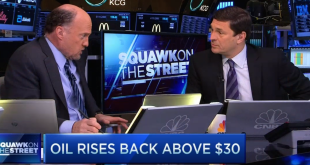
Cramer and Faber were discussing this topic today (by the way, this is my favorite CNBC show of the day, a clownless Cramer and sharp Faber) and I agree 100%. The market can get great earnings reports from leading companies, oversold market conditions can persist, and pretty good economic data could be released– and it would mean nothing, unless the Fed, China and Oil cooperate with the long thesis.

In order for this market to rally and hold its gains, we need the Fed to back off, China to stabilize and oil needs to go up. Forget about oil stabilizing. That’s horseshit. It needs to trade up to $40-$50 asap.

Comments »

BE CAREFUL WHO YOU TRUST

This market isn’t for old men. Straight away this morning, many of you jumped headlong into the market, after seeing futures reverse to the upside.

However, Mother Market might have different plans in store, insidious ones. I’m now in the process of removing myself from the market. I’ll be out of SPY by 2/2 and with a very token position after tomorrow.

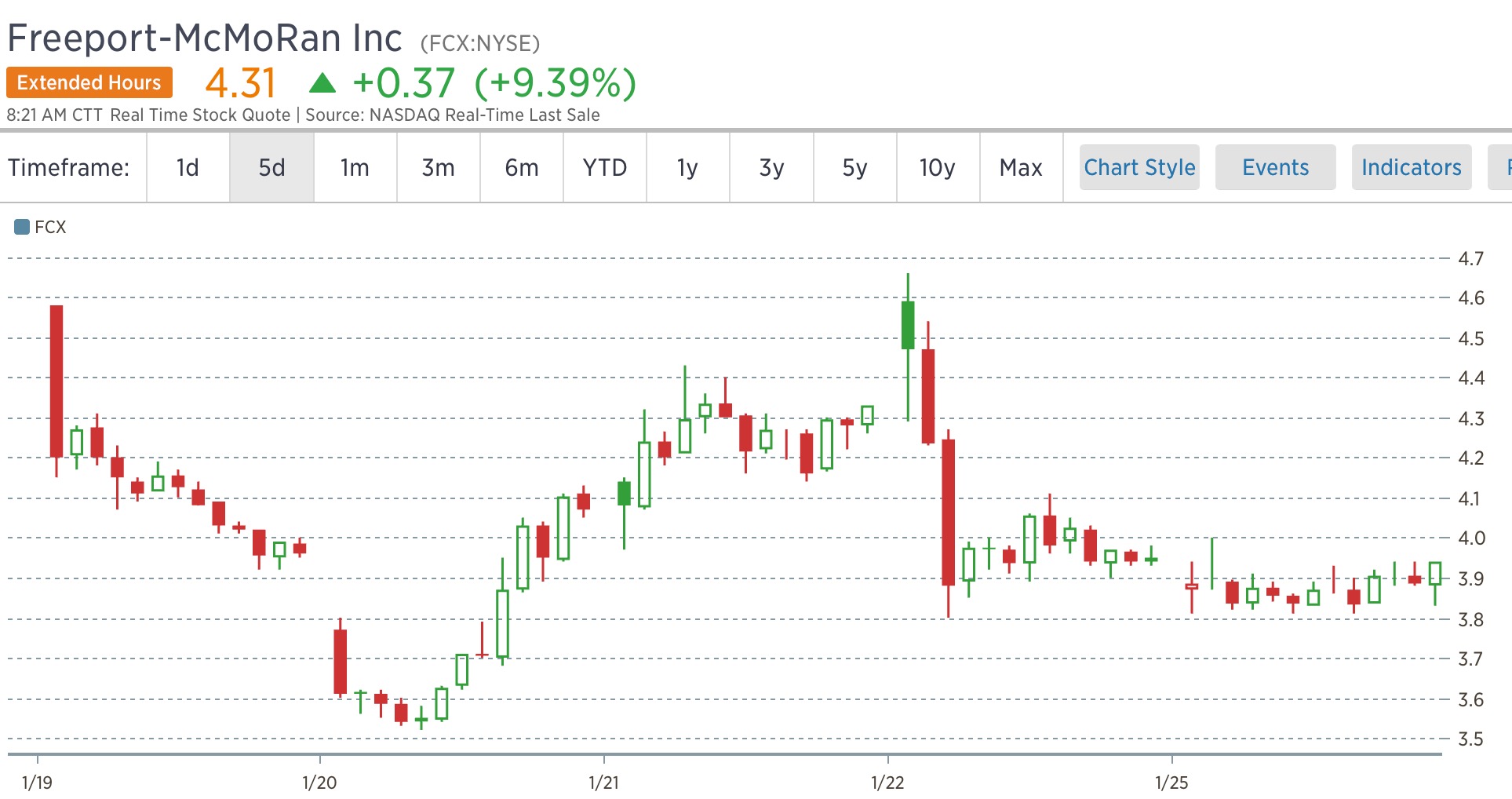
While it’s true, the bounce in crude and non disaster in FCX are encouraging signs for a bounce, I’m not interested in gambling now. With history as my guide, stocks are poised for another leg lower in February. If we can’t rally this week, we’ll never rally again.

Comments »

Freeport Beats Estimates; Outlines Encouraging Cash Flow Plan for 2016

The stock is rising like a bat out from hell after the co smashed estimates by .17 cents and outlined free cash flow for 2016 would be upwards of $3 billion–balancing out expenditures–accounting for these low copper and oil prices.

image

Reports Q4 (Dec) loss of $0.02 per share, $0.17 better than the Capital IQ Consensus of ($0.19); revenues fell 27.5% year/year to $3.8 bln vs the $3.82 bln Capital IQ Consensus.

Consolidated sales totaled 1.15 billion pounds of copper, 338 thousand ounces of gold, 20 million pounds of molybdenum and 13.2 million barrels of oil equivalents (MMBOE) for fourth-quarter 2015.

Consolidated sales for the year 2016 are expected to approximate 5.1 billion pounds of copper, 1.8 million ounces of gold, 73 million pounds of molybdenum and 57.6 MMBOE, including 1.1 billion pounds of copper, 200 thousand ounces of gold, 19 million pounds of molybdenum and 12.4 MMBOE for first-quarter 2016.

Consolidated unit net cash costs averaged $1.45 per pound of copper for mining operations and $16.17 per barrel of oil equivalents (BOE) for oil and gas operations for fourth-quarter 2015.

Consolidated unit net cash costs are expected to average $1.10 per pound of copper for mining operations and $15 per BOE for oil and gas operations for the year 2016.

Operating cash flows totaled $612 million for fourth-quarter 2015 and $3.2 billion for the year 2015. Operating cash flows for the year 2016 are expected to approximate $3.4 billion (Prior guidance $6.8 bln)

Capital expenditures for the year 2016 are expected to approximate $3.4 billion (Prior guidance $4.0 bln), including $1.4 billion for major projects at mining operations and $1.5 billion for oil and gas operations, and excluding $0.6 billion in idle rig costs.

Revised Operating Plans

FCX today announced additional initiatives to accelerate its debt reduction plans and is actively engaged in discussions with third parties regarding potential transactions.

Several initiatives are currently being advanced, including an evaluation of alternatives for the oil and gas business (FM O&G) as well as several transactions involving certain of its mining assets. FCX expects to achieve progress on these initiatives during the first half of 2016.

Cash Flow Guidance

Based on copper prices of $2.00 per pound and Brent crude oil prices of $34 per barrel, FCX estimates consolidated operating cash flows of $3.4 billion (net of approximately $0.6 billion in idle rig costs) and capital expenditures of $3.4 billion for the year 2016.

The impact of price changes on 2016 operating cash flows would approximate
$440 million for each $0.10 per pound change in the average price of copper,
$55 million for each $50 per ounce change in the average price of gold,
$60 million for each $2 per pound change in the average price of molybdenum and

$135 million for each $5 per barrel change in the average Brent crude oil price.

Using similar price assumptions and the recent 2017 future price of $40 per barrel for Brent crude oil, FCX estimates consolidated operating cash flows of $3.5 billion (net of approximately $0.4 billion in idle rig costs) and capital expenditures of $2.3 billion for the year 2017.

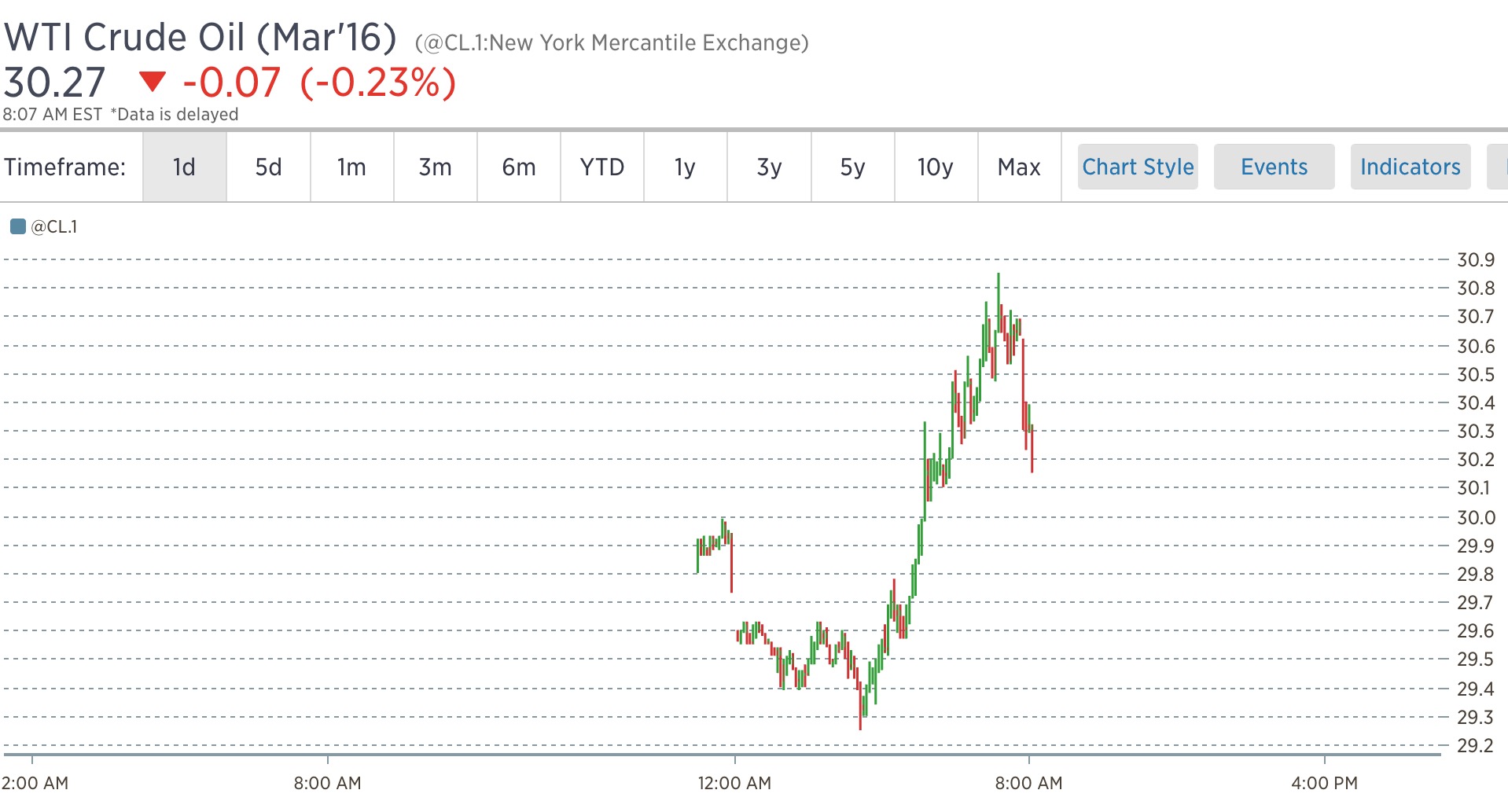
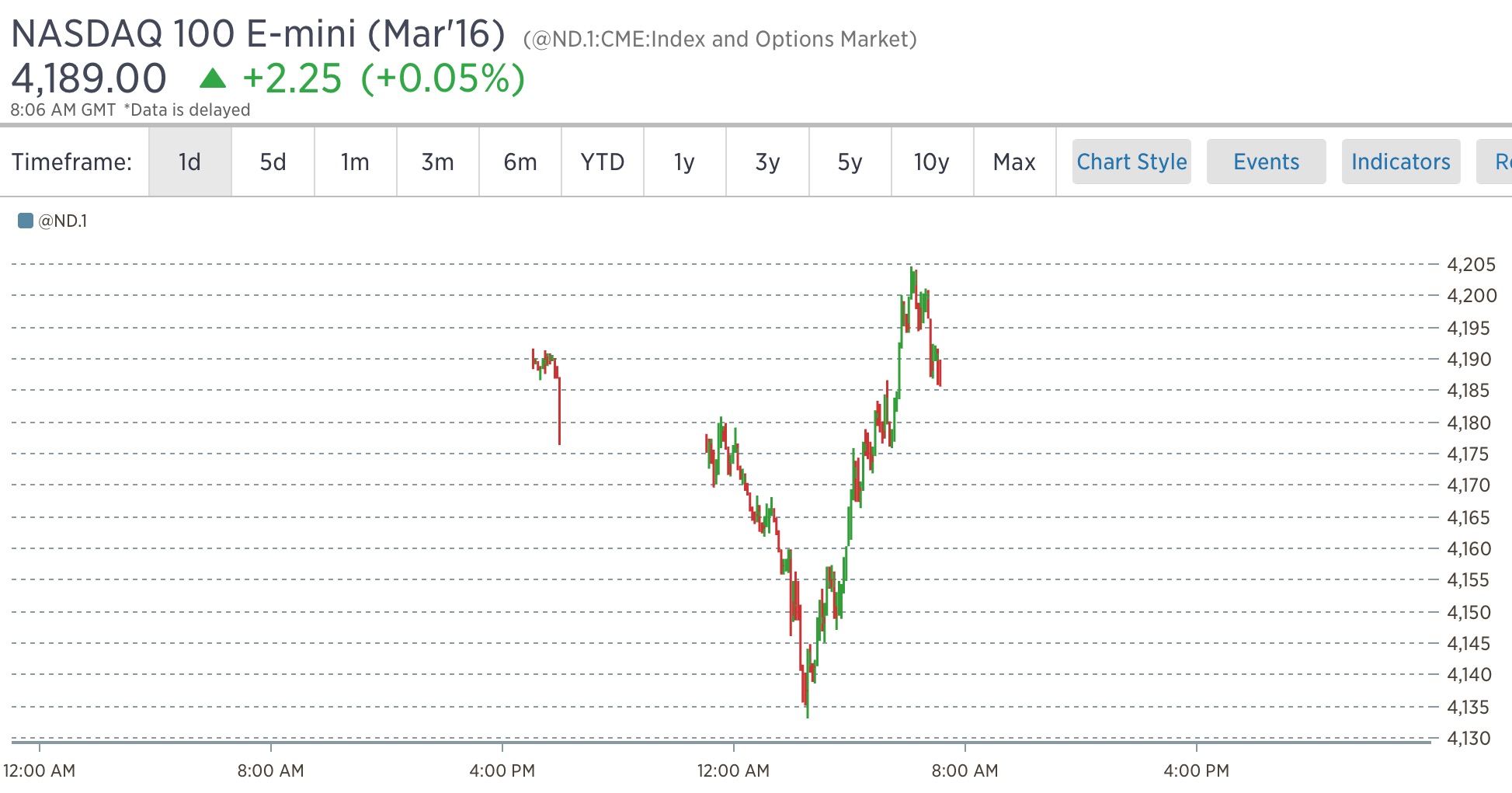
Related: NASDAQ futs are positive, reversing a deep deficit. And oil prices have recovered and are now moving about the $30 handle.

image
image

Comments »

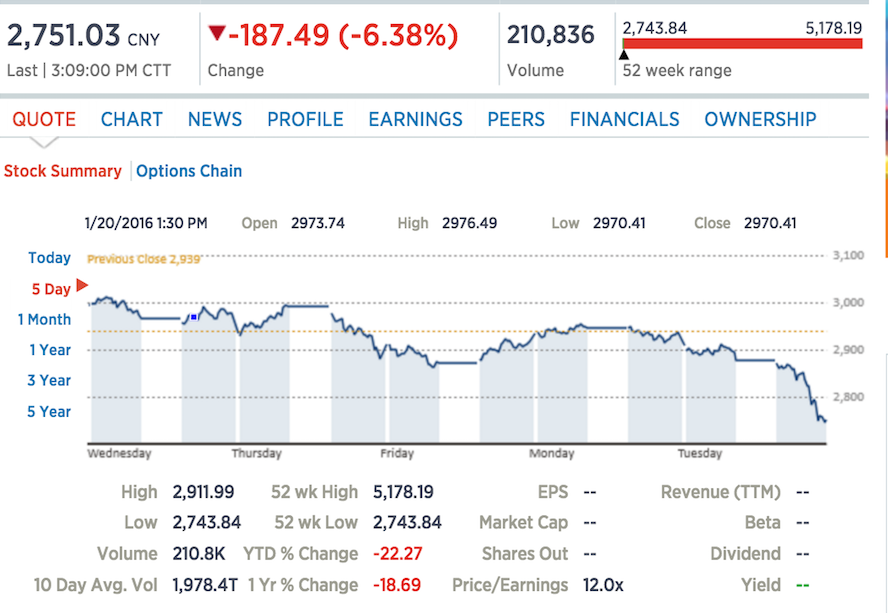
Surprise: The Shanghai Crashed Again; Global Markets Are Reeling

The Chinese markets careened lower tonight, even after a prominent BofA/Merrill analyst, named Baghdad Bob, said all was well and there was nothing to fear.

It dropped by 6.3%.

China

The NIKKEI wasn’t too sporty either, fleeced for 2.4%.

Naturally, oil is lower by almost 3% and the Russian ruble is getting its brains blown out, now off by 2.4% v the dollar.

Over in Europe, broader indices are lower by 1.5%–providing the three guys in pajamas with the excuse they need to drill U.S. futures lower by 120.

Thank God Janet Yellen and her board of fucking morons will hike rates 16 times, from now until 2018.

Comments »

Chesapeake Energy Credit Downgraded to CCC+ at S&P; Outlook Negative

How will the market respond to a Chesapeake bankruptcy? We might soon find out.

With nearly $12 billion in debt, CHK looks like a goner. Debt is trading at bankruptcy levels. Their credit is junk and the stock price is cornered into a ‘fag box.”

From S&P:

Standard & Poor’s Ratings Services today lowered its corporate credit rating on Oklahoma City-based exploration and production company Chesapeake Energy Corp. to ‘CCC+’ from ‘B’. The outlook is negative.

At the same time, we lowered the senior unsecured debt ratings to ‘CCC-‘ from ‘CCC+’. The ‘6’ recovery rating is unchanged, reflecting our expectation for negligible recovery (0% to 10%) in the event of a payment default.

In addition, we lowered the rating on the company’s first-lien senior secured debt to ‘B’ from ‘BB-‘. The recovery rating on this debt remains ‘1’, indicating our expectation for very high (90% to 100%) recovery in the event of a payment default. We also lowered the issue-level rating on the company’s second-lien notes to ‘B’ from ‘BB-‘ and placed them on CreditWatch with
negative implications, reflecting the potential for lower ratings if a revised PV-10 results in lower recovery expectations.

We also lowered our rating on the company’s preferred stock to ‘D’ from ‘CCC’ based on Chesapeake’s decision to suspend dividends, which we view as a default on the securities.

“The downgrade reflects the implementation of the recent change in our base case oil and natural gas price assumptions,” said Standard & Poor’s credit analyst Paul Harvey. We lowered our 2016, 2017, and long-term price assumptions for Henry Hub natural gas by over 15% and West Texas Intermediate (WTI) crude oil by about 20%%, which resulted in significantly weaker financial measures for Chesapeake, with funds from operations (FFO)/debt under 5% and debt/EBITDA well over 10x for the next two years. At such levels, we assess debt leverage as unsustainable. Based on our price assumptions, we expect only limited improvement in the near-term and that Chesapeake will face both a challenging operating environment and weak capital markets as about $2 billion of debt comes due in 2017. The downgrade of the preferred stock to ‘D’ reflects the suspension of dividends on that security, which we view as a default.

The negative CreditWatch placement of the second-lien notes reflects the potential that we could lower ratings on that debt class if a revised PV-10 results in lower recovery expectations.

The negative outlook reflects our expectation that financial measures will remain very weak over the next 24 months based on our natural gas and crude oil prices assumptions. Under these challenging conditions, we expect debt leverage to exceed 12x on average. Additionally, liquidity is likely to be challenged under these low prices, both from diminished cash flows and
potential reductions in the company’s borrowing base. Also, the negative outlook reflects the potential that Chesapeake could launch an exchange offer or other refinancing we would view as distressed, resulting in a selective default.

We could lower ratings if we expected liquidity to materially weaken in the face of the 2017 debt maturities and expected puts, such that we assessed liquidity as weak. Additionally, we could lower ratings if Chesapeake pursued a distressed refinancing of its debt, which we would view as a selective default.

We could revise the rating outlook to stable if Chesapeake can address upcoming maturities and putable debt such that we assessed liquidity as adequate, and at the same time financial measures improved on a sustained basis such that FFO to debt was 5% or better and debt/EBITDA was below 10x. Both events are likely in conjunction with improving hydrocarbon prices, such that our natural gas price assumption exceeded $3.00 on a sustained basis.

Other commodity companies with similar or worse debt profiles include: PBR, SDRL, ETE, FCX, LNG, ESV, WLL, SM, OAS, NOG, BBG and more. In all, we’re talking about $800 billion in debt.

Comments »

WHO ALERT: The Zika Virus is Coming and There’s No Cure

This one is especially disdainful, as it target babies.

Out of the Amazon jungle, an insidious baby killing virus has been unleashed, infecting thousands of infants in Brazil. World Health Organization officials say it will soon spread across the Americas, into the United States–just in time for summer.

“We’ve got no drugs and we’ve got no vaccines. It’s a case of deja vu because that’s exactly what we were saying with Ebola,” said Trudie Lang, a professor of global health at the University of Oxford. “It’s really important to develop a vaccine as quickly as possible.”

Large drugmakers’ investment in tropical disease vaccines with uncertain commercial prospects has so far been patchy, prompting health experts to call for a new system of incentives following the Ebola experience.

“We need to have some kind of a plan that makes (companies) feel there is a sustainable solution and not just a one-shot deal over and over again,” Francis Collins, director of the U.S. National Institutes of Health, said last week.

The Sao Paulo-based Butantan Institute is currently leading the research charge on Zika and said last week it planned to develop a vaccine “in record time”, although its director warned this was still likely to take three to five years.

British drugmaker GlaxoSmithKline said on Monday it was studying the feasibility of using its vaccine technology on Zika, while France’s Sanofi said it was reviewing possibilities.

2015-cha-autoch-human-cases-zika-virus-ew-51

No drugs, cures, treatments–nothing. Just brain damage for babies. Fucking great.

Comments »

Burlap Wearing Short Seller Aficionado, Carson Block(head), Launches Hedge Fund

Muddy Waters, the preeminent source of bearish online reports, especially gravitating towards men in the orient playing parlour tricks with their accounting standards, launched a hedge fund today.

Reuters is reporting it was seeded with a $100 million investment.

Truth be told, and as much as I hate to admit it, his research is pretty darn good.

Best of luck.

Comments »