iBankCoin
Home / 2016 (page 310)

Yearly Archives: 2016

We Should Be Getting Hammered Today

But we’re not.

Crude is off almost 5%. European stocks are off by 1%+. Gold and bonds are higher, yet the NASDAQ is up.

Why?

Tech stocks are being accumulated. Stocks like GRPN, YELP, YHOO and even ETSY are higher. While commodity related names get poleaxed into oblivion, WDAY, PANW, QUNR and DATA are up.

Inside Exodus, my bubble basket is higher by 0.5%, while the commodity basket is off by 2.7%.

Thanks to AMAT, semis are up too.

In my opinion, this is indicative of institutional accumulation in undervalued, or beaten down, tech names, whose growth prospects are now attractive relative to their valuations. The rallies are too broad based for it to be a coincidence.

As an investor, you’re running out of spots to place your money. If you’re not interested in gold or bonds, what can you buy? Do you want to chase CLX and MO after the runs they’ve been on? They’re not cheap. You’re not buying commodities. The cycle is over.

The only place that makes sense, if you’re a bull, is tech. For the most part, balance sheets are clean. They’re making a lot of money and valuations have shrunk.

Whether or not this thesis ends up being correct remains to be seen. As of right now, looking at the screen in front of me, this is the bet that is being placed by money managers.

Comments »
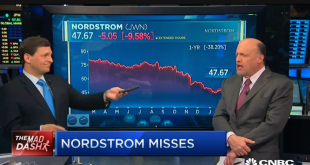

Cramer: Flabbergasted by Nordstrom Miss; Avoid Apparel

How many of you go clothes shopping on amazon? I don’t get that. Nevertheless and apparently, plenty of people do. The traditional moat that higher end retailers once enjoyed have been destroyed by niche online websites like Net-a-Porter, and I suppose, to some extent, Amazon. I think the problem with Nordstrom have more to do with a shifting demographic of young people who dress like hobos, than an overall apathy of cladding oneself with garb made from cotton.

Have you seen some of these young people running about the earth? They look like extras from the Mad Maxx remake. Call me olde fashioned, but I’m not a fan of the dystopian society look.

In this morning’s take on Nordstrom’s miss, Faber and Cramer had a nice kitschy conversation about the struggling retailer, bemused by the powers vested in Amazon.

JWN is down 40% over the past 12 mos.

Comments »

Fed’s Mester: Oil Prices Can’t Go Down Indefinitely

Does she get paid to say things like ‘oil can’t go down forever” or “the dollar can’t keep going higher”? To me, this sounds like a person digging in her heels in a sunk cost fallacy. You know, the guy who keeps buying GPRO from $90 because he’s already lost so much, he might as well lose more.

Or the guy at the casino who won’t give up because of all of the time and money he’s lost. He justifies throwing good money after bad because of the sunk cost fallacy.

My current expectation is that the U.S. economy will work through this episode of market turbulence and the soft patch of economic data to regain its footing for moderate growth,” she said in prepared remarks at a Global Interdependence Center event in Sarasota, Florida.

Mester also said she still expects inflation to return to the Fed’s 2-percent target, even though it will remain “lower for longer” than previously thought.

“I take less of a signal from the downward moves in market-based measures of inflation compensation…these more likely reflect changes in liquidity premia and inflation risk premia rather than changes in inflation expectations,” she said.
Mester acknowledged, however, that policy will likely need to remain accommodative “for some time” given slow growth abroad, the strong dollar, more restrictive financial conditions and the hard-hit energy sector.

She noted that the impact of China’s slowdown on the global economy, market volatility and the risks of low oil prices need to be considered, but that it was still “premature” to make a material change to her outlook.

Consumer spending had started the year “on a strong note,” Mester said, and would continue to be supported by low oil prices.

Plainly, the Fed has been wrong, very wrong, on inflation–currently saddled at 1.4%, well below their target.

To say this:

“Oil prices cannot continue to decline indefinitely, nor can the dollar continue to appreciate forever,” she said. “At some point, both will regain some stability and the effect of previous changes on inflation will dissipate.”

You have a problem with your core thesis. Stop doubling down on a bad bet, Loretta. The inflation monster isn’t going to rear its head anytime soon. Moreover, making moronic speeches like this only serves to shatter investor confidence; hence, creating the deflationary environment that you’re trying to defeat.

Comments »

Ackman Ups His Valeant Stake; Wells Fargo Is Not a Fan

It was just revealed that “Broadway” Bill ‘Montauk’ Ackman upped his retarded sized VRX position from 8.5% to 9% yesterday. Today, Wells Fargo did a Larry David “eh, not impressed”, starting the drug maker with an underperform, affixing a price target of $65-68 to it.

Wells Fargo analyst David Maris started Valeant Pharmaceuticals (VRX) with an Underperform rating and $65-$68 price target range. The drugmaker closed yesterday down 58c to $94.07. Valeant has not explained how the unwinding of Philidor, which represented 6.8% of revenue, results in a 36.6% reduction in earnings, Maris tells investors in a research note. The analyst rolled out coverage of ten companies in the Specialty Pharmaceuticals space, eight of them with Outperform ratings. Valeant is his only Underperform rated name in the space. His focus Outperform calls are on Teva (TEVA) and Amphastar Pharmaceuticals (AMPH)

There are so many hedge funds wrapped up in VRX. If someone ever wanted to inflict maximum damage to the industry, they’d just have to target VRX as a way to communicate with them.

VRX is down almost 4% in the pre-market.

Comments »

Crude Brexit Fears Stoke Hornets Nest; Future Slide

This is the part of the B movie when you start to throw popped corn at the screen for being so absurd. The dialogue of this market is cringe-worthy and it feels like we’re all actors in a  poorly staged opera. Out of all the things to worry about, the UK potentially leaving the EU was not one of them.

Nevertheless, here we are.

`We don’t know what would come our way with a Brexit,” said Gabriel Felbermayr, director of the Center for International Economics at the Ifo Institute in Munich and one of the authors of the report. “But what is completely sure is that it would create enormous uncertainty, and there is very good empirical evidence to show how poisonous uncertainty is for trade flows and economic development.”

Very nice.

Economic ramifications?

Sure, got that too.

brexit

Dow futures are off by 75, crude 2% and the DAX -1.14%.

It’s all one large mystery, something entirely unneeded right now.

Once settled, I assume markets will pretend to be relieved and find an excuse to trade higher. So stupid.

Comments »

The Last Great Unicorn, Uber, is Getting Crushed in China

According to recent reports, Uber is losing $1 billion per annum in China, thanks to what they call a ‘fierce competitor’ called Didi Kuaidi.

This competitor, according to Uber, is “unprofitable in every city they exist in, but they’re buying up market share’ nonetheless.

Uber has gone from 1% share in China at the beginning of 2015 to 30-35%, only to get crushed by the Chinese competitor, who has partnered with Uber’s arch nemesis, Lyft, and is backed by the very powerful Chinese-born companies, Tencent and Alibaba.

According to the last capital raise, Uber is valued at $62.5 billion, presently conducting business in more than 300 countries.


Comments »

The Bankers Are Getting Gigantic Pay Hikes As Shareholders Suffer Under the Hideous Visages of Underperformance

Your local, and gigantic, global bank thanks you for charging this year’s holiday shopping season onto one of their numerous 29.99% interest bearing credit cards. As such, profits have rebounded to pre-crisis levels; and with it, the compensation of the Ceasars who operate these denizens of criminality have soared.

Simultaneously, the share prices of these respective banks have slumped, mightily.

Let’s review the numbers.

Citi’s CEO, M. Corbat, increased by 27% to the paltry sum of $16.5 million (note: Corbat has zero homeruns and zero hits for the year)

Citi’s CFO, J. Gerspach, increased by 20% to a mere $9 million.

Citi’s Chief of their Institutional Clients Group enjoyed an 18.5% increase to $16 million.

Citi’s share price is down 25% over the past 12 months.

Bank of America’s CEO, B. Moyniham enjoyed a 23% spike to $16 million.

Bank of America’s share price is down 24% over the past 12 months.

And, lastly, JP Morgan’s own J. Dimon ‘earned’ $27 million in 2015, up 35%.

Jp Morgan’s share price was up a fantastical 0.11% over the past 12 months, which is more than enough to bestow a 35% hike to Dimon.

On the austere side, Morgan Stanley’s CEO, J. Gorman, was racked with a 7% reduction to the miserly annual pay of $21 million.

Morgan Stanley’s share price is down 33% over the past 12 months.

Goldman Sach’s CEO, Brooklyn’s own, Lloyd Blankfein, was penalized with a 4% pay cut to fall in at $23 million.

Goldman Sach’s share price is down 21% over the past 12 months.

Indeed.

Comments »

Magellan Global Holding Most Cash Since 2009

I’d hardly call this ‘dumb money’. The Magellan Global fund manager, H. Douglass, has eviscerated and laid waste to fellow managers for years now. You’re only privy to this news of a very successful fund manager’s recent foray into risk aversion because of a charitable man in H. Douglass and the speed by which information passes through, in this day and age. Had this been the wondrous years of the Robber Baron era, you’d all be clamoring around the 3-d printer stock pits, hoping to snag a few shares– a fortnight before their absolute collapse.

Hamish Douglass, whose Magellan Global Equity Fund beat 99 percent of peers over the past five years, boosted cash to about 14 percent of assets by April to prepare for the “stiff headwind” he expected in share markets. He’d been sensing danger as far back as mid-2014. The stock-picking chief executive officer of Magellan Financial Group Ltd. now has almost 16 percent of his fund in cash, matching the biggest proportion since 2009, and no immediate plans to buy shares.
“We’re happy to bide our time in the cash position,” Sydney-based Douglass, 47, said in a phone interview. “We took a lot of our action well before any of this turmoil started.”

“Our central thesis is that China won’t collapse and that the yuan won’t collapse and that’ll we’ll get a continuation of the economic recovery story in the U.S. over the next few years,” he said.

The issue, as Douglass sees it, is valuations. If the economy recovers and the Federal Reserve gradually raises interest rates, some of the best-loved stocks are going to look overpriced. Once they fall he’ll start buying again, he said.

High-quality shares “are still at very expensive levels, effectively factoring in a zero interest rate world virtually forever,” he said. “We’re holding cash rather than the most defensive equities we would have otherwise held.”

“It’s better being six months too early than six minutes too late on these things, he said. “Maybe I was 12 months too early rather than 12 minutes too late.”
Still, when it comes to buying, he’s prepared to wait.

“China will steady over the next 12 months,” he said. “If that happens, as U.S. rates start to go up, we’ll get some interesting repricing that will enable us to deploy the cash.”

Even if he thought the risk was indeed systemic, H. Douglass is too embedded in the corporate apparatus of political correctness to say as much. Instead, like many of his peers, he leans on the cliche of valuations and how they might portend to lower equity prices.

No one sells 12 months in advance due to valuation concerns, unless they believe something grave was lurking in the shadows. Mr. H. Douglass is firmly embedded in the bear pornography camp, idly waiting for the world to burn.

Comments »

Unprecedented Airline Fare War Persists in Dallas

The airline industry had it good, heading into 2015. Profits were at record highs, oil was dropping, and share prices were all soaring.

Critics have persistently said the airlines would eventually destroy themselves, complete morons bereft of the basic instincts that have permitted mankind to survive over 30,000 years.

Alas, fare wars are have deleterious effects on profits and share prices.

While that’s no longer the case, the “very toxic fare environment” has continued, said Virgin America Chief Executive Officer David Cush.

“We are not going to fly passengers at rates that will not make money,” he said on a Thursday conference call with analysts. “We are going to make sure we get an average ticket value up to where its sustainable and we can earn a return, and we’ll take the hit on load factor.”

One-way fares of $30 from Dallas to destinations along the U.S. West Coast and $41 walk-up fares from Dallas to New York’s LaGuardia Airport were among those Virgin America cited from a recent review of airline data filed with the U.S. Transportation Department. There’s no indication when the battle might end, and “everyone is feeling the pain,” he said.

Southwest and American are reporting load factors, or the amount of seats sold, above 90 percent on some flights to Los Angeles and New York, with about half the tickets priced below $100, he said.

Fare wars are occurring in other markets, like Atlanta and Chicago. In Dallas, however, “I’ve never seen anything like it in my life,” Cush said. “Clearly, what we have is a market-share war going on in Dallas.”

American Airlines Group Inc., the world’s biggest airline, has said it won’t lose passengers to discounters and is creating a Basic Economy fare class that would offer a seat at a low base price, with no extras. The carrier declined to comment Thursday, while Southwest didn’t immediately comment.

image

image

image

I am certain this will end poorly for all parties involved.

Comments »

Market Takes a Breather; Gold, Bonds, Utilities Soar

Breadth was robust for a -46 Nasdaq day at 42%. Risk assets, for the most part, traded off–paving way for a fanatical run in gold, bonds and utilities.

Asset managers have been flung far and violently ever since the calendar changed to the year 2016. It’s not unusual or without precedent to see markets digest gains, without it being a precursor of horrible times.

Not every rally will mean bull market, and vice versa.

Before passing judgement on whether or not this market has more upside in it, as I believe it does, let’s permit a few days to pass.

If I’m right, the selling done today and possibly tomorrow will be ephemeral. The Federal Reserve and other world central banks are now firmly in line to succor markets and improve overall conditions in investor sentiment.

It’s important to take note of these changes and invest accordingly.

Comments »