iBankCoin
Home / 2016 / March (page 17)

Monthly Archives: March 2016

The Mighty Caterpillar Warns, Offers Significant Earnings Guidance Cut

This stock has been on fire since the beginning of the year, in the hopes that China wasn’t that bad and the slowdown in crude was meh.

Well, gents, the market is an ass and CAT just vomited all over itself with a St. Patrick’s Day earnings warning.

Via briefing.com

Co issues downside guidance for Q1 (Mar), sees EPS of $0.65-0.70, ex items, vs. $0.95 Capital IQ Consensus Estimate; sees Q1 (Mar) revs of $9.3 to 9.4 bln vs. $10.22 bln Capital IQ Consensus Estimate.

Representatives of the Company also stated that they remained comfortable with the full year guidance for 2016 sales and revenues and profit per share as most recently stated in a Form 8-K Caterpillar filed with the Securities and Exchange Commission on January 28, 2016. (was for FY16 (Dec) EPS of $4.00 vs. $3.73 Capital IQ Consensus Estimate; sees FY16 (Dec) revs of $42 bln at mid-point vs. $41.5 bln Capital IQ Consensus Estimate).

Shares have led the Dow higher.
image

The reaction is muted, quite frankly. A reduction in guidance of this magnitude should engender a sharper response.

SPY futs are -10.

Comments »

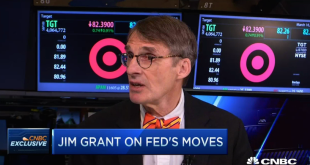
Jim Grant on the Fed: There’s No Need For Inflation

Look, it’s late and I’m tired. I’ve written and published 40 articles over the past two days. I can’t even begin to think about what this bow tied man just said in the video below. Since young, I’ve been brain-washed into believing that an acceptable level of inflation, approved by my overlords, was good for the economy. Now Grant enters the fray, being all smart and stuff, telling me the Matrix isn’t real and that everything I’ve known my entire life is a lie.

Quite frankly, it’s too much for me to bear.

Comments »

Pershing Square Raises Cash, Post Apocalypse

After losing $700 in a single day of trade, Pershing Square sold a 20 million share block of MDLZ, one of their better acting, liquid positions.

They cite all sorts of bullshit reasons for the sale. But make no mistake, they are fighting for survival and trying to get tactical, in order to make up lost ground.

“After the close, we completed a block sale of 20 million shares of Mondelez International. As a result of the sale, we now own a 5.6% stake in the company, are the third largest owner, and have substantial uninvested cash. We reduced our stake because Mondelez had become an outsized position in light of its initially large size and its outperformance relative to other holdings. We continue to believe in the potential for operating improvements and margin expansion that we expect will lead to substantial further increases in value. As a result, it remains our largest exposure. We are reducing the position size for portfolio management purposes only. We have carefully reviewed the balance of our holdings and have concluded that they are appropriately sized. As such, we have no current plans to sell any of our other investments.”

I don’t see them enduring another 20%+ drawdown and surviving to tell the tale. All hands are on deck. Ackman is fighting for dear survival, while playing with a billion plus in his checking account.

Comments »

Energy Stocks Surge and Are Now the Best Performers of 2016

Because nothing says ‘we’re killing it’ like $38 crude.

winners

I promise you, without a shadow of a doubt, these gains are unsustainable.

I offer you an analogy to explain the current situation in the energy sector.

Imagine that you’re living in a giant mansion. You bought the dwelling at the peak of your business cycle. You were fat, greedy, a gluttonous human being of extreme indecorous depravity. You moved your bratty family into a 10,000+ sq ft home and spent upwards of $100k per month in general upkeep and mortgage.

You spent your days and nights living like a fucking Caeser, ordering subjects to fetch things for you, grill you some steaks, wash your car and bicycles. Then everything changed for the worse. Your business cratered by 90%. Your savings quickly depleted under the heft of your absurd expenditures. Then you enjoyed a small respite. Your revenues bounced 40%, from $10k per month to $14k, well below the $100k needed to maintain your hedonistic lifestyle.

Bankruptcy is inevitable. This is the current state of the oil markets.

Good day.

Comments »

King Dollars Are Being Crushed; Markets Rejoice

It would be foolish to think the market is topping right now. The reaction to the Fed’s position on rates is having a deleterious effect on the dollar, now down more than 1% v the euro, which is buoying commodities, and by extension, stocks.

UUP

Massive gains are abundant without pause in all of the commodity sectors. My favorite tell is FCX, a company racked with debt and massive exposure to copper and also oil. We are rallying because the bears are weak, flaccid, pathetic sub-humans. Any interest rate hike will cause panic and sheer horrors for this market, yet the specter of it seems so far away.

Irrespective of what the market is bound to do here, or throughout the month of March, I do not believe there is a significant downside to this tape. If anything, we will grind higher and continue to climb the wall of worry. However, come late April and early May, dislocations will be more than a maybe, but a certainty.

Enjoy these last few weeks of hedonism and be sure to save for a rainy day, for a deluge is coming and you’re gonna need an ark to survive it.

Comments »

Commodities are Ripping Higher, Post Fed

WTI crude is higher by an astonishing 6% to $38.5. Gold is higher by almost 2% and copper 1% to the good. This is happening, as the dollar plummets v the euro to the tune of 0.6%, because of an inferred dovish stance by the Federal Reserve.

NASDAQS have gone apeshit to the upside, now higher by 25.

Leadership sectors are all in commodities. Stocks like FCX, SM, CRZO, as well as a slew of gold stocks, are leading the fray higher.

Market breadth is improving, now 67%.

Comments »

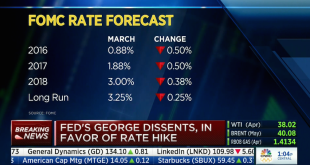
FED LEAVES RATES UNCH, WANTS TWO MORE RATE HIKES FOR 2016

The market is hockey-sticking higher on news that the Fed sees just 2 rate hikes, instead of 4. Duh. We already knew that. More to the point of two rate hikes, the market is delusional if it thinks it will enjoy those, whenever in fact they do occur.

However, I think the noteworthy part of this statement is the proverbial bending of the will to the market. Nevertheless, these statements are red herrings, meaningless drivel designed to provide succor to a market that has hitherto gotten everything it has asked from the Fed, and more.

Let this be as a stark reminder to you: you will not like any rate hikes, not even one.
FOMC

Nevertheless, markets are rejoicing in their own feces, now higher by 5 whole NASDAQS.

Sell the news; board the ark.

Comments »

Biotech is Tanking Again; Sector Now Off by 28% For 2016

Some of these biotech stocks are having their brains eaten for them. Wow. Shares of MNK are off by 13.5%, chained to the VRX ball heading to the bottom of the sea.

ZYNE is off by 21%
GWPH is off by 9.5%
PBYI is off by 8%
VRTX is off by 5.7%
BMRN is off by 4.5%

And there are scores of small cap names down 5%+.

Biotech is easily the worst performing sector of 2016, down 28%. To put that into perspective, for all of the doom being cast over the oil sector it is up 0.2% for the year–completely reversing stark losses that were endured earlier in the year.

Comments »

Moody’s: Negative Rates Are Having Unintended Consequences

Well, well, well, look what we have here: a fucking asset bubble crisis born from egregiously low interest rates. Yet, in this special case, we are talking NEGATIVE interest rates and their deleterious effects.

Moody’s is out with a report, warning Sweden (of all places) that their current housing market is bubblelicious and very soon they’re all fucked and in the streets panhalding for snaps and glog.

… the unintended consequences of the ultra-loose monetary policy are becoming increasingly apparent — in the form of rapidly rising house prices and persistently strong growth in mortgage credit”, adds Ms Muehlbronner. In Moody’s view, these trends will likely continue as interest rates will remain low, raising the risk of a house price bubble, with potentially adverse effects on financial stability as and when house prices reverse trends. In all three countries, households are highly leveraged, and while they also have high levels of financial assets, returns on these assets will be under increasing pressure if the negative interest and yield environment persists.

Here is the full report, via Moody’s.

London, 16 March 2016 — The central banks of Switzerland, Denmark and Sweden (all rated Aaa stable) have been among the first to push policy rates into negative territory. A year into this novel experience, Moody’s Investors Service concludes that, from among the three countries, Sweden is most at risk of an — ultimately unsustainable — asset bubble.

Moody’s report, entitled “Governments of Switzerland, Denmark & Sweden: Negative interest rates have unintended consequences, with Sweden most at risk of asset bubble,” is available on www.moodys.com. Moody’s subscribers can access this report via the link provided at the end of this press release. The rating agency’s report is an update to the markets and does not constitute a rating action.

The three countries’ central banks have lowered their key policy interest rates to the current -0.75% in Switzerland, -0.65% in Denmark and -0.5% in Sweden, albeit for different reasons. The Swiss and Danish central banks were aiming to reverse the intense appreciation pressure on their currencies as a result of the ECB’s introduction of its quantitative easing program. In Sweden, the central bank is focused on lifting persistently low inflation, in the context of the ongoing strong economic expansion.

“In Moody’s view, the Danish and Swiss central banks have achieved their main objective given that the appreciation pressure on their currencies has eased or, in the case of Denmark, even disappeared completely. But this is not the case for Sweden, where the Riksbank has not been successful in engineering higher inflation, while Sweden’s GDP growth continues to be among the strongest in the advanced economies,” says Kathrin Muehlbronner, a Senior Vice President at Moody’s.

“At the same time, the unintended consequences of the ultra-loose monetary policy are becoming increasingly apparent — in the form of rapidly rising house prices and persistently strong growth in mortgage credit”, adds Ms Muehlbronner. In Moody’s view, these trends will likely continue as interest rates will remain low, raising the risk of a house price bubble, with potentially adverse effects on financial stability as and when house prices reverse trends. In all three countries, households are highly leveraged, and while they also have high levels of financial assets, returns on these assets will be under increasing pressure if the negative interest and yield environment persists.

Moody’s is not overly concerned about Switzerland and Denmark as the rating agency considers these trends as “unavoidable” side effects of an otherwise successful policy. Mortgage lending also shows first signs of slowing in both countries, and Switzerland in particular has deployed several macro-prudential tools to reduce risks to financial stability.

However, Moody’s believes the situation is different in Sweden. It believes that the Riksbank will find it difficult to achieve its objective of significantly pushing up consumer price inflation in a deflationary global environment, while the sustained and strong growth in mortgage lending and house prices risks leading to an (ultimately unsustainable) asset bubble.

The Swedish authorities have imposed counter-cyclical capital buffers on their banks, and the country’s banking regulator has announced additional measures with effect from mid-2016 onwards. However, it remains to be seen how effective these measures will be in achieving a material slowdown in credit growth and house prices, while interest will likely remain at negative (or very low) levels. In general, Moody’s believes that macro-prudential tools are most effective if they complement rather than oppose the direction of monetary policy.

Comments »

Markets Moderately Higher Ahead of Yellen

This is a nice, cordial, market ahead of the Yellen speech. It’s highly unlikely she will hike rates today. However, the market wants to know which one of those asshole Fed heads wanted to. Moreover, every syllable of her statement will be parsed and vetted for keywords that will tell us when the Fed will hike next.

My belief, from the start, is that rates should be permanently at zero because of the $19 trillion debt burden, coupled with the fact that I rather enjoyed POMO. However, the tone and tenor of this Fed are appreciably more hawkish than the Bernanke Fed, which leads me to believe they will stop at nothing to hike rates, whenever they can.

As such, I believe today’s meeting will point towards a June hike. The markets are firmly in denial, high on nitrous oxide, laughing like little bitches at all the bad news because nothing can go wrong. Hell, we might rally after the statement and squeeze the shorts a little more, formerly a favorite avocation of mine. But, make no mistake, the market will not like the reality of higher rates, when they do finally befall on his market.

Ahead of the news, oil is higher by 3.6%. Both the dollar and bonds are higher and gold is flat.

My hunch: sell the news.

Comments »