Author Archives: Woodshedder

Bottom Signal: Percentage of Stocks Above 20 and 50 Day Averages At Historic Lows

The percentage of major exchange listed stocks above their 20 and 50 day moving averages has fallen to levels that have been associated with bottoms in the market.

Click on the chart to enlarge it…

The middle pane of the chart is where we find the percentages.

  • The green line is the percentage of stocks trading above their 20 day moving averages. It is registering 14.73%.
  • The red line is the percentage of stocks trading above their 50 day moving averages. It is registering 19.96%.

While the chart clearly shows that these levels have been strongly associated with bottoms, I decided to run a test to be sure. The green and red arrows in the graph above show the buy and sell points, which are specified in the buy rules below.

The Rules:

Buy SPY at the close if:

  • the percentage of stocks trading above their 20 day moving averages is less than 15% AND the percentage of stocks trading above their 50 day moving averages is less than 20%.

Sell X days later. No commission or slippage included. All SPY history used.

The Results:

While volatile, the results are very bullish. There are 54 occurrences of this setup, but the samples are reduced to 17 when the trade is held for the full 50 days.

Let’s roll the chart back further and examine a few more years worth of trades.

Save for the trade made in September 2008, this setup has been remarkably successful at identifying turning points.

Note the spikes in volume which occur near or on the exact same day as the buys. Scroll back up to the first chart and you’ll see that there was a spike in volume on Friday, but it was not nearly has strong as previous volume spikes. That worries me a bit. It is possible that we have not yet had enough capitulation for a bottom, but this study shows that we are likely very near to one.

History in the Making: Third Consecutive Day QQQ RSI2 < 1

Folks, this is history in the making. QQQ RSI2 closing beneath 1 for the 3rd consecutive day is extremely rare. This is only the 5th time in the history of QQQ that this has occurred.

Here are the dates for all occurrences:

  1. 5.18.2006
  2. 10.10.2008
  3. 7.1.2010
  4. 7.2.2010
  5. 5.16.2012

What can we expect to happen next? Let’s test it and find out what has happened in the past…

The Rules:

Buy QQQ at the close if:

  • RSI2 < 1 for the 3rd consecutive day

Sell X days later. All QQQ history used. No commissions or slippage included.

The Results:

Yes, there are only 3 samples. We couldn’t say that history was being made if there were enough samples to get something statistically significant.

The average next day bounce of 3% is certainly enticing. Again, beware of the miniscule sample size.

What is probably more instructive, and more generalizable, is that volatility ramps up. What we have are 3 swings averaging 3% over the course of only 10 days.

Perhaps the most important takeaway is that there has only been 1 previous date when QQQ RSI2 has closed beneath 1 for 4 consecutive days…

Good luck tomorrow!

RSI2 is (Not) Dead. Long Live RSI2.

As I was performing my evening chart-chomping last night, I was struck by the low RSI2 levels on all the major indices. If my memory serves, QQQ was below 1 and SPY was below 4. These are extreme RSI2 readings, yet a quick but not exhaustive search of the blogosphere did not return any articles on the low RSI2 reading. I found that odd because 3 to 5 years ago, RSI2 was all the rage and such an extreme reading would have sparked numerous articles.

Like most fads, it seems the RSI2 popularity has faded.

This is not a surprise as the indicator did hit a period of sub-par performance, and anyone who discovered it during its fad stage likely started trading it as the effectiveness was waning.

But RSI2 is not dead.

The indicator, at extreme readings, is still very effective at predicting short-term, over-sold bounces, similar to what we are seeing this morning.

Last night, I ran a few quick tests on QQQ and SPY, and the extreme readings we saw last night typically lead to a higher close within approximately 5 days, roughly 70-80% of the time. That is an impressive win rate. And those stats include the recent years of sub-par performance.

Starting tonight I will dust off some of the older RSI2 systems and re-evaluate them to see how they have performed since the Armageddon trade of 2008-2009. I may even present a very simple, yet still my favorite RSI2 system, never before published on my blog.

Stay tuned…Until then, enjoy the bounce!

Breadth Indicators Suggesting Bounce Ahead

Breadth is not yet registering extreme levels, but it is at a level that tends to be associated with bounces.

The decliners indicator (green line) closed above 84. At this level, we can expect better than average returns over the next 10 days. Closing above 90 would register an extreme and would constitute a high likelihood of a bounce.

The number of stocks above their 5 day moving averages (red line) closed at a level that has been associated with bounces in 2012. However, this indicator can go much lower, as shown in 2011.

With the market showing slight gains today, we should see these indicators move into neutral territory, if the gains are held. I again reiterate that we are in bounce or die mode. The level these indicators closed at last night is good enough to support a 2 to 3 day upswing. If we do not get that, more downside is probable, in my humble opinion.

HAH! Finally A Study Returns Bearish Results

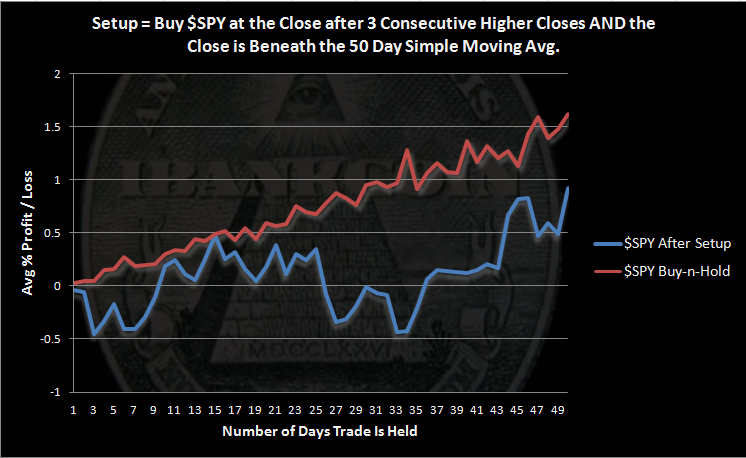
Here is the setup: Buy SPY at the close if it closes less than 0.5% above the lower Bollinger Band (50,2). As you will see below, unlike almost all studies looking 50 days forward, this one is bearish.

If one applies Bollinger Bands to SPY using a 50 day period and 2 standard deviations it is evident that SPY rarely closes near the lower band. Just look back over 5 years and you’ll see what I’m talking about. Usually when it does get near the lower band, it bounces. But sometimes it doesn’t bounce…

Since SPY closed on Friday less than 0.5% above the bottom Bollinger Band, I was curious what had happened when that occurred in the past.

The Results:

The graph above shows the average trade spends most of its time in negative territory after this setup.

However, it is important to note that these results are heavily influenced by a few large losers, with the largest being a -29.84% loss on November 25, 2008.

In fact, with a 62.5% win rate (generated by selling the trade after 50 days), the setup has a decent edge in terms of predicting a higher close over the intermediate term. Unfortunately, in terms of the average winner compared to the average loser, the results are not nearly as positive.

The average winner was 4.77% The average loser was -8.99%.

So while over the intermediate term there is a better than average chance that 50 days later SPY will be higher than Friday’s close, if the setup does not work, the damages could be severe.

I might be a tad melodramatic when I write this, but we are nearing a bounce or die situation.

Resting Up for the Tournament

We arrived safely in Myrtle Beach, S.C., aka the Redneck Riviera late this afternoon. It is good to be back in my home state and near to my old stomping grounds. The water was warm enough to get in and the weather was a perfect 75 degrees with just a few clouds.

My son is playing in a 10 and under tournament this weekend at The Ripken Experience. We have two games on Saturday and at least one and as many as three (assuming we are winning) on Sunday. His first game is 9:00 a.m. Saturday morning, so we are all retiring early tonight.

Perhaps I’ll have some time to get a post up this weekend. Perhaps not. We’ll see…

As for the markets, any gains keep getting sold. The market cannot hold its gains into the close. We should be bouncing, but are not. That is troublesome. I’ll be thinking over this weekend how to break down the recent action to see if there are any clues about the future waiting for us in the past.


S&P 500 Makes New 43 Day Low. Bearish Yet?

The S&P 500 has closed lower 5 out of the last 6 days and is now resting just above its lower Bollinger Band (50,2). I’m a tad concerned that we could see the S&P start a slide down the lower Bollinger Band. Still, even with the above conditions and the S&P making a new 43 day closing low, the intermediate term is still looking bullish. It is truly rare to find a set of conditions that are bearish when looking 50 days ahead.

The Rules:

Buy SPY at the close if

  • It will make a new 43 day low

Sell the trade X days later, at the close.

No commissions or slippage included. All SPY history used.

Results:

This setup has occurred 170 times, and if the trade was held for the full 50 days, there were 45 samples used to make the average represented in the graph above.

We can see increased volatility in the graph, but other than that, everything appears just about normal as the market trends upward at a slightly increased pace following a new 43 day low.

What is somewhat abnormal is closing so close to the lower Bollinger Band. As noted above, caution is in order. However, the intermediate term outlook is that on average, the market recovers from these pullbacks and nothing abnormal occurs.


feedback