iBankCoin
Home / 2016 (page 303)

Yearly Archives: 2016

Palo Alto Earnings Leak Designed to Crush Short Sellers

This is what you get for betting against Silicon Valley’s hottest tech company. The vultures came looking for you, found you, then picked you apart aftet you laid dead in the after-hours–due to an earnings leak.

Shorts thought they could cover before the market closed, to lock in gains and avoid non-systematic risk?

Think again, fucked faces.

PANW

Do not believe for a second this was an accident. Instead, you should know, it was done by design.

For its fiscal Q2 ended Jan. 31, Palo Alto’s earnings per share soared 110.5% to 40 cents, beating estimates by a penny. Sales jumped 54% to $334.7 million, above views of $318.3 million. Both measures, however, decelerated for the second consecutive quarter.

“People are not interested in adding one more agent onto the endpoint,” he said. “So simplified on the endpoint is a driver and it’s very analogous to when people say, ‘Hey, I don’t want firewall and plus, plus, plus (more products).”

Billings also surged 62% to $459 million during Q2 as customers began “buying all elements of our platform,” CFO Steffan Tomlinson said on the call.

Subscription revenue of $84.3 million grew 68% vs. the year-ago quarter.

“We’re seeing customers standardizing on our platform,” McLaughlin said. And with that, “they’re adopting a lot more subscription services than they have in the past.”

Current-quarter sales guidance for $335 million-$339 million topped analyst forecasts for $334.9 million, but Palo Alto’s EPS ex items outlook for 41-42 cents missed Wall Street expectations for 45 cents.

The company’s Q3 sales would be up 44% at the midpoint of guidance, and EPS ex items would rise 80% at the midpoint. But both metrics would also decelerate for the third consecutive quarter. On a seasonal basis, Q1 and Q3 tend to be weaker, Tomlinson said.

Just before the stock halted and earnings leaked, it was trading at $125. The stock has roared higher since, trading up to $147, or 17% higher from the price where the stock traded before the leak.

Comments »

Pershing Square is Cursed; Herbalife Soars in After Hours FTC Deal

Bill Ackman must be paying for some egregious sins to undergo this sort of cruel punishment. The stock market Gods have declared war on Pershing Square and they won’t quit until the enemy, in this case William A. Ackmam, has been vanquished.

HLF

“The company is currently in discussions with the FTC regarding a potential resolution of these matters,” Herbalife said in a regulatory filing on Thursday. “The possible range of outcomes include the filing by the FTC of a contested civil complaint, further discussions leading to a settlement which could include a monetary payment and other relief or the closure of these matters without action.”

The announcement stoked investor optimism that Herbalife can overcome the dispute without incurring much further damage. The company has waged a three-year battle with Ackman and his hedge fund, Pershing Square Capital Management, which made a $1 billion bet against the nutrition company.

With more than a billion short HLF, representing almost 9% of Pershing’s overall assets, this move is sure to apply pressure on some of his other positions, namely VRX.

You’ve got to be fucking kidding me.

Comments »

The Breadth Was Weak

Today is a perfect example why I chose to trade SPY this year, in favor of the whack a mole game of individual stocks. Stock picking has become exceedingly difficult, as money sloshes from one asset to the next. In my opinion, it’s better to be macro, at least for the time being.

Stocks surged ahead again, adding to recent glorious gains. Total winship of the S&P 500 stands at around 7% over the past two weeks.

But the breadth was weak, quite so. Stock pickers were inexorably punched in the face today, with upside participation less than 65% of stocks traded. This doesn’t mean the wheels fall off tomorrow. It simply means there is overhead supply in this market by people who were buried in positions. Now that the market has decided to trade up, they are getting the hell out.

As discussed earlier this week, my final sale of SPY will take place tomorrow, placing me in a 75% cash position. After tomorrow, out of respect for paying members of Exodus, trades will only be discussed, in real time, inside Exodus.

Happy trading.

Comments »

Fed’s Williams: We Should Just Keep Raising Rates

Fed’s Williams thinks crude will be low for years to come. Moreover, he believes inflation can make a roaring comeback to 2%. Most importantly, he believes the Fed should tune out all of the noise, while watch ‘the dats’, and continue its path towards rate normalization.

According to the Federal Reserves ‘dot plot’, this means a total of 16 fresh rates hikes over the next 3 years.

“I still think we should be following the same strategy, however many increases or the pace of increases, which will be driven by the data,” San Francisco Fed President John Williams told reporters in New York.

“We get caught up too much in should we raise in March or June or not or either… It just makes sense the strategy of gradually raising interest rates,” he added.

“I don’t see anything on the domestic economy that worries me in terms of GDP or employment data that we’ve seen. But the inflation data has been a struggle” given persistently low oil prices, though he added he is not too concerned about falling market-based inflation expectations.

All of this jawboning about whether or not to raise interest rates is fantastically boring to Fed’s Williams. He has more important things to do than to worry about pesky stock markets and global trade disruptions due to forex gyrations.

Comments »

Canada’s EDC Gives $553 Million in Emergency Funding to Energy Firms

Export development Canada are throwing good money after bad by subsidizing the poor decisions of small to medium oil firms by providing them with capital.

They’ve approved $553 million worth of funding to help keep otherwise bankrupt companies alive, in spite of massive losses and a commodity that doesn’t look to be making a comeback any time soon.

“There are many smaller companies across Canada with solid fundamentals that are financially stressed, and those are the companies that we can really help to make it through this period of lower oil prices,” Mark Senn, vice president for western Canada, said in a statement.

It’s these sort of actions that keeps pressure on the price of crude. Companies must be allowed to fail, in order to balance the supply/demand situation.

I guess it’s up to the United States to lose jobs and bankrupt firms, for the benefit of oil companies worldwide.

America to the rescue, again.

Comments »

Where’d It All Go? Ackman Gives Up All of 2014’s Forty Percent Gains

In a somber note by the once illustrious hedge fund manager, Bill Ackman, he reported to be down more than 17% for 2016, thanks to an investment plan that consists of concentrated gambles on some very high beta stocks.

Moreover, these losses, when coupled with last year’s 20% drubbing, means that the entirety of his insider trading (AGN deal) fueled 40% returns, which was perfectly legal, are now gone.

Poof. Vanished from existence. It never happened.

At Pershing’s high water mark, assets under management were $20 billion. As of today, a little less than $12 billion.

Comments »

Citi: Global Growth Likely 2%; Recession Risks Are Rising

In a most pointed research note coming out of Citi in a long time, they assert true Chinese growth, ex fraud, is probably in the ballpark of 2%.

Let that sink in.

They feel global recession is something that is entirely possible and that it is the duty of central banks to remain vigilant and to fight back the pangs of deflation through easing.

However, given the current environment, easing is something not likely to occur.

“In our view, global growth is at a highly precarious point, after 2-3 years of relative calm,” the team of economists led by Willem Buiter said in their note likely to exacerbate concerns about the world’s ability to withstand a pause in China’s stunning economic growth.

“The long-standing fragilities in the world economy relate to the structural and cyclical slowdowns in China and its unsustainable exchange rate regime, the excessive level of debt across many countries and sectors and ongoing regional and geopolitical uncertainty,” the economists said. The economists have accordingly revised their forecast for growth this year in advanced economies from a 2.4 percent back in January 2015 to 1.6 percent currently, and warned the 2016 figure “could well be lower.”

When they adjust for what they call “true Chinese growth,” the Citi team finds that global growth might have been as low as 2 percent year-over-year in the final quarter of 2015. That is the lowest since the eurozone recession of 2012-2013, and if growth remains at such depressed levels, it would qualify as a global recession according to their measures:

“To avoid a recession and to avoid a greater slowdown in potential output growth than is warranted because of worsening demographics, the world needs a global version of what we would call ‘Abenomics plus,'” which in Citi’s terms would be easy monetary policy coupled with fiscal stimulus and structural reform that would include “material deleveraging.”

But, given their recession call, the team doesn’t believe these policy measures will actually occur as fiscal stimulus faces high political hurdles.

“Even though we suspect that ongoing economic weakness and limited options for incremental monetary easing will probably reinforce the trend towards modest fiscal easing, we do not foresee a shift to decisive fiscal easing,” they somberly conclude.

image

As such, markets are on their own, naked and exposed to the easterly winds of doom.

Comments »

Goldman: This is Nothing Like the Subprime Crisis

Goldman’s head of global credit, Charles Himmelberg, thinks you’re all idiots for making such a fuss about the oil collapse and the comparison to the 2008 sub prime meltdown.

His main points are the lack of size of the debt problem, when compared to the housing collapse. For example, the subprime debt was $800 billion. The bad oil debt, although $1.5 trillion globally, is merely just $300 billion in the high yield sector.

Is this man out of his fucking mind?

“For one, the magnitude of the subprime mortgage problem in 2007 was much larger with total mortgage debt outstanding rising $5 trillion from 2002 to 2007, while the growth of debt in the oil and gas sector (globally) increased by just $1.5 trillion from 2006 to 2014,” the team says. “At the risky end of the market, subprime mortgages totaled $800 billion in 2007, whereas [high-yield] debt exposed to the energy sector in the US, including both bonds and loans, is estimated to be about $300 billion today.”

“In the run-up to the subprime crisis, the market tolerated extremely high levels of leverage embedded in mortgage-backed securities because house prices and hence mortgage losses were viewed as highly predictable,” the team points out. “In the energy sector, by contrast, the historical volatility of oil prices was well known (even if bond markets failed to foresee the collapse), and thus prevented issuers from pursuing anywhere near the same level of leverage or complexity that was encouraged by the faulty, ‘AAA’ assessments of credit risk in mortgages.”

“Bank balance sheets have far less exposure to energy risk today than they had to mortgage risk in 2007,” Goldman says. “In 2007, for example, mortgages and mortgage securities comprised 33 percent of all bank loans in the U.S. Today, by contrast, commercial loans to the energy sector are relatively modest at just 2.5 percent of total bank loans.”

The level of naivety exhibited in this report runs very deep. Although the debt is less than the housing collapse, does it make the current scope and depth of this debt crisis benign?

In other words, western finance as we knew it was ending in 2009. Comparing this to that is childish and absurd. The world may not be ending; but that doesn’t mean everything is good.

Plus, there are ancillary effects to this story that he doesn’t mention, such as housing debt gone bad due to oil centric job loss and the many industries that rely upon big oil to sustain their bottom line.

Comments »

Houston’s Real Estate Market Reeling From Oil Bust

Contrary to what the Fed and many others will tell you about the economy and the containment of the oil collapse to specific industries, the housing market is being crushed in oil rich towns like Houston.

Just browsing through the for sale notices on realtor.com, it’s easy to see the pain.

image

Prices for homes valued over 500k, just in the month of January, plunged by 9%.

Twenty months into the worst oil price crash since the 1980s, well-heeled residents of the world’s oil capital are among the hardest hit largely because tanking energy firm shares make up much of oil and gas executives’ compensation.

In River Oaks, a neighborhood of palatial mansions and lush gardens, the average sales price of a home has tumbled to $1.3 million from $2 million in the middle of 2014 when oil began its more than 70 percent slide, according to data from the Houston Association of Realtors and Keller Williams. Median property prices in the area have already fallen further in this downturn, which is not yet over, than the 16 percent drop in the previous oil slump in 2008 and 2009.

“When oil does well, River Oaks does well. When oil does bad River Oaks does bad,” said Paige Martin, a Keller Williams broker who specializes in the neighborhood. “Not everybody can afford a $10 million house.”

City-wide data also show that while overall sales of single family homes fell 2 percent in January, sales of those priced over $500,000 tumbled 9 percent. The overall median house price was $200,000, up 5 percent on the year, according to the realtors’ association.

In a nod to the downturn, Ouisie’s Table, a River Oaks institution, is now offering its “Oil Barrel Bargain,” a three course dinner for the price of a barrel of oil, now around $30.

This is called contagion. The wealth created in the Houston oil economy is being destroyed. As time passes, homes will be foreclosed and banks will be forced to take write downs.

I seriously doubt the Texas economy is as diversified as so many bank execs from Texas like to say. I suppose we’ll see about that shortly.

Comments »

NEWS FROM THE ORIENT: The Chinese Market Has Crashed Again

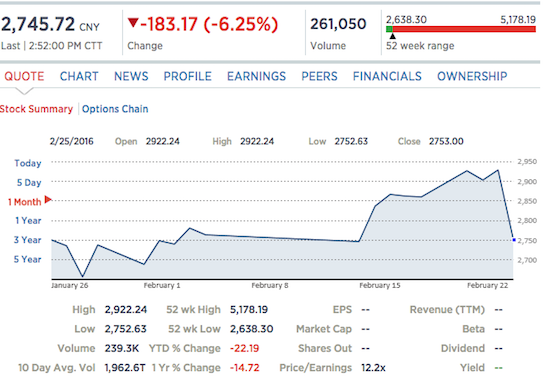
Happy tidings to you, gentlemen, on this fine northeastern evening of rain and wind. I interrupt your internet surfing to inform you that the Chinese stock exchange has plunged by 6%. The tech heavy Shenzen, however, was less delicate in its demeanor towards the rural dwelling shareholders of China. It has traded down by 7%.

China

The samuari in Japan are ignoring the low-level dealings of the Chinese, trading higher by 1.4%–almost spitting in the face of their fiercest competitor in the far east.

Domestically, U.S. futures are lower by just 0.2% and euro-trash futs are ignoring the ignoble Chinese, trading up by 1%.

Portugese-German bonds spreads have widened to 323bps. Once it hits 400bps, the world will end.

Comments »