Global markets are careening lower, amidst the change in the calendar. Without question, the month on the calendar has been changed from April to May. As such, stocks are trading substantionally lower, as investors acclimate themselves to this new reality.
The German people were caught offguard by this shift, spilling beer swill all over their regalia.
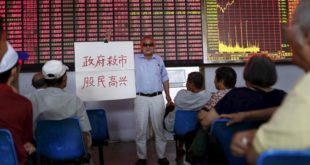
Analysts in China were off by a larger margin for their stock predictions than any other developed country in the world. According to Bloomberg, based off the recommendations of more than 2,000 stocks, these morons were off by 43%.
Let it sink in and wait for it.
“The capital market is hardly predictable,” said Zheng Chunming, a Shanghai-based analyst at Capital Securities Corp.
Horseshit. Of course it’s predictable, if you know what you’re doing.
And here it comes.
“The largest companies on there are owned by the government essentially,” he said in an interview in New York. “The government can tell them what to do — for example, no insider selling at all. They did that for a while last year.”
Ah, ha!
See, the analysts weren’t wrong about their stock predictions. The Chinese nation is home to some of best intellects in the world. Their work ethic is renowned for being superb. Their efficiency in mathematics and the sciences is legendary. So how could they be so wrong on giving stock advice?
BECAUSE THEY ARE DECEIVING YOU ON PURPOSE. One of the first things a Chinese analyst learns to do, when raised in a Chinese equity analyst camp, is to lie. They are fed such lies from the federal government, whose mandates must be followed to the tee, otherwise, an electric powered execution van (save the planet) will visit said analyst for expeditious organ harvestation and subsequent liquidation.
Using some simple scans in Exodus, it behooves me to report that the once ridiculed and often maligned commodity sector is poleaxing the soft helmets of short sellers this year. Thanks in large part to the triple digit run in gold stocks, the basic resource sector–whose market caps are greater than $500 million– are up 19.6% for the year.
Simply amazing.
Consumer goods stocks, led by PG, BUD, PM and CL, are up 6.7%.
Financial stocks are lagging, up just 3.5%.
Healthcare stocks, hamstrung by deleterious pricing pressures during this politically charged year, are lower by 7.2%.
Industrial goods, led by BRK.a, MMM, HON and CAT, are up 10%.
Services, led by AMZN, WMT and MCD, are higher by just 4.2%.
Tech stocks, best represented by AAPL, GOOG, MSFT and FB, are up just 0.10% this year.
Lastly, utilities, often a boring sector but now exciting, are ripping to the upside–higher by 14.6%.
In summary, tech, financials and healthcare, who make up 53% of the market, are vastly underperforming the overall market. If you weren’t a fucking psychopath leaning heavily towards commodities and utilities, you aren’t making much money in 2016.
The market is a wondrous place, built upon the frustrations and failures of many, to the benefit of a select, diversified, few.
The Greenlight Capital funds (the “Partnerships”) returned 3.0%,1 net of fees and expenses, in the first quarter of 2016. It has been a while since we’ve had a profitable quarter to report. Though we would like to make it a habit, trying to manage for quarterly results is really not our philosophy. We think one of our advantages is the ability to be more patient than others, especially as investment horizons appear to be getting shorter.
It was a strange quarter. The S&P 500 spent the first half of the quarter going straight down. Then in the spirit of “never mind”, it turned on a dime, recovering all of the loss and then some. Continuing the game of lower and beat, most companies beat low-balled fourth quarter estimates and many further lowered targets for 2016. In 2015, the S&P 500 companies collectively earned $117, which was 6% less than expected at the beginning of the year.
Yet each quarter when companies reported, earnings were about 3% higher than expected, with roughly two-thirds of the companies exceeding estimates. Impressively, there were 32 companies in the S&P 500 that earned less last year than was expected at the beginning of the year, and reduced expectations for 2016, while somehow managing to report positive surprises every quarter in 2015.
2016 looks to be more of the same. Since the beginning of the year, bottom-up consensus estimates for S&P 500 earnings have fallen from $126 to $120. Companies are again poised to succeed at clearing a continually falling bar.
……………
The “bubble basket” of shorts declined about 13% as several companies within the basket disappointed and de-rated and the market shifted emphasis away from momentum stocks for part of the quarter.
Gold advanced from $1,061 to $1,233 per ounce for a number of reasons. Foreign central banks implemented even more aggressive, and in our view, counter-productive monetary policies. Also, the U.S. Federal Reserve reduced its forecast for future rate hikes in response to a variety of fears/rationalizations including foreign exchange rates, corporate credit spreads, and equity market volatility. Notably, the Fed’s “data dependency” doesn’t appear to relate to employment, which continues to improve, or core inflation, which is now running above its 2% target. We believe the increasingly adventurous monetary policy is bullish for gold.
…………
We had two significant losers during the quarter: ? Resona Holdings (Japan: 8308) fell from ¥591 to ¥402 in response to the Bank of Japan implementing a negative interest rate policy. This will be a headwind for all Japanese financials. Nonetheless, we believe Resona has overshot to the downside. The shares presently trade at 0.6x book value and less than 6x expected earnings. This seems too low for a bank earning a double-digit ROE without significant credit or capital issues.
SunEdison (SUNE) collapsed from $5.09 to $0.54. In January we negotiated with the company to add an independent director to the board. Unfortunately, and to our surprise, the patient was already in terminal condition. Obviously, we underestimated the fragility of the situation.
……………..
We purchased Yelp (YELP) at an average price of $21.16. YELP is a dominant search and review website for local businesses with roughly 200 million unique monthly visitors and the 21st most popular mobile app in the U.S. The stock has suffered due to missed expectations and anxiety about an upcoming negative documentary. YELP is adding more transaction-based revenue, gradually relocating its salesforce to lowercost cities, and providing more reporting tools to its customers to better illustrate the robust ROI of dollars spent with YELP. If the company executes its current plan, by 2019 it will double revenues and earn $300 million of EBITDA at a 35% margin. A peer group EBITDA multiple would imply a $55 stock price. Alternatively, YELP could pare back and operate only in its top 20 markets – using a similar EBITDA multiple, we estimate 30% upside in this “downside” scenario. We also believe that the company has strategic value and that it has been approached by multiple potential acquirers. Should YELP’s board ever decide to auction the company, a bidding war could emerge. Finally, we’ve reviewed the criticisms raised in the trailer to the documentary and we are comfortable that they won’t have a negative impact on our investment thesis. YELP shares ended the quarter at $19.88. We rate them five stars.
We also added a new macro position in natural gas through the purchase of 2017 and 2018 calendar strips at an average price of $2.71 and $2.84 per MMBtu, respectively. Natural gas prices are not high enough to justify drilling in all but the very best locations. The industry has responded by dramatically reducing drilling activity. As existing wells deplete, supplies should fall. The high cost of liquefying and transporting natural gas limits competition to North American sources. Current inventories are high following a period of over-drilling and a record warm winter. However, the excess inventory is only a couple percent of annual production, which has already begun to decline. Normal weather combined with lower production could lead to a shortage within a year. The 2017 and 2018 strips ended the quarter at $2.77 and $2.87, respectively.
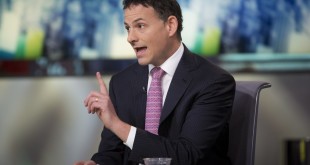
David Einhorn, in his Q1 letter to shareholders, announced a position in the beleaguered social media outfit dubbed ‘Yelp’, ticker symbol for you morons out there: YELP. The core business of Yelp surrounds itself in the ancient criminal traditions of extortion. Much of YELP’s focus is to ‘fish-hook’ restaurant owners into becoming paying customers via advertising or other nefarious services that they offer. Failure to succumb to the YELP hegemony could mean a deleterious drop in their ratings, vis a vie gobsmacking reviews that could wreak havoc upon 2nd rate eateries.
Here is Einhorn’s rationale.
We purchased Yelp (YELP) at an average price of $21.16. YELP is a dominant search and review website for local businesses with roughly 200 million unique monthly visitors and the 21st most popular mobile app in the U.S. The stock has suffered due to missed expectations and anxiety about an upcoming negative documentary. YELP is adding more transaction-based revenue, gradually relocating its salesforce to lower cost cities, and providing more reporting tools to its customers to better illustrate the robust ROI of dollars spent with YELP. If the company executes its current plan, by 2019 it will double revenues and earn $300 million of EBITDA at a 35% margin. A peer group EBITDA multiple would imply a $55 stock price. Alternatively, YELP could pare back and operate only in its top 20 markets – using a similar EBITDA multiple, we estimate 30% upside in this “downside” scenario. We also believe that the company has strategic value and that it has been approached by multiple potential acquirers. Should YELP’s board ever decide to auction the company, a bidding war could emerge. Finally, we’ve reviewed the criticisms raised in the trailer to the documentary and we are comfortable that they won’t have a negative impact on our investment thesis. YELP shares ended the quarter at $19.88. We rate them five stars.
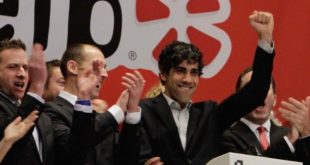
Shares of YELP are higher by 6% in the after-hours, but down 63% over the past two years. This is an unusual position for Einhorn, who typically positions into value stocks. Althought not a very profitable enterprise, YELP’s price to sales valuation is at historically low levels, now under 3x. Back in 2012, whence the social media IPO craze had just begun, YELP traded 21x. Growth has slowed, but is still robust at around 40% year over year. Lastly, out of all the former major social media darlings, YELP’s price to sales valuation is just about the cheapest.
There’s always a bear market. In this case, it lies in the shares of AIG, getting clown-punched in the after hours, off by 3%
Reports Q1 (Mar) operating earnings of $0.65 per share, $0.35 worse than the Capital IQ Consensus of $1.00.
Normalized ROE increased by 110 basis points to 8.9% from the first quarter of 2015, and includes a benefit of 50 basis points due to the lower effective tax rate
GOE reduction of 5% from the first quarter of 2015, excluding the impact of foreign exchange
Commercial Property Casualty accident year loss ratio, as adjusted, of 64.5, 1.7 points lower than full-year 2015 and 0.1 point higher than the prior-year quarter
Strong growth in Personal Insurance underwriting results
Returned $4.0 billion to shareholders
They missed by 0.35 cents. I can’t wait to hear how longs justify remaining long this abomination. This company should’ve been broken up into 10,000 pieces during the financial crisis. It is a reminder, a tombstone rather, of American stupidity, largess.
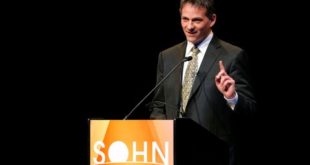
The Sohn conference is for pediatric cancer; needless to say, it’s a great cause. But why can’t these numbskulls just go and have a good time, do stand up comedy routines or sing karaoke for charity, instead of using it as a platform to talk their own books?
Here are some of the outlandish stock advice given during last year’s Sohn conference, by America’s best money managers.
Einhorn, Greelight Capital: short PXD (-2%), short CXO (-9%), short CLR (-29%), short WLL (-70%)
Bravo!
Rosenstein, Jana Partners: QCOM (-27%)
Meister, Corvex: YUM (-10%)
Cooperman, Omega Advisors: GOOGL (+29%)
Robbins, Glenview: ABBV (-6%), BKD (-50%)
Gaonkar, Lone Pine Capital: MSFT (+7%)
Gundlach, Doubleline: Puerto Rican bonds (-5%)
Ackman, Pershing Square: VRX (-84%), JAH (+15%)
Get ready for some new money losing ventures at this year’s conference, scheduled to begin on May the 4th, 2016.
Nothing can stop stocks from marching higher. Oil could go to zero and CAT would still press higher, selling their equipment to drillers who would be legally obligated to buy as per their ridiculous long term contracts. There’s a lot of good deals taking place these days (extra Trump), in spite of the fact that merger cancellations are up 62% in the United Steaks over the past year.
I’ve been unwinding my XLE short for the past week, and have reduced it to less than half of its original size. It was a bad trade that will leave a mark. But I’ve been through far worse and look forward to digging myself from out the hole–something I am rather adept at doing.
The Dow surged more than 100, NASDAQS more than 40. Lads and lasses alike, rejoice in the splendour of American capitalism, a brand of winship that is unparalleled throughout all hemispheres on Earth.
Coming up next: the retarded stock picks from our best hedge fund managers at last year’s Sohn conference.
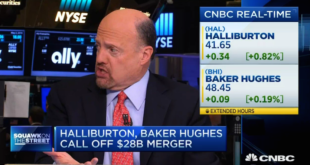
When I read that Halliburton was going to pay Baker Hughes a $3.5 billion termination fee because of the government hurdle in their way from completing the deal, I could not believe it. How is it possible that the law team at Halliburton could get this so wrong and leave the company exposed to a disastrous termination fee? I’ve never heard of such malfeasance.