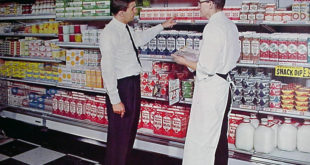
One of the silver linings of having some money during depressions is that you’re able to buy so much. Just think of all the fun you could’ve had during the wonderful days of the Great Depression, when people cost less than a pint of beer. For many years, I’ve suffered in great angst at the Whole Foods grocer, where he’d rip me off with reckless abandon. I prefer to eat food without the inconvenience of cancer causing chemicals in it. As such, my monthly grocery bill typically tops $3k for a family of five. While it’s true, my caprices lead to towards high-end olive oil, balsamic vinegar and the very best cuts of meat, I would prefer to spend less for greedily shoving provisions into my gullet.
Well, according to recent data, it appears the local grocer is in a bit of a bind — thanks to Walmart and other crony capitalists — and prices are crashing, precipitously, the most since 1960.
In a startling development, almost unheard of outside a recession, food prices have fallen for nine straight months in the U.S. It’s the longest streak of food deflation since 1960 — with the exception of 2009, when the financial crisis was winding down. Analysts credit low oil and grain prices, as well as cutthroat competition from discounters. Consumers are winning out; grocery chains, not so much. Their margins and, in some cases, their stock prices, are taking a hit. Eggs and beef have have grown especially inexpensive, and it isn’t only an American phenomenon: In England, Aldi recently offered its prized 8-ounce wagyu steaks from New Zealand for about $6.50 — a little more than the price of a pint of beer.
“The severity of what we’re seeing is completely unprecedented,” said Scott Mushkin, an analyst at Wolfe Research who has studied grocery prices around the country for more than ten years. “We’ve never seen deflation this sharp.”
Mushkin, who researches local markets, recently found that prices of a typical basket of grocery items in Houston, had fallen almost 5 percent over the past year.
He credits, in part, the discerning behavior of shoppers like Manny Sinclair. On a weekday lunch break, the 43-year-old contractor stopped by a Wal-Mart in Secaucus, New Jersey, to pick up turtle food and paper towels.
At first, falling prices helped grocers. Low-cost commodities pushed down the tab for meat and packaged food and boosted profits. Now, deflation has turned ugly for the industry. Led by Wal-Mart, retailers are pushing down prices, eating away at their profit margins.
“It starts to border on irrational pricing,” said Jennifer Bartashus, an analyst at Bloomberg Intelligence. “People are lowering prices just to draw traffic, without thinking about their margins.”
Supermarkets are facing competition not just from Wal-Mart Stores Inc. and Aldi but also dollar stores and online retailer Amazon.com Inc. It could get worse. Lidl, one of Aldi’s German competitors, is building three distribution centers on the East Coast and plans to open U.S. stores by 2018. Even Whole Foods Market Inc. — famously derided as “Whole Paycheck” — is trying to compete on price through digital coupons and promotions on items such as beer and produce.

It was only a matter of time for the deflationary vortex to whirlwind though the food industry, laying waste to margins and causing wholesale disruptions in the industry — which, inevitably, will concede the balance of the market to very large corporate players. Ordinarily, I’d dismiss this news item as transient — a minor blip in an otherwise very magnificent economy. Notwithstanding, there is an estimable draw down taking place in grocery stocks, which I find to be notable.
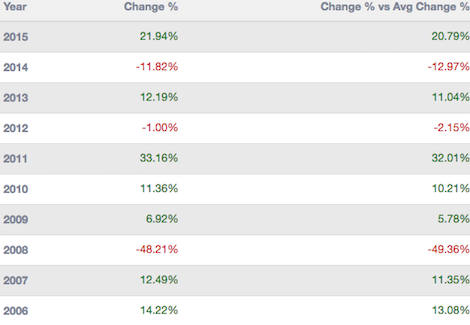
Most of the carnage in the food sector has been isolated, hitherto, only in the grocery stores. Chiefly, stores that compete with Walmart are getting smoked, like KR.
KR -27%
WFM -14%
SFM -24%
SVU -32%
SFS -30%
NGVC -45%
CALM -10%
FLO -27%
HAIN -14%
Just guessing out loud here, eventually the price declines will begin to hurt processed food manufacturers and meat producers. For now, the big winners are consumers.
Comments »