iBankCoin
Home / 2016 (page 108)

Yearly Archives: 2016

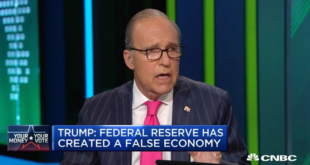
Kudlow Defends Trump’s ‘False Economy’ Claim, Says We’re ‘Perilously Close to Recession’

Aside from agreeing with Trump, that the Fed is complicit in rigging the economy, Larry offered some solutions–which chiefly include lower taxes for small businesses and lower tax rates to permit a repatriation of more than $2 trillion in cash held overseas by U.S. corporations. He then laid waste to a Clinton advisor, who said the economy was doing just fine.

But Larry seems to not grasp what exactly is underway here, or maybe he does and simply doesn’t say it on air.

The high taxes are the moat of big business, that keeps competition at bay. The limbo world that permits U.S. corporations keep cash overseas, indefinitely, without being taxed is preferred by just about everyone on Wall Street. After all, how much in investment banking fees have Goldman and Morgan Stanley made issuing debt for corporations who want to buy back their own stock? Since their cash is overseas, they’re forced to tap into the debt markets to raise capital.

Apple alone has upwards of $72 billion in debt, all the while more than $200 billion sits collecting dust overseas. This is the stupidest, croniest capitalistic, system in the history of mankind.


Comments »

Something to Consider Before You Make Contributions to Your Portfolios: Trump Hates Rigged Markets and the Fed

This an election like none other in the history of the United Steaks. As readers of the site, you know that I’ve been hating on the elderly and infirmed Hillary Clinton, mainly because she’s a neocon establishment bitch. If I were still managing money and allocated long, I’d have a very difficult time reconciling the end of the rigged establishment mafia, who’ve been controlling their henchmen at the Fed to prop up markets, with my personal income/livelihood in the markets. Believe me, I understand how some of you feel, who have much to lose, over the specter of a Trump presidency.

However, you’re not fucking imbeciles and have plenty of time to prepare for a Trump surprise, which will likely entail in sharply lower equity prices–at least initially.

Speaking to reporters on his jumbo jet, Trump had this to say about markets and the Fed.

“They’re keeping the rates down so that everything else doesn’t go down,” Trump said in response to a reporter’s request to address a potential rate hike by the Federal Reserve in September. “We have a very false economy,” he said.

“At some point the rates are going to have to change,” Trump, who was campaigning in Ohio on Monday, added. “The only thing that is strong is the artificial stock market,” he said.

Whoa Nelly! Could you imagine the reaction to futures upon hearing that Trump, a man who openly says the market and the Fed are rigged, won the election?

Don’t look now, but in a very biased and fucked up poll done by DNC operatives at CNN, Trump is leading Clinton by 2.

The market is not pricing this in, not even close.

Comments »

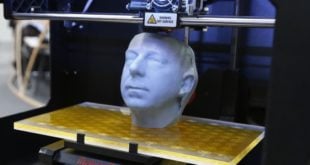
3-D Stocks Explode Higher After $GE Acquisitions Stoke Interest in the Space

The 3-d sector has been crushing it for months and sport fantastic year to date returns, following years of chicanery and price collapses. Today GE announced two acquisitions in the space, both small, but rather motivated in the premiums afforded to the acquirees.

“Additive manufacturing will drive new levels of productivity for GE, our customers, including a wide array of additive manufacturing customers, and for the industrial world,” GE Chief Executive Jeff Immelt said in a statement.

They bought Sweden’s Arcam and then swung on over to Germany to buy SLM Solutions, for a combined $1.4b. Shares of 3-d printer ETF, PRNT, is hitting new highs today. Additionally, the space is on fucking fire.

3d

I’d be careful, however, comparing valuations of the two companies that were just acquired to others in the sector, such as DDD or XONE. Truth is, this was a very targeted set of acquisitions. GE knew exactly what they wanted and bought it. If they thought DDD could help their manufacturing process better, they would’ve bought them. At the end of the day, this is still an industry without profits and is struggling to find consistency in their revenue expectations. I would only buy these stocks with the money of my enemies.

Comments »

Vanity Fair Completes the Destruction of Theranos

Oh my. I do love a good piling on. Nick Bilton from Vanity Fair deconstructed Elizabeth Homes, put her back together, and then hammered her into 10,000 pieces in this scathing review of the once love Theranos.

As you recall, John Carreyrou from the WSJ first broke the story, exposing Theranos for the fraud it was. According to this Vanity Fair report, the employees of Theranos had some choice words for Mr. Carreyrou.

A company-wide e-mail instructed technicians in lab coats, programmers in T-shirts and jeans, and a slew of support staff to meet in the cafeteria. There, Holmes, with Balwani at her side, began an eloquent speech in her typical baritone, explaining to her loyal colleagues that they were changing the world. As she continued, Holmes grew more impassioned. The Journal, she said, had gotten the story wrong. Carreyrou, she insisted, with a tinge of fury, was simply picking a fight. She handed the stage to Balwani, who echoed her sentiments.

After he wrapped up, the leaders of Theranos stood before their employees and surveyed the room. Then a chant erupted. “Fuck you . . .,” employees began yelling in unison, “Carreyrou.” It began to grow louder still. “Fuck you, Carreyrou!” Soon men and women in lab coats, and programmers in T-shirts and jeans, joined in. They were chanting with fervor: “Fuck you, Carreyrou!,” they cried out. “Fuck you, Carreyrou! Fuck. You. Carrey-rou!”

Fucking idiots.

Comments »

Shockingly Weak ISM Numbers Places the Egg Faced Fed on Hold; Gold, Bonds Soar

Mission accomplished. I know these ISM numbers seem grim to you, and they are. These numbers were truly dire, the worst since 2008.

The Institute for Supply Management’s non-manufacturing index slumped to 51.4, the lowest since February 2010, from 55.5 in July, the Tempe, Arizona-based group’s report showed Tuesday.

While a reading above 50 indicates the industries that make up almost 90 percent of the economy are expanding, the figure is lower than the most pessimistic projection in a Bloomberg survey.

Measures of orders and business activity skidded by the most since 2008, when the U.S. was in a recession, and an employment index moved closer to stagnation. Following the group’s factory survey, which showed manufacturing unexpectedly contracted, and separate figures indicating hiring cooled in August, the services slowdown raises questions about the economy’s strength ahead of the Federal Reserve’s meeting later this month.

Seven of 18 industries in the survey showed a contraction in August, including retail; arts and entertainment; transportation and warehousing; and mining. That compares with three industries in the July survey.

The business activity index, which parallels the ISM’s factory production gauge, dropped to 51.8 from the prior month’s 59.3. It was the lowest level since January 2010 and the steepest slide since November 2008.

The new orders measure fell to 51.4 from 60.3, marking the lowest level since December 2013 and largest decrease since January 2008. A gauge of order backlogs fell to 49.5 from 51.

The employment gauge decreased to 50.7 from 51.4, the second straight drop.

As a result of these penny dreadfuls, markets have priced out any chance of a September hike. This, of course, was always the plan. Just when it looked as if the Fed was really gonna pull the trigger, BAM!, a fucking sundry of negative headlines cuts their dicks off.

image

At the moment, markets are throwing a fit and is off a little bit. But barring another China scare, due to capital flight, bad news will likely be viewed as good news for QE easy Fed loving bulls.

Yields are plunging through the floorboards. Gold and silver are ripping higher. Utilities and REITs, or anything with a yield, are measurably outperforming. Markets should love this news, as it permits the faux reality where Central Banks rig markets and set prices thrive in perpetuity.

If you recall, thanks to Exodus, I went all in on gold a fortnight ago, fully expecting this horseshit to materialize.

image

The dollar is getting hammered v the euro, off by 0.9%.

image

Naturally, the yen is soaring during a time of duress, higher by 1.15% v the dollar.

image

Gold +1.5%.

image

US 2yr plunges 5bps to 0.74%

image

Also, the ark floats.
image

Comments »

Larry Summer Destroys Yellen’s Waterboy, Reifschneider, in Washpo Missive

Crazy Larry called this a blog. It read more like a missive. In it, he discussed the absurdity of his new arch nemesis, Janet Yellen’s research expert David Reifschneider.

He argued the Fed was a delusional group of fuckheads who are building in 900 basis point cuts, via QE, during the next bad recession as plainly absurd. He believes the Fed shouldn’t be so sanguine and that the economy might be barreling into a fucking wall of fire.

The Fed should be focused on preventing recession. Also, he notes the Fed would need much higher rates to begin cutting from, in order to have any real chance at fighting a sharp economic slowdown.

The market is right. The Fed is wrong. Reifschneider is a moron of the first magnitude.

As I argued in the first blog post in this series last week, I was disappointed in what came out of Jackson Hole for three reasons. The first reason, as I wrote in that post, was that the Federal Reserve should have signaled a desire to exceed its 2 percent inflation target during periods of protracted recovery and low unemployment, and in this context to signal that a rate increase was off the table for September and quite likely the rest of the year. Friday’s employment report further strengthens the case for delay both by adding to the evidence on the absence of inflation pressures and by suggesting a less robust economy than most expected.

Even apart from the desirability of allowing inflation to rise above 2 percent in a happy economic scenario, gross domestic product, labor market and inflation expectations data all make a compelling case against a rate increase. Private sector GDP growth for the last year has averaged 1.3 percent, a level that has since the 1960s always presaged recession. Total work hours have over the last six months have grown at nearly their slowest rate since early 2010. And both market and survey measures of inflation expectations continue to decline.

My second reason for disappointment in Jackson Hole was that Federal Reserve Board Chair Janet L. Yellen, while very thoughtful and analytic, was too complacent to conclude that “even if average interest rates remain lower than in the past, I believe that monetary policy will, under most conditions, be able to respond effectively.” This statement may rank with former Fed chairman Ben Bernanke’s unfortunate observation that subprime problems would be easily contained.

Rather I believe that countering the next recession is the major monetary policy challenge before the Fed. I have argued repeatedly that (1) it is more than 50 percent likely that we will have a recession in the next three years (2) countering recessions requires four to five percentage points of monetary easing (3) we are very unlikely to have anything like that much room for easing when the next recession comes.

Yellen, relying heavily on research by David Reifschneider using the Fed’s main FRBUS model, comes to the relatively serene conclusion that by using forward guidance and quantitative easing policies — or large-scale asset purchases (LSAP) in Fed parlance, the Fed will likely able to respond adequately to the next recession with its existing tool kit.

I think this conclusion is unlikely to be right.

As Paul Krugman points out, Reifschneider, working with John Williams and using the same FRBUS model, concluded that the ZLB was only a very small issue less than a decade before the financial crisis led to an eight-year stretch of zero rates. The market has been consistently wrong for most of the last decade on the ease with which interest rates could be raised by the Fed. And estimates of the neutral rate have been far lower for far longer than anyone would have predicted a decade ago. All of this suggests the need for substantial humility about what the Fed’s capacities will be the next time the economy encounters difficult times.

There is an important methodological point here — distrust conclusions reached primarily on the basis of model results. Models are estimated or parameterized on the basis of historical data. They can be expected to go wrong whenever the world changes in important ways. Alan Greenspan was importantly right when he ignored models and maintained easy policy in the mid-1990s because of other more anecdotal evidence that convinced him that productivity growth had accelerated. I believe a similar skeptical attitude towards model results is appropriate today in the face of the clear evidence that the neutral real rate has fallen. I pay attention to model results only when the essential conclusion can be justified with some calculation where I can see and follow each step.

Four more specific points deserve emphasis. First, Reifschneider assumes in his base case that the Fed funds rate reaches 3 percent before the next recession and treats as an extreme case the possibility that rates will reach only 2 percent before the next recession. As Jared Bernstein points out, market expectations are much more pessimistic than this. According to the OIS market (basically long-term Fed fund futures), Fed funds are expected even in the long run to rise only to 1.5 percent. This may be a bit misleading because the expected Fed funds rate in 2020 of 1 percent includes some probability that it is zero because of a recession. Even so markets, which have been much more right than the Fed so far, are clearly signaling the likelihood that rates will be under 2 percent when the next recession comes.

I appreciate that Reifschneider takes seriously the possibility of secular stagnation by including a section on it. However, I fear he is overly sanguine in assuming that even under secular stagnation the Fed will start the next recession with an interest rate of 2 percent, as well as a 10-year rate of 3 percent. This seems optimistic given both the market expectations discussed above and the fact that current interest rates are 0.50 percent nearly eight years after the last recession.

Second, though he downplays the significance, Reifschneider finds that the Fed will likely not have as much room to cut rates as it would like under the “optimal control” method that Yellen has extolled in the past. Under this method, the Fed is attempting to minimize the amount that inflation and unemployment differ from target over a series of years. In his simulations, the Fed is not able to use unconventional policies to fully achieve the equivalent of the nearly 12 percent rate cut it would otherwise desire. This shortfall is in response to a recession less severe than the recent one and with the questionable assumption that the Fed should view unemployment being too low as being as harmful as being too high.

Third, I suspect that prevailing views at the Fed about the efficacy of quantitative and forward guidance substantially exaggerate their likely impact. I don’t think the Fed has taken on board the lesson of the three year period since QE ended. If longer term rates had risen after QE and forward guidance ended, this would surely have been taken as further evidence of their potency. It follows that the fact that term spreads have fallen substantially since the end of unconventional policy, as shown in Figure 3, should lead to more skepticism about their efficacy.

On the issue of QE, Greenwood, Hanson, Rudolph and I show that the contrary to much of the discussion during the QE period, the stock of longer term public debt that the market has to absorb went up not down. The amount of longer term federal debt that markets have to absorb is now as high as it has been in the last 50 years and long rates are extraordinarily low, as are term spreads. This calls into question the idea that price pressures caused by changing relative supplies are likely to have large impacts at times like the present when markets are functioning.

I wonder what credibility Fed forward guidance is likely to have given the utter disconnect over many years between Fed and market views regarding future rate and the track record so far of the Fed being wrong and the market being right.

Fourth, even if unconventional policy could be highly efficacious in moving long term rates and even if QE induced moves in long rates were potent, there is the question of how much room there is to bring down long rates. Reifschneider in his very careful paper shows that with a big recession rates would likely approach -6 percent, or even -9 percent, but for the zero lower bound. I find the idea that forward guidance and QE could do the anything like the work of 600, let alone 900, basis points of rate cutting close to absurd. Both QE and forward guidance are said to work by bringing down longer term rates. The 10 year Treasury is now in the 1.6 percent range. If the Fed returned Fed Funds to its lower bound level in the context of a recession, I would expect to see 10 year rates fall substantially perhaps to 1 percent without any QE or forward guidance. How much room is there for unconventional policy to bring them down further?

Reifschneider ‘s assumption that there will be room for unconventional policy to bring down 10 year rates by hundreds of basis points seems to me very doubtful.

To put the point differently, typically in recessions the 10 year Treasury has declined from peak to trough by around 1.8 percentage points. Even if the rate got to European or Japanese levels, surely an unappealing prospect, there may not be enough room to bring down long rates to assure prompt recovery.

On balance, I think the Fed’s complacency about its current toolbox is unwarranted. If I am wrong in either exaggerating the risks of recession or understating the efficacy of policy, the costs of taking out insurance against a recession that cannot be met with monetary policy are relatively low. If my fears are justified, the costs of complacency could be very high. The right policy in the near term should be tilting as hard as possible against recession as argued in the first blog in this series. For the longer term the Fed will have to reconsider its broad policy approach. This will be subject of my next entry.

Comments »

Goldman: Markets in Unsustainable Goldilocks Mode; The Bear Will Catch Her and Bite Her Head Off

In a joyous, albeit somewhat cantankerous note today, Goldman says the current rally and situation with low yields and stretched valuations is unfucking-sustainable. More than that, they likened the market to Goldilocks and said the bear will catch up to eat her.

It’s very simple, according to Peter Oppeheimer (unsure as to his relation to the father of the atomic bomb), either yields go higher and stocks get to enjoy unchecked hedonism, or this fucker is going down in flames–like the fucking Hindenburg.

“Like Goldilocks herself, the market might get away with it for a while but it will eventually get caught by a bear,” said Chief Global Equity Strategist Peter Oppenheimer.

“Either bond yields and interest rates stay at record lows and economic and profit growth disappoints once again (capping valuations), or growth and inflation surprise to the upside (perhaps on the back of more fiscal easing) but bond yields adjust higher (also capping valuations).”

Oppenheimer sees three ways forward for markets:

Reflation — growth picks up, but bond yields do too;

Stagflation — inflation propels bond yields higher, but without a commensurate acceleration in growth; and

Fat and Flat — the most likely scenario, a continuation of the current trend of sluggish growth and low bond yields.

Notably, the potential for multiple expansion in light of ultra-low bond yields – a key component of the Fed Model that’s pointed to attractiveness of equities over sovereign debt – isn’t likely to come to fruition even under the “fat and flat” scenario, the strategist argues.

“There are limits to how much yields alone can drive equity valuations, in our view,” he writes. “Eventually, they have to reflect a realistic assumption about long-term nominal growth.”

Globally, Oppenheimer estimates that measures of the equity risk premium are near levels reached during the European sovereign debt crisis and amid the market turmoil following the Chinese devaluation.

But if one assumes that slow-growth environment that’s prevailed since the financial crisis is a “new normal,” rather than a series of stiff headwinds that will fade over time, equities don’t look like as much of a screaming buy.

“Here lies the great dilemma for investors: on the one hand, current bond yields imply that valuations can continue to rise for financial assets (as they have already done over recent years), but, on the other hand, to justify current risk free rates into the future, we should assume lower long-term growth (consistent with ‘secular stagnation’),” concludes Oppenheimer.

While scribbling random notes on random pieces of loose leaf paper, Oppenheimer was heard saying ‘you can’t have it both ways, motherfuckers.’

Comments »

Morgan Stanley Ups Target for S&P, America the Beautiful Best in Class

The bookworms at Morgan Stanley are impressed with themselves for predicting greener pastures post BREXIT. They’re upping their base case scenario for the S&P to 2,300 and 2,500 for their super duper boolish upside balls on fire market–+14.7% above current levels.

The rationale is very simple, mind you.

As follows.

Compared to bonds, equities appear attractively priced.

In a world where investors are increasingly worried about liquidity, “70 percent of the global equities that trade $100 million or more each day are in the U.S.”

Earnings per share are expected to grow in the U.S., in contrast to many other major regions.

Investors aren’t expecting a massive move higher for U.S. stocks.

“Most U.S. consumer metrics appear directionally positive (housing, jobs, delinquencies, obligations, confidence, personal spending, etc.); corporate excess seems under control; and low growth is still the base case economic forecast,” he wrote. “With few other attractive investment alternatives, we see the U.S. equity market as the beneficiary of further appreciation.”

image

The MS analyst, Parker, loves credit card companies who partake in predatory lending and also nefarious biotech companies with nefarious laboratories who bilk the small people for billions with overpriced drugs. Parker finds both these industries ‘compelling.’

He did hedge his profligate manner with a sober assessment on yields, suggesting low yields usually accompany low PEs because, well, things are fucked.

“In the past, extreme real yields, like where we are now at near 0 percent, were associated with lower price-to-earnings multiples because typically these were perceived as riskier regimes where the world was reliant on policymakers and their efficacy,” quipped Parker. “So perhaps the bubble we are all searching for is simply in the belief in policymakers.”

It’s anyone’s fucking guess. Happy Tuesday.

Comments »

Chinese Yuan Hits 6 Year Lows Versus Dollar

Remember when everyone was losing their shit in February because the yuan was getting hit vs the dollar? All of the headlines spoke to a capital flight out of China, which caused the PBOC to crucify people who tried to convert yuan to dollars, more than the government permitted. World markets were in flux and every single motherfucker I know was scared to buy stocks.

Lo and behold, the yuan is hitting new lows again, much lower than February of 2016–the lowest in six fucking years.

“Bears were testing the psychologically important level of 6.7, which appeared to have been the PBOC’s bottom line lately, but the central bank may have tried to support the exchange rate later,” said Kenix Lai, a Hong Kong-based foreign-exchange analyst at Bank of East Asia Ltd. “China will likely continue to defend 6.7 as the yuan will enter the International Monetary Fund’s basket of reserves in less than a month.”

cny

Talk about currency rigging. Do you people have any idea how badly the Chinese are fucking Japan right now in the FX markets? Try -20% YTD vs the Yen.

How can any country compete vs China when their currency is constantly dropping?

Comments »

CLINTON ENDURES CRINGEWORTHY COUGHING FIT IN OHIO

This isn’t anything new. The chorus of people who’ve been questioning Hillary’s health are getting louder and her actions and infirmed appearance are emboldening others to ask “what the fuck is going on here?”

During today’s speech in Cleveland, Clinton underwent a cringeworthy 4 minute coughing fit. Watch here.

She blamed allergies for her fit.

Weather and pollen count in Cleveland, OH today.
ragweed

Maybe she’s allergic to ragweed?

Comments »