iBankCoin
Home / 2016 / August (page 9)

Monthly Archives: August 2016

IPOs Are Smoking Fucking Hot

Let me preface everything that I say here with the fact that I am actively ignoring the melt up and will continue to do so–because I refuse to play in a rigged game. Granted, this leaves me out in the cold like Fred Flintstone, while the rest of you do blow with Dino and Wilma. Like any good Doctor, I endeavor to do no harm, using that as my credo as I navigate markets with a snarky disposition.

Having said that, the true barometer of any good bull market is the health of its IPO market. Last year, the IPO market was dreadful, littered with stupid shit like ETSY–regularly blowing people to smithereens, Fred Wilson style. But this year, its been good–real good.

Using the IPO screen in Exodus, the following stocks are crushing the market over the past month. Overall, the median return for IPOs, over the past 3mos, is upwards of 11%. That number is much higher for the anointed few.

TEAM +29%

SUPV +21%

TWLO  +38% over the past month (shout out to Option Addict on this one)

SQ +31%

RRR +18%

ACIA +239%

CCRC +56%

PEN +42%

Look for a slew of IPOs to come public in September, once the junior traders are slapped fucking stupid off the trading turrets, making room for the true bosses coming back from a summer of narcotic induced sauntering.

Comments »

Mylan’s CEO, Heather Bresch, Enjoyed a 671% Spike in Compensation After Epipen Price Gouging


Since 2007, when Mylan acquired the life saving allergy drug called Epipen, the company has been on a mission from hell to gouge desperate patients who need the drug to survive. More than that, its executives have also lavished themselves with gratuitous compensation hikes, reminiscent of the days when Marie Antoinette famously suggested the starving ham and eggers outside the castle gates be fed cake to subside their anguish.

From 2007-2016, Mylan’s CEO, Heather Bresch, enjoyed a 671% pay hike, from $2.4m to $18.9m. Also, their President and COO, Rajiv Malik and Anthony Mauro saw their salaries increase 11% and 13.6%, respectively, in the year 2008 alone.

Over the same time period of Heather’s exorbitant lifestyle upgrade, the price of the Epipen increased 461% from $56.64 to $317.82. From the fourth quarter of 2013 thru 2016, Mylan jacked up the price of Epipen by 15% every other quarter.

How nice of them.

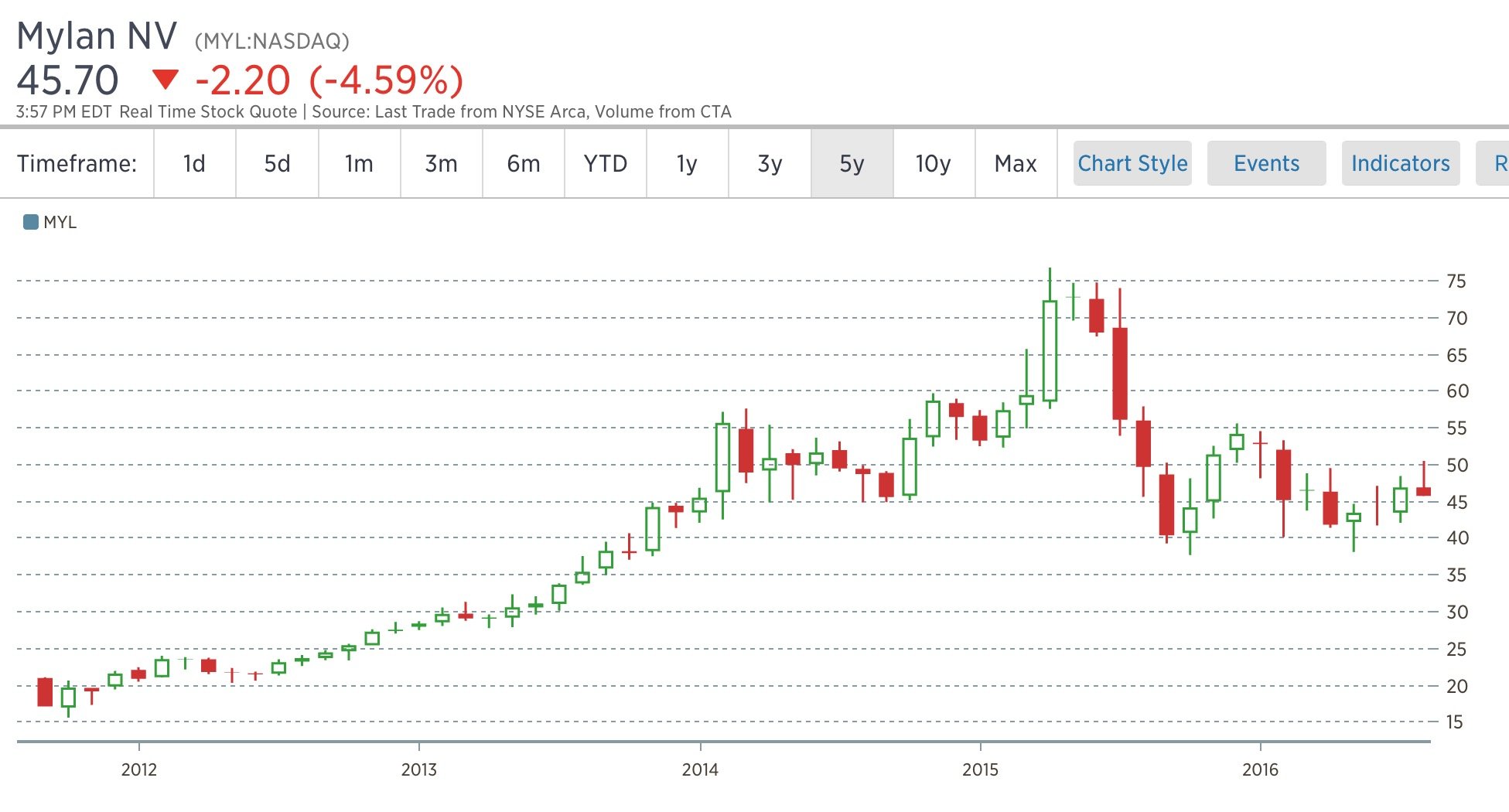
Shareholders have done very well, magnificently so. The stock has risen from $13 to $47 over the same time period.

image

Wait, it gets better.

Like any good executive worth his/her salt, the company sought out to expand the usage of the Epipen. After all, people needed it. Kids needed it, to live. So they ramped up their lobbying efforts, dramatically, spending $1.2m in 2008, up from $270k, to ‘convince’ officials to see things their way.

Shortly thereafter, the FDA changed its recommendation that two Epipens be sold per package, allowing them to sell one at a time, and that it be prescribed to ‘at risk’ patients only.

In 2013, congress passed a law that required Epipens be stocked in public schools, all the while Heather and Co., like the true robber barons they are, price gouged and injured the American tax payers, while endangering the lives of those who needed the drug to survive by making it unaffordable.

Crony capitalism.

Comments »

Sanford Bernstein: Passive Investing is Worse Than Marxism

You’d expect an advisory firm to shit on index ETFs in a report saying they’re worse than Marxism. Index ETFs have only grown in popularity thanks to the underperformance of professional asset managers. There is, however, a much graver threat to our form of crony capitalism that is rarely discussed, one that the eggheads from Bernstein skipped over.

In a note titled “The Silent Road to Serfdom: Why Passive Investing is Worse Than Marxism,” a team led by Head of Global Quantitative and European Equity Strategy Inigo Fraser-Jenkins, says that politicians and regulators need to be cognizant of the social case for active management in the investment industry.

“A supposedly capitalist economy where the only investment is passive is worse than either a centrally planned economy or an economy with active market led capital management,” they write.

Fraser-Jenkins notes that the rise of indexing should theoretically entail that stocks tend to move in the same direction more often (though such a simple relationship isn’t necessarily borne out by the data), and cites research indicating that “if the correlation of stocks increases then that impedes the efficient allocation of capital. That is, there isn’t as big of a difference in capital expenditures on a sector by sector basis than what would be expected based on relative profit growth.

The social function of active management, in a capitalist society, is that it seeks to direct capital to its most productive end, facilitating sustainable job creation and a rise in the aggregate standard of living. And rather than be guided by the Invisible Hand and profit motive, capital allocation under Marxism is conducted by an oh-so-visible hand aimed at producing use-values that satisfy each member of the society’s needs. Seen through this lens, passive management is somewhat tantamount to a nihilistic approach to capital allocation.

“The commonality between both active market management and the Marxist approach is that in both cases there are a set of agents trying – at least in principle – to optimize the flows of capital in the real economy,” writes Fraser-Jenkins.

Bernstein’s team isn’t asking for governments to bail out active managers, but merely advises that lawmakers and regulators “may wish to consider the broader benefits of a functioning active asset management industry to society as a whole so that when policy initiatives are undertaken they do not explicitly undermine active management.”

Let’s talk about Serfdom, Fraser-Jenkins. While SPY or QQQ ETFs might muddy the waters, lumping in great companies with shitty ones, there is a much greater, invidious, force out there that is misallocating capital on an unprecedented and monumental scale. It’s called QUANTITATIVE EASING.

I discussed this last night, in a missive against the BOJ. The ETFs are merely the vehicle towards  the socialization of markets. QE, or the creation of money for the explicit purpose of manipulating markets, is the fuel.

There cannot be a market if the game is rigged. With the ECB and the BOJ artificially causing yields to drop, we are bearing witness to a melt up in equities, driven by passive investments in major ETFs, as investors search for yield. In Japan, their schemes are far more advanced and egregious, as previously noted. While the existence of index ETFs might be inconvenient for the asset management industry, its deleterious effects on capitalism pales in  comparison to the degenerate central bank schemes of QE.

Get real Bernstein.

Comments »

Enemy Reporters at $NYT Hacked By Russian Devils

CNN is reporting that “Russian Intelligence” has hacked into email addresses at some prominent reporters at the enemy news organization, dubbed The New York Times.

I am not sure whatever the fuck CNN is talking about, in regard to Russian hackers. They also blamed the Russians for the DNC Leaks, which wasn’t a hack, but a fucking leak. Conveniently, CNN leaves out the part that the founder of Wikileaks, Julian Assange, said Seth Rich was the leaker and the Russians had nothing to do with the matter.

The narrative out of the White House and the Clinton camp, which is basically synonymous, is to blame Russia for just about everything. If in fact you do not agree with this assertion, speaking to a vast Russian conspiracy to take down America, then you’re a fucking Russian spy.

McCarthyism is alive and well.

Comments »

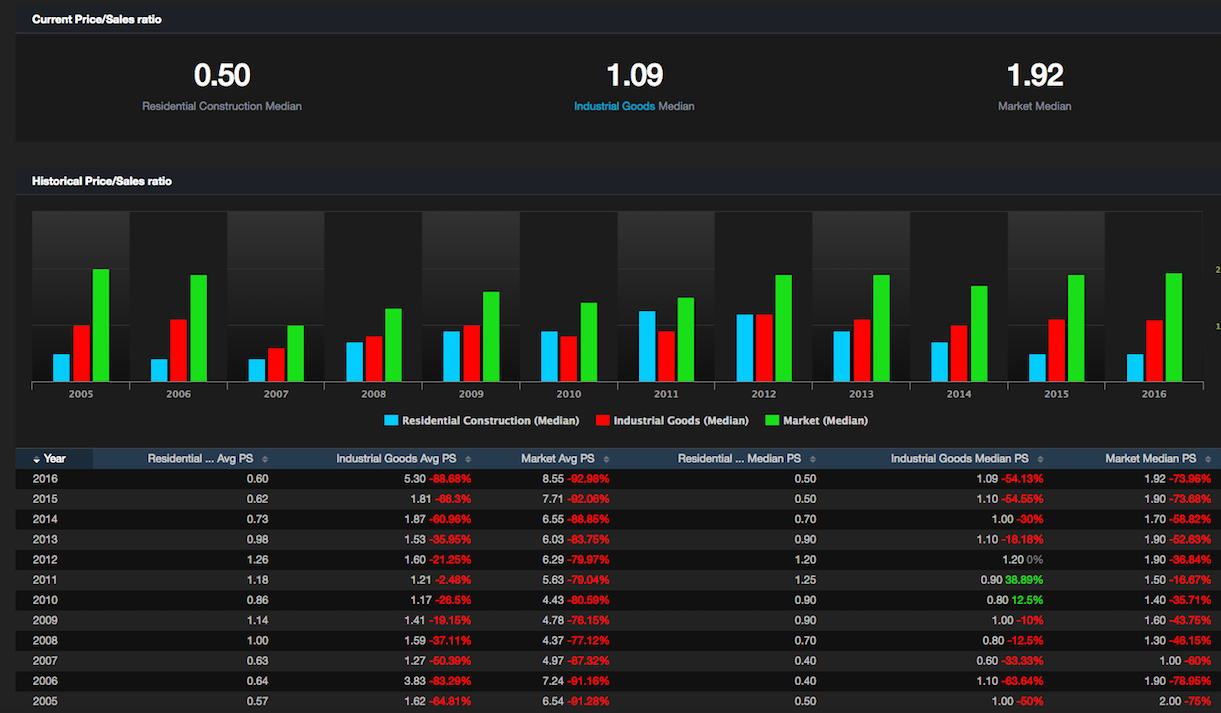
Housing Stocks Roar Because HOUSING BOOM

The median return for the housing sector is +6% this year. Over the past two years, however, the sector is down by 8.8%, in spite of record low interest rates and record high stock prices.

Today Toll Brothers came out with better than expected results and truly lauded the state of the residential market in their call.

Contracts grew in every region; virtually every metric improved Y/Y. TOL saw sequential improvement throughout Q3 and August reservations were up 23%.

  • Repurchased ~3.7 mln shares at $26.33/share ($97 mln), representing ~2% of outstanding shares. Will opportunistically buy back stock
  • Still bought $459 mln in land, mostly in California; now has 48K lots owned/optioned
  • Margin reduction a result of some higher margin City Living property deliveries being pushed out into FY17.
  • Not seeing any softness in luxury home market.
  • No change in appetite from foreign buyers (low to mid-single digit mix)
  • High end of NYC market is fine. Remains bullish in California, well positioned. Ivy Zellman said co is ‘kililng it.
  • California, Vegas, No. Virginia, NJ/PA, Seattle, Dallas, Raleigh all strong; both coasts going well.

As a result, shares of many homebuilder stocks are rising.

housing

According to Exodus, valuations for the sector haven’t been this attractive since 2007.
RE

But that was a different story back then, wasn’t it? Homies were crushing numbers and trading like internet stocks, because of the housing bubble. Aside from the luxury market, there isn’t a bubble in real estate anymore. If your home is priced in the $300k-$999k range, values haven’t moved in years.

Having established those points, this is an intriguing sector to be long, if you believe the economy will improve and the Fed might hike rates over the next 12 months. Typically, the specter of higher rates coerces people into buying, in order to lock in rates.

Home ownership is at 50 years lows, as the younger class of vagabonds rent inside of filthy and disgusting urban centers. But there’s always a counter-balance and I am sure some of these punk kids, once properly employed, will venture out into the suburbs for a cleaner and better life. They’ll buy a home, and a few fucking dogs, and live happily ever after.

Seasonally speaking, September is the worst time to own the sector, which means it might be a good time to buy dips.

While everyone seems to be focused on the caprices of Amazon and Exxon shareholder behavior, there is a whole sector of economically sensitive stocks out there–trading at historically low valuations, that are now moving to the upside.

Comments »

Bank of America Releases Their Absurd Top 10 Reasons Why Stocks Should Drop

I’m wondering why they only published 10 reasons why stocks should correct from current levels and not 11 or even 15? These lists are usually concocted by infantile baboons.

Positioning
The most hated rally since the great pyramid building craze in ancient Egypt has a lot of shorts throwing in the towel. Investors are becoming increasingly bullish, which of course is bearish, because the layman is a moron.

Economic Surprises
Investors have become super complacent, playing with dynamite sticks inside gunpowder factories, always a bad idea.

Valuations

Shit is expensive and that might provide someone, somewhere, with a reason to sell.

Elevated Expectations
Every one is very sanguine about QE and an economy that can sail smoothly into the sunset, as indicated by the VIX.

Growth

Growth is essentially non existent and expectations can easily fall short, leading to harrowing declines.
China

The Chinese economy, as measured by the PMI, is contracting. Therefore it is a headwind and a risk.

Credit and Leverage

Credit and leverage are high because we’re all degenerates. The lack of credit is mostly widely found in the energy sector.

“Leverage is high and credit is slowly tightening, while appetite for equity issuance may also be drying up,” she writes, highlighting high levels of indebtedness among S&P 500 companies once financials and tech are removed from the equation.

Elections
Donald Trump is a yuuuge risk to the globalization narrative.
The Fed

The Yellen Fed is lost at sea.

Seasonality
September is a dreadful month for stocks. October is renowned for market crashes. Enjoy.

Comments »

BEST BUY CRUSHES ESTIMATES; LET THE GOOD TIMES ROLL

My son works at Best Buy in one of the highest grossing stores in America. He’s been telling me how good sales were, tracking ahead by 10% over last year. These numbers are, without question, the best barometer for the consumer that can be used as a short term catalyst to buy stocks like FIT, GPRO and even WDC.


  • Reports Q2 (Jul) earnings of $0.57 per share, excluding non-recurring items, $0.14 better than the Capital IQ Consensus of $0.43; revenues rose 0.1% year/year to $8.53 bln vs the $8.39 bln Capital IQ Consensus.
  • Comps +0.8% vs. flat guidance.
  • Domestic revenue of $7.9 billion increased 0.1% versus last year driven by comparable sales growth of 0.8%, partially offset by the loss of revenue from 12 large format and 22 Best Buy Mobile store closures. Industry revenue in the NPD-tracked categories declined 3.2%.
  • From a merchandising perspective, comparable sales growth in health & wearables, home theater, major appliances and computing was partially offset by declines in mobile phones and gaming.
  • Domestic online revenue of $835 million increased 23.7% on a comparable basis primarily due to increased traffic, higher average order values and higher conversion rates. As a percentage of total Domestic revenue, online revenue increased 200 basis points to 10.6% versus 8.6% last year.
  • Co issues guidance for Q3, sees EPS of $0.43-0.47, excluding non-recurring items, vs. $0.45 Capital IQ Consensus Estimate; sees Q3 revs of $8.8-8.9 bln vs. $8.77 bln Capital IQ Consensus; comps +1%.
  • “As it relates to our full year financial outlook, we are reaffirming our expectation of approximately flat revenue and raising our full year non-GAAP operating income3 outlook. We continue to expect the slight revenue decline in the first half to be offset by slight growth in the back half and in light of our first half performance, we are now expecting a full year non-GAAP operating income growth rate in the low-single digits versus our previous expectation of approximately flat. This includes lapping the significant periodic profit sharing benefits from our services plan portfolio that we earned in fiscal 2016. As we discussed on our previous earnings calls, our full year outlook assumes (1) a relatively better mobile cycle; (2) a trend in the NPD-tracked categories consistent with the last two quarters; and (3) delivering our cost reduction and gross profit optimization initiatives.”

Boolish.

Comments »

Goldman: The Recent Rally in Crude is a Fiction

The rocket scientists at Goldman Ballsachs have scratched their nuts, taken a look at current WTI prices, and posited that the recent move is completely and utterly out of the realm of rational thinking.

“While oil prices have rebounded sharply since Aug. 1, we believe this move has not been driven by incrementally better oil fundamentals, but instead by headlines around a potential output freeze as well as a sharp weakening of the dollar (and exacerbated by a sharp reversal in net speculative positions),” Goldman Sachs said.
The bank said a proposal by members of the Organization of the Petroleum Exporting Countries (OPEC) and other producers like Russia to freeze output at current levels “would leave production at record highs” and therefore do little to bring supply and demand back into balance.

After today’s drubbing, the price of WTI is higher by 8% over the past two weeks. A move of this magnitude has gotten many “Commodity Kings” to become quite perturbed by the violent manner from which this rally was spawned.

What goes up, must come down.

Comments »

Trump Calls for Special Prosecutor to Investigate the Crimes of Hillary Clinton

This is a snippet from a lengthy speech given today in Akron, Ohio. During his barbarous savagery of H. Clinton, Trump paid waste of the Department of Justice, calling it an arm of the White House–utterly and contemptibly corrupt. He runs through a laundry list of Clinton fuckery and asks for a special prosecutor to be assigned to investigate the litany of crimes committed by a certain H. Clinton.


All that being said, tomorrow’s Washpo/NYT headlines will probably read “TRUMP IS A FUCKING RACIST PIG BASTARD MOTHERFUCKER; BURNS CROSS IN AKRON AND LYNCHES TEN DOZEN AFRICAN AMERICANS AT WHITE ONLY RALLY.”

Comments »

Investors Begin to Worry About the Long Term Prospects of a Government Controlled Japanese Stock Market

Explain to me how this could possibly not end in disaster? Pretend that I am a moron baby, unable to decipher the difference between a lion and a glass of milk. If you can convince me that my dire and gloomy outlook for Japan is both overzealous and too grim, I will reverse my position and buy NIKKEI futures tonight.

Since the Bank of Japan added ETF’s to their shopping list of goods to be purchased by their imaginary Kuroda money, they’ve quickly come to dominate the Japanese equity markets–being a top five holder in over 80 stocks listed on the NIKKEI 225. Very soon, and at the pace they’ve been buying ETFs, they will become a top 5 shareholder in every single company in the NIKKEI 225, all by printing money that never existed before and then transferring those digits into the open market to buy said shares.

Currently, they are the #1 shareholders in over 55 companies.

This is the ultimate socialization of markets. Gone are the days when good companies with solid metrics went up in value, based upon merit. In Japan, and coming soon to a western market near you, all companies domiciled in a targeted index are subject to misallocations and purchases of shares for reasons unrelated to company fundamentals.

“The increased BOJ purchasing provides a very favorable demand environment for listed equities,” said Michael Kretschmer, chief investment officer at Pelargos Capital in the Hague. “Nevertheless, in the long run we strongly doubt these type of monetary gimmicks aimed at price setting of risk assets can have a sustained positive impact on economic growth.”

The BOJ decided on July 29 to expand this stimulus by increasing its annual purchases of ETFs to 6 trillion yen ($60 billion) from 3.3 trillion yen.

With foreign investors largely staying away, disappointed at the lack of progress in Japan’s structural reforms, the BOJ is almost sure to be the biggest buyer on the Tokyo Stock Exchange for the foreseeable future.

“The market is driven completely by the BOJ’s buying rather than views on each companies’ earnings,” said a fund manager at a Japanese asset management firm.

ENTER A TRUE FRANKENSTONIAN MARKET

“The rise in share prices may seem desirable but it causes harm as well,” said Shingo Ide, chief equity strategist at NLI Research Institute. “Even if companies need to improve their management, shareholders may not take them seriously if share prices are not falling.”

So extrapolate out and try to imagine what their markets will look like in 10 years. How will the BOJ unwind these positions? They cannot. If they continue to purchase stocks and corner the market, based upon all of the books in my library that tell tales from the Robber Baron era when cornering markets went bad, they’re in for a very rude and stark rebuttal– whenever people wake up and reject the notion that markets aren’t simply a binary exercise of buyers and sellers.

Historically speaking, gauche plans like this one rarely produce the mechanized gilded results desired by its authors. Speculators have been drawn and quartered for far less. This will end, in my estimation, in utter catastrophe–an unseasonable theatricality never seen before in modern times.

Comments »