iBankCoin
Home / 2016 / January (page 30)

Monthly Archives: January 2016

Fed’s Mester is Completely Delusional; Wants to Hike Faster

What is this a fucking joke? They trot this crazy eyed woman out there when everything is falling apart to tell us China is not a concern and how our growth is so good, so robust, why, if left only to her, she’d have rates exploding to the upside in no time at all.

“I am not that concerned about that in terms of the U.S. economy,” Mester said in an interview with Bloomberg television.

How very nice.

“We’ve built in a weakening path for China. I don’t see that as a significant risk to the forecast” for the U.S. economy, she sai

Don’t worry, Loretta Mester built it all in. Oh, as for U.S. GDP growth, she has some estimates for us.

“I’m pretty comfortable with the median path … I think that’s not a bad description,” Mester, who votes on U.S. monetary policy this year under a rotation, said on the sidelines of an American Economic Association meeting.

“I’m probably a little steeper than that in the near term, just because I have a higher growth forecast.”

Mester expects the U.S. economy to grow at a 2.5 percent to 2.75 percent pace this year, slightly stronger than the 2.4-percent rate median forecast of her colleagues. That optimism allows her to view more than four rate hikes as appropriate, she said.

We are so lucky to have policy heads like her, watching over our coffins as they get tossed into shallow graves.

Comments »

GRAINS CRATER TO 9 YEAR LOWS

With all of these prices going lower, I’d love to see some of the supporting arguments from the Fed to raise rates another 4-5 times this year.

Atop of everything else, grains are hitting 9 year lows and these poor bastards are hoping that a flood, mind you, will help alleviate the hell they find themselves in.

image

The Bloomberg Grains Subindex fell as much as 2.1 percent to 38.77, the lowest since Sept. 15, 2006. Beneficial rain boosted prospects for crops in Brazil, and Argentina exporters are increasing shipments, partly after the government relaxed tariffs. World equities had the biggest drop to start to a year in at least three decades, led by a rout in China.

“It’s just a culmination of everything,” Don Roose, president of U.S. Commodities in West Des Moines, Iowa, said in a telephone interview.

Remember the great boom in potash and fertilizer stocks? Well that’s dead. POT, MOS, and IPI are down anywhere from 35-80% over the past two years.

Comments »

WORST OPENING DAY SINCE 1932

I am waiting for locust swarms to swoop in and decimate my neighbors gardens.

Stocks are having their clocks thoroughly cleaned for them today, off by 450.

There are a few lads running about the prairies who feel this sell off is overdone. But there aren’t too many of them.

“A lot of it has to do with China and a lot of it is overdone,” said Art Hogan, chief market strategist at Wunderlich Securities.
“The China PMI hasn’t changed much. It’s not unusual to have an outsized reaction when you’ve got a base case that 2016 could be a tough year.”

“I think it’s very much global markets are in a risk-off mode. It’s very hard to step in the way of (that),” he said.

Things were a lot easier back in 1932. The economy was affirmed to be mired in a bit of a slump, unlike this ambiguous smoke and mirrors crap. There weren’t any hipsters. And CNBC wasn’t invented yet.

Ah, the good olde days of 1932.

Comments »

Gold Soaring During Times of Crisis is Boring

How many times do we have to see this show? Gold is a piece of offal 361 days per annum. For that one really bad trading week, sans the Friday when people come to their senses and sell gold again, gold goes on a nice run.

During these 4 trading days of greatness, the gold bugs crawl out from their caves to declare martial law on equity markets. They order all women and children out of the markets and attempt to kill all men of military age.

As they chase these windmills, gold sets up to dump out again and again and again.

image

With the Dow off by 400, amidst panic and cataclysm, gold stocks are soaring.

image

BORING.

Comments »

BRITISH FORCES TO BE DEPLOYED TO SEIZE BACK LIBYAN OIL FIELDS FROM ISIS

Everything is lower, but crude stocks. Go figure. We live in bizaaro land. But there are some interesting developments, as well as oil grabs, taking placed in Libya.

Four Islamic State militants and two petroleum guards were killed in the ongoing armed confrontations near Es Sider, al-Hasy said by phone. An oil storage tank was hit by a shell and caught fire, he said. The storage tank is close to the oil port of Ras Lanuf, Mohamed Elharari, spokesman of the state-run National Oil Corp., said by phone

“An oil storage tank caught fire and there was a big explosion,” Elharari said.

Islamic State militants previously tried to attack Es Sider in October, killing one guard, but were repelled at the gate of the terminal by the petroleum guards. Es Sider and Ras Lanuf terminals have been closed to oil exports since force majeure was declared in December 2014 when armed groups attacked the ports. Force majeure is a legal status protecting a party from liability if it can’t fulfill a contract for reasons beyond its control.

Libya, with Africa’s largest oil reserves, pumped about 1.6 million barrels a day of crude before the 2011 rebellion that ended Muammar Qaddafi’s 42-year rule. It’s now the smallest producer in the Organization of Petroleum Exporting Countries, producing 370,000 barrels a day in December, data compiled by Bloomberg show.

In response to ISIS fuckery, western nations, led by Britain, are deploying up to 6,000 soldiers to seize Libya’s top oil fields. No, that was not a typo.

SAS troops are understood to be preparing for an offensive involving 1,000 British soldiers to wrest back control of a dozen oil fields seized by the jihadists.

ISIS has taken advantage of the lawlessness since the 2011 ouster of Colonel Gaddafi to make large gains along the coastline, setting up its power base in the former dictator’s hometown of Sirte.

Mirroring its strategy in Iraq and Syria, the terror group has seized a number of revenue-boosting oil fields and are now targeting the Marsa al Brega refinery, the biggest in North Africa.

SAS troops are understood to be planning an offensive involving 1,000 British troops to seize back control of oil fields captured by the Islamic State in Libya after the country descended into chaos.

The operation will involve around 6,000 U.S. and European soldiers led by Italian forces, the SAS and military close observation experts from the Special Reconnaissance Regiment.
British experts will advise Libyan military commanders on so-called ‘battle-space management’ – tactics and skills needed to control the battlefield.

Don’t fuck with Rome’s oil.

This is the worst start to a New Year since 2001.

Comments »

GET ON THE ARK; THE WORLD IS ENDING

Futures are off by 300. European markets are swan diving into solid cylinders of cement. And all of Saudi Arabia’s friends are severing ties with Iran.

The world is ending, once again. When the world ends, people get nervous. They fear their money will lose value, or their investments go bust. In the past, gold would serve as a safe haven. Nowadays, the hipsters toss the tips they make from bar tending into Bitcoins. The small pleb can play it via ETF now. How splendid.

image

For real players, however, men of industry and property, U.S. Treasuries and Japanese Yen is where you want to be. For treasuries, people enjoy having their money in the strongest and the best country in the world. Our military apparatus can and will lay waste to all other armies in the world, combined. That’s the true backing of the U.S. Dollar, see. It isn’t based upon economics, but safety.

image
The Yen is more of a doomsday clock scenario playing out, where an aging Japanese society, saddled with absurd debt, loses control of the “Yen carry-trade”, which eventually leads to the complete annihilation of the Japanese people.

This, of course, never really happens, only in Kyle Bass’s sick, demented mind.

Nevertheless, when risk assets are under pressure, people assume the loans taken out in Yen to buy stocks in Europe or America will pressure that trade to end. As such, FXY rises and ultra-bearshitters reap the rewards.

image

As you know, I cleared the decks before the New Year’s and have a very large portion of my assets parked in TLT. Until Exodus gives me my first trade of 2016, I am more than comfortable waiting for things to settle down long U.S. Treasuries.

Comments »

CHINA PLUNGES, EUROPE PLUNGES; WELCOME TO 2016

They say as January goes, so does the rest of the year. If that’s the case, we’re about to begin our journey into 2016, deep in the hole. Dow futures are off more than 250, after China’s idiotic stock exchange soiled itself–causing officials to just shut the damned thing down–losing about 7%.

image

Copper is down nearly 3% and European markets are wishing they has Chinese overlords around to just stop the bleeding and arrest the damned short sellers who keep pressuring the indices.

image

How important is January to markets? A down month has resulted in down years, 70% of the time.

image

Comments »

CHINA CRASHES 7%; STOCKS HALTED FOR TRADE

Happy New Year’s!

Chinese markets broke through the floors boards, falling by 7%, causing officials to say “fuck it” and just shut the whole thing down.

image

Chinese stocks plunged Monday, spurring a trading halt for the rest of the session and leading stock markets in Asia Pacific lower after feeble manufacturing surveys revived concerns over the durability of the country’s economic recovery.

The Shanghai Composite tumbled 6.85 percent to 3296.66 and the Shenzhen Composite plunged 8.1 percent. The CSI 300 was down 6.98 percent; when that index rises or falls 7 percent, a trading halt in China’s markets is triggered for the rest of the session.

Circuit breakers are in effect. Other Asian markets are following them down the sewer drain. Dow futures are now off 158.

Comments »

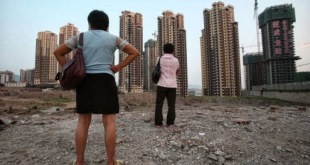
China Wants Poor Migrant Workers to Fill Their Ghost Cities

But it’s impossible, you see. According to the laws of economics, persons making $400 per mo, slaving away at a Foxconn suicide factory, to make lavish Apple products, cannot buy luxurious condos, unless of course the gov’t looks the other way when it comes to lending.

You know, just like we did from 2003-2007.

The move underscores Beijing’s concerns over a stock of some 1 billion square meters of vacant housing – around 13 million homes or enough to house the population of Australia – and the broader knock-on effect of any defaults by struggling property developers as the world’s second-largest economy grows at its slowest pace in a quarter of a century.

While encouraging migrants to buy homes in lower-tier cities seems like a remedy to boost demand, making money available to them will prove tougher. Many of China’s more than 270 million migrants earn below 3,000 yuan ($462) a month, less than half the cost per square meter needed for a home in a lower-tier city such as Changzhou, in eastern Jiangsu province.

“Conditions are not mature for migrant workers to buy unsold homes. You can’t count on a certificate for housing ownership to resolve everything,” said Jason Hu, head of research at Chinese property consultant Holdways in Beijing.

“Everyone wants to settle in the city, but where’s the money?” said Hu, adding other issues need to be resolved such as giving migrant workers equal access to social security and public services.

Authorities aim to get 100 million migrants to settle in cities by 2020, and officials in small-and medium-sized cities have pledged to give permanent resident status, or hukou, to more rural people, although access to welfare remains a concern.

Another potential obstacle is that more than 70 percent of migrant workers already living in cities prefer to rent, according to National Health and Family Planning Commission data.

“If I can earn enough I’d go back to the city near my hometown and buy a home there,” said a restaurant worker in Beijing who gave just his surname of Long. “Prices here are too high, it’s impossible for me to settle here,” added the 26-year-old who left his village in central Hunan province five years ago.
With home ownership still a distant dream for most low-income migrant workers, the challenge is to make homes more affordable.

“I’m not sure what the government could do to ‘encourage price cuts’ unless it’s going to subsidize them,” said Yin Chin Cheong, a Singapore-based analyst at CreditSights.
Some developers welcomed the move, saying the proposal is part and parcel of China’s urbanization process.

“It would stimulate demand for housing. But these are not temporary measures to run down inventory, they are part of a long-term urbanization,” said Fan Xiaochong, vice president of Sunshine 100, a developer focused on second- and third-tier cities.

While parallels have been drawn with the U.S. subprime crisis, which was also preceded by excess housing inventory, risky mortgages and aggressive lending, some experts shrugged off such a scenario.

“Mortgage penetration levels are lower and down-payments are higher compared with the U.S., and household debt is much lower. So it’s unlikely to snowball into a sub-prime like situation,” said Christopher Yip, Hong Kong-based analyst at Standard & Poor’s.

I love how they say proposals to get 100 million migrant workers, earning $400 per mo, doesn’t compare to the degeneracy of America’s subprime issues of 2007. What was the median income for subprime folks back then? I am sure it was a hell of a lot more than $400 per mo.

Comments »

Chinese Companies Tapping Debt Markets at Frantic Pace

What can go wrong?

image

As the slowing economy cuts earnings, companies increasingly need fresh note offerings to pay off old obligations, according to China Securities Co., the top arranger of bond offerings from state-owned and listed firms. It forecasts issuance of corporate notes will jump at least 30 percent in 2016 to top 10 trillion yuan ($1.54 trillion), more than the annual economic output of Spain.

“It’s urgent to solve some companies’ liquidity problems, as profitability has worsened given the slowing economy,” said Ji Weijie, a bond analyst at Beijing-based China Securities. “If they can’t roll over their debt, there may be bigger default risks or even systemic risks.”

Chinese companies are being encouraged to tap foreign bond markets, aka greedy incompetent westerners, to bridge liquidity gaps. In other words, they are actively pursuing a policy to transfer systemic risk of their shit-filled companies from them to us.

I am sure this will end nicely.

Comments »